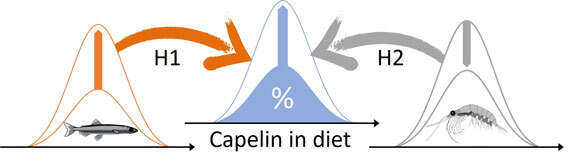
In the Barents Sea, much of the food web runs through a small forage fish; the capelin. Capelin eat plankton and are, in turn, eaten by many predators such as cod, whales, seals, and seabirds. When capelin numbers rise or fall, the entire ecosystem feels it.
In a paper published in MEPS, Durant et al (2026) wanted to know how different predators respond when capelin abundance is changing (Figure 1). Do they simply eat more capelin when there’s more of it, or do they switch to other prey like krill? Alternatively, do they eat capelin because their favourite prey is less abundant? And how is all of this affected by a rapidly warming climate and shrinking sea ice?
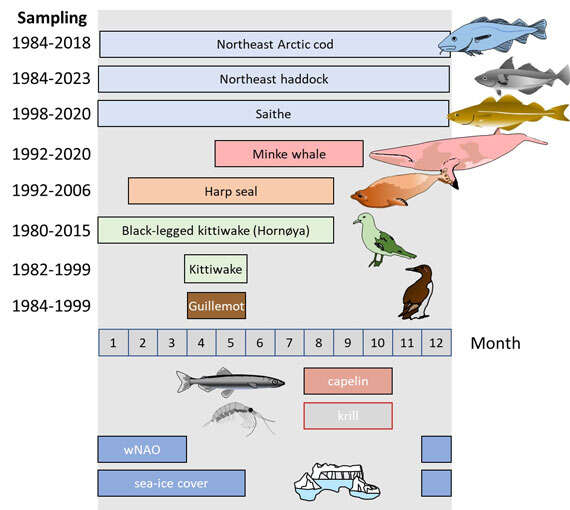
To answer these questions, Durant et al. (2026) analysed 10 to 36 years long time series of diet data from eight predator populations: three fish (Figure 2: Atlantic cod Gadus morhua, haddock Melanogrammus aeglefinus , saithe Pollachius virens), two seabirds (black-legged kittiwakes Rissa tridactyla and common guillemots Uria aalge), and two marine mammals (minke whales Balaenoptera acutorostrata and harp seals Pagophilus groenlandicus). For each species and year, they calculated what percentage of the diet was made up of capelin, then compared that to independent estimates of capelin and krill abundance in the Barents Sea, as well as climate indices like sea‑ice extent and the North Atlantic Oscillation.
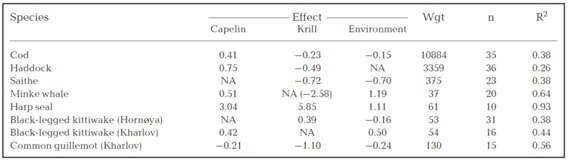
They found that most predators eat more capelin when capelin are plentiful (Table 1). This was especially clear for cod, haddock, whales, seals, and one of the kittiwake colonies. However, fish tended to switch away from capelin and toward krill when krill were abundant. In other words, they could “buffer” capelin shortages by changing their diets. Guillemots showed the strongest shift away from capelin when krill increased.
Climate also mattered. As sea‑ice extent and large‑scale weather patterns changed, the amount of capelin in predator diets changed too, although these effects were generally weaker than the direct effects of capelin and krill abundance. The reason is that predators and prey do not just respond to how much food is available, but also to where and when they overlap in the ocean.
The study also looked at how stable each predator’s diet was over time and how many different types of prey each species used. Cod and haddock, for example, had fairly stable diets and relatively broad menus, while harp seals and guillemots changed their diets more from year to year.
These findings matter for fisheries and conservation. Capelin are both a commercial fish and a vital food source for many predators. If fishing pressure on capelin is high at the same time that environmental change is pushing capelin farther north or causing population crashes, predators like seabirds and seals may struggle — especially those that cannot easily switch to other prey or travel long distances. The results can feed into ecosystem‑based management models that set catch limits while accounting for the needs of predators.
In short, the study shows that capelin really is a keystone species in the Barents Sea, but its importance depends on where predators are, what else they can eat, and how the climate is changing around them.
References:
Durant JM, Langangen Ø, Dolgov AV, Lindstrøm U, Krasnov YV, Nikolaeva NG, Holt RE. 2026 Importance of capelin in the diet of Barents Sea predators relative to alternative prey. Mar Ecol Prog Ser. 781:1–13.
Log in to comment