
George Cherry is a PhD Candidate at the Rosseland Centre for Solar Physics (ROCS), Institute of Theoretical Astrophysics, UiO. George is also part of the CompSci doctoral program. George will be defending their thesis for the degree of PhD, which was submitted for evaluation on the 20th of May of 2025.
From the CompSci team we wish you good luck and all the best in your future endeavors!
→ Read more about the disputation in the website of the Institute of Theoretical Astrophysics
Programme
10:15 – Trial lecture: "The magnetic connection of the Sun to the solar wind" – Aud 209, Svein Rosselands Hus
13:15 – Disputation: "Quantifying energy transfer in the solar atmosphere" – Aud 209, Svein Rosselands Hus
This event is open for everyone. No registration needed.
The PhD defence and trial lecture will be 100% in-person.

PhD candidate
Research group | RoCS
Main supervisor | Boris Gudiksen
Co-supervisor | Mats Carlsson
Affiliation | Institute of Theoretical Astrophysics, UiO
Contact | georgche@uio.no
Adjudication committee
Professor Tom van Doorsselaere, University of Leuven
Research Astrophysicist, Nicholeen Viall-Kepko, NASA Goddard space flight center
Associate Professor, Hans Arnold Winther, Institute of Theoretical Astrophysics, University of Oslo
Chair of defense
Head of institute, Luc Rouppe van der Voort, University of Oslo
Short summary
Quantifying energy transfer in the solar atmosphere
Just like in the oceans and atmosphere on Earth, a vast range of waves exist in the plasma of the solar atmosphere. Understanding the transfer of energy via these magnetohydrodynamic (MHD) waves has important implications for our theory on the heating of the upper solar atmosphere (coronal heating) and the prediction of geomagnetic storms by monitoring the solar wind. Despite extensive theory and simulations, the detection of waves in realistic simulations still presents a large challenge, due to wave interaction, conversion, dissipation and numerical artefacts: it is like finding a needle in a haystack full of needle-like objects.
Through the development of a new method for detecting wave activity in simulations, I have demonstrated that different magnetic structures can inhibit and prohibit the propagation of waves, including the dominant oscillations at 3.5 mHz and 5 mHz, which have previously been detected as “global modes” in both observations and simulations. Specifically, we find that twisted magnetic features called swirls enable the transport of magnetoacoustic waves at 3.5 mHz waves to the upper atmosphere, whilst in the absence of swirls, plasma motions in the chromosphere enhance the wave activity at 5 mHz. These results lead to exciting prospects in the realm of quantifying the energy deposit to the upper atmosphere in different solar regimes.
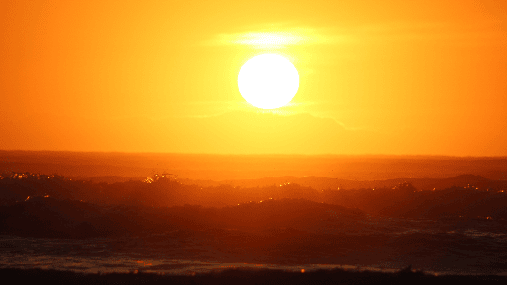
Photo: Sunrise over the North Sea. Credit: George Cherry
