
Anthony Val Camposano is a PhD Candidate at the Njord (Centre for Studies of the Physics of the Earth), Department of Physics, UiO. He is also part of the CompSci doctoral program. He will be defending his thesis for the degree of PhD, which was submitted for evaluation on the 6th of June of 2025.
From the CompSci team we wish you good luck and all the best in your future endeavors!
→ Read more about the disputation in the website of the Department of Physics
Programme
10:15 – Trial lecture: "Numerical methods for transition path sampling in chemistry" – Lille Fysiske auditorium (V232), Fysikkbygningen
13:15 – Disputation: "Parameterization of a Reactive Silica-Water Model using the Vashishta Functional Form" – Lille Fysiske auditorium (V232), Fysikkbygningen
This event is open for everyone. No registration needed.
The Disputation will be live streamed for everyone else.

PhD candidate
Research group | CONDPHYS, NJORD
Main supervisor | Anders Malthe-Sørenssen
Co-supervisor | Henrik Andersen Sveinsson
Affiliation | Department of Physics, UiO
Contact | a.v.camposano@fys.uio.no
Adjudication committee
Professor Lars Pastewka, University of Freiburg, Germany
Associate Professor Senbo Xiao, Norwegian University of Science and Technology, Norway
Dr. Gunnar Felix Lange, University of Oslo, Norway
Chair of defense
TBA
Short summary
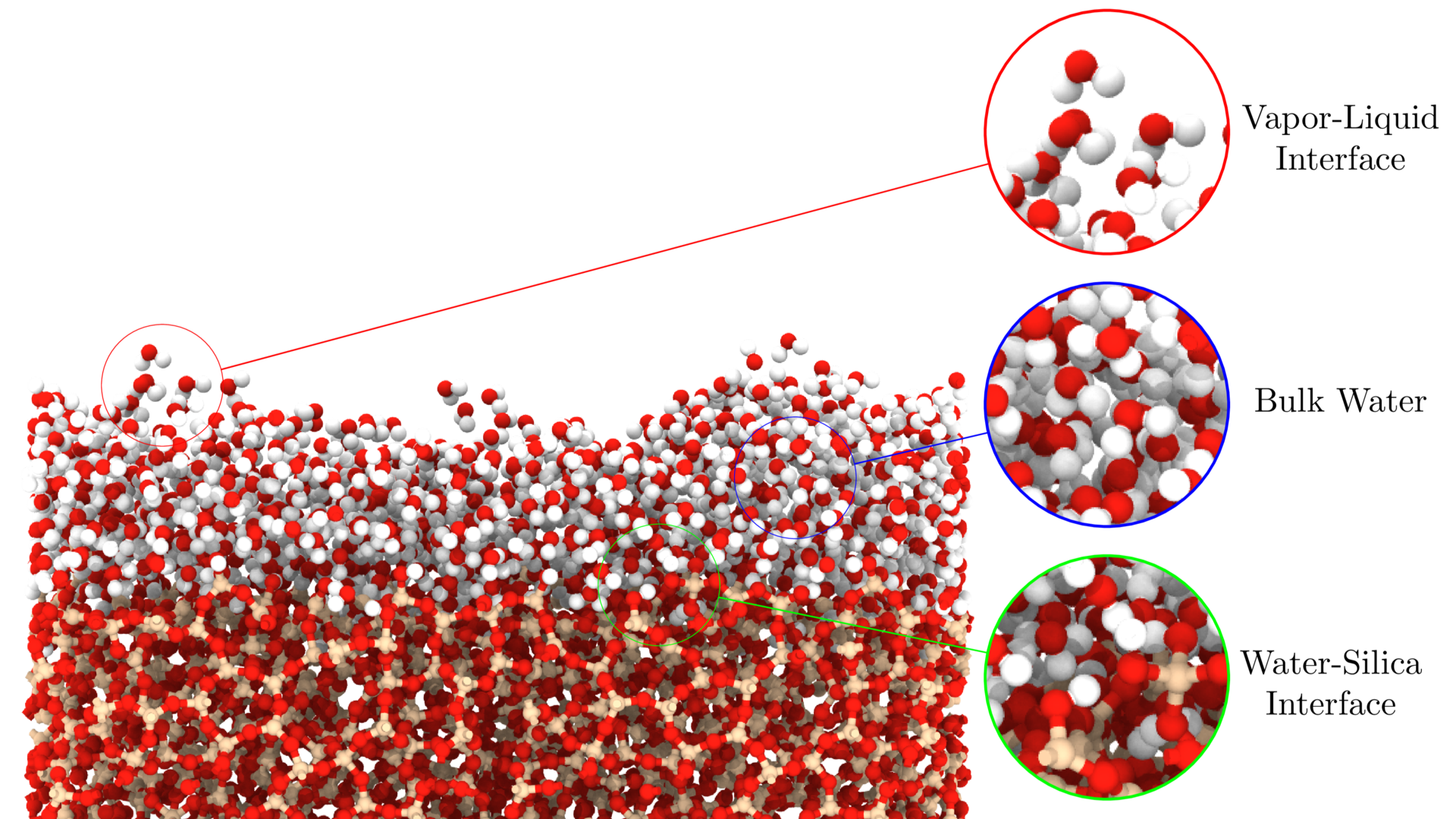
Parameterization of a Reactive Silica-Water Model using the Vashishta Functional Form
Water is known to weaken materials like rock and glass, a critical process in everything from earthquake dynamics to the durability of ceramics. Computer simulations can help us understand this weakening at the atomic level, showing how water molecules interact with a material as it breaks. However, existing simulation methods have faced a trade-off: they are often too slow to model the millions of atoms needed to see a crack propagate realistically, or they are not accurate enough to capture the chemical reactions happening at the crack's tip.
This thesis presents a new, computationally efficient model that tackles this dilemma. We have developed a tool that is both fast and allows for chemical reactions by using a specific framework, the Vashishta potential, to model atomic interactions. We optimized the model to successfully simulate water's behavior over a wide range of conditions and its reaction with a silica surface. These capabilities enable larger and longer simulations, providing a powerful new resource for understanding material failure in aqueous environments in geology, materials science, and engineering.
