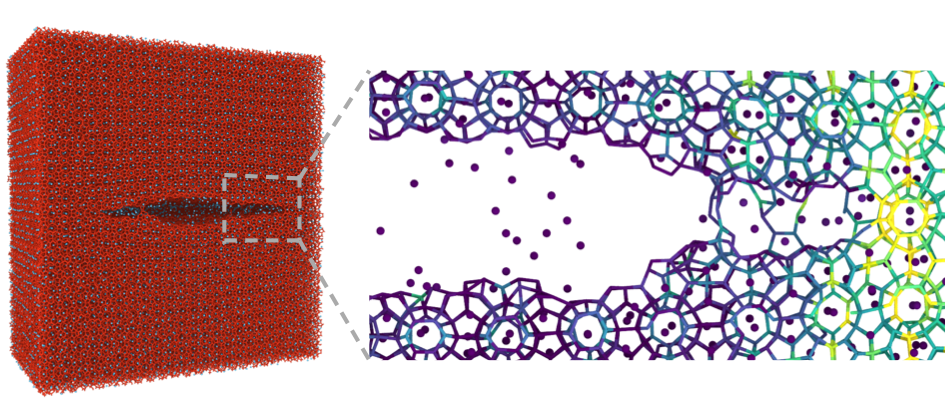
Jeg bruker datasimuleringer basert på fysikkens lover på liten skala til å forstå hvordan sprekker, knuses, sklir og omdannes. Jeg ser mest på geologisk relevante materialer som is, stein og gasshydrater.
For å forstå hva som foregår i materialer på atomnivå bruker jeg datasimuleringer der atomer tiltrekkes av hverandre, kolliderer og frastøtes etter bestemte, realistiske, regler. Jeg ser etter orden i kaoset av atomer som beveger seg tilsynelatende tilfeldig. Hvis vi klarer å forstå hvordan atomene beveger seg kan vi lage forenklede bilder av hvordan større deler vil oppføre seg og vi kan kanskje kvantifisere sammenhengen mellom en uheldig hydrogenbinding i en iskrystall og et kilometerlangt krater på havbunnen.
Camposano, Anthony Val Canillas; Hafreager, Anders; Malthe-Sørenssen, Anders & Sveinsson, Henrik Andersen
(2026).
Silica-water model using the Vashishta force field.
Journal of Chemical Physics.
ISSN 0021-9606.
165(10).
doi: 10.1063/5.0343021.
Fulltekst i vitenarkiv
Vargdal, Sigurd; Reis, Paula Kozlowski Pitombeira; Sveinsson, Henrik Andersen & Linga, Gaute
(2026).
Neural Networks for Predicting Permeability Tensors of 2D Porous Media: Comparison of Convolution- and Transformer-based Architectures.
arXiv.
doi: 10.48550/ARXIV.2512.01517.
Fulltekst i vitenarkiv
Camposano, Anthony Val Canillas; Nordhagen, Even Marius; Sveinsson, Henrik Andersen & Malthe-Sørenssen, Anders
(2025).
Genetic Algorithm Workflow for Parameterization of a Water Model Using the Vashishta Force Field.
Journal of Physical Chemistry B.
ISSN 1520-6106.
129(4),
s. 1331–1342.
doi: 10.1021/acs.jpcb.4c06389.
Fulltekst i vitenarkivVis sammendrag
Water participates in countless processes on Earth, and the properties of mineral surfaces can be drastically changed in the presence of water. For example, the fracture toughness of silica glass is reduced by 25% for water-filled cracks than for dry cracks [Geophys. Res.: Solid Earth 2018, 123, 9341–9354]. An accurate description of water is therefore essential for modeling the behavior of minerals in aqueous environments and, in particular, for modeling dynamic processes such as fracture, where the mechanical response of water may play an important role. On the molecular scale, molecular dynamics simulations with empirical force field methods provide a way to study large molecular systems at a relatively low computational cost. Many water models have been developed previously; however, a computationally cheap water model capable of describing reactions with minerals is lacking. Here, we present a parametrization of the water potential using the Vashishta potential form [Phys. Rev. B 1990, 41, 12197–12209]. For this 3-point water model, we obtain good agreement with experimental transport and liquid–vapor properties. Importantly, the Vashishta form opens up compatibility with existing silica glass models, thus enabling the simulation of mineral–water interactions.
The power-law creep properties of methane hydrates were measured experimentally two decades ago, but their microscopic explanation is still missing. Here we show, using molecular dynamics simulations spanning almost 2 orders of magnitude of stresses and 3 orders of magnitude of strain rates, that such power-law creep emerges in molecular dynamics simulations of polycrystalline methane hydrates using a monatomic water model, suggesting that only simplified molecular interactions and the concept of a hydrate polycrystal are needed for such power-law creep behavior to emerge. Damage patterns post-creep suggest that hydrates are strong because damage only occurs on crystal surfaces.
Nordhagen, Even Marius; Sveinsson, Henrik Andersen & Malthe-Sørenssen, Anders
(2025).
Velocity-Dependent Dynamics of Friction and Wear.
Tribology letter.
ISSN 1023-8883.
doi: 10.1007/s11249-025-02045-5.
Fulltekst i vitenarkiv
Nordhagen, Even Marius; Sveinsson, Henrik Andersen & Malthe-Sørenssen, Anders
(2025).
Tailoring Frictional Properties of Surfaces Using Diffusion Models.
Journal of Physical Chemistry C.
ISSN 1932-7447.
129(32),
s. 14559–14564.
doi: 10.1021/acs.jpcc.5c02768.
Fulltekst i vitenarkivVis sammendrag
This work introduces an approach for precisely designing surface friction properties using a conditional generative machine learning model, specifically a denoising diffusion probabilistic model (DDPM). We created a dataset of synthetic surfaces with frictional properties determined by molecular dynamics simulations, which trained the DDPM to predict surface structures from desired frictional outcomes. Unlike traditional trial-and-error and numerical optimization methods, our approach directly yields surface designs meeting specified frictional criteria with high accuracy and efficiency. This advancement in material surface engineering demonstrates the potential of machine learning to reduce the iterative nature of surface design processes. Our findings provide a pathway for tailoring surface properties and suggest broader applications in materials science where surface characteristics are critical.
Camposano, Anthony Val Canillas; Nordhagen, Even Marius; Malthe-Sørenssen, Anders & Sveinsson, Henrik Andersen
(2025).
An Extended Energy-Biased Aggregation-Volume-Bias Monte Carlo (EB-AVBMC) Method for Nucleation Simulation of a Reactive Water Potential.
Journal of Chemical Theory and Computation.
ISSN 1549-9618.
21(14),
s. 6769–6776.
doi: 10.1021/acs.jctc.5c00722.
Fulltekst i vitenarkiv
Adversarial approaches, which intentionally challenge machine learning models by generating difficult examples, are increasingly being adopted to improve machine learning interatomic potentials (MLIPs). While already providing great practical value, little is known about the actual prediction errors of MLIPs on adversarial structures and whether these errors can be controlled. We propose the Calibrated Adversarial Geometry Optimization (CAGO) algorithm to discover adversarial structures with user-assigned errors. Through uncertainty calibration, the estimated uncertainty of MLIPs is unified with real errors. By performing geometry optimization for calibrated uncertainty, we reach adversarial structures with the user-assigned target MLIP prediction error. Integrating with active learning pipelines, we benchmark CAGO, demonstrating stable MLIPs that systematically converge structural, dynamical, and thermodynamical properties for liquid water and water adsorption in a metal-organic framework within only hundreds of training structures, where previously many thousands were typically required.
Jensen, Mikkel Metzsch; Malthe-Sørenssen, Anders & Sveinsson, Henrik Andersen
(2025).
Strong strain dependence of friction in graphene kirigami allows engineering a negative coefficient of friction.
Proceedings of the National Academy of Sciences of the United States of America (PNAS).
ISSN 0027-8424.
122(28).
doi: 10.1073/pnas.2501728122.
Fulltekst i vitenarkivVis sammendrag
The friction force typically increases linearly with normal load with a constant of proportionality called the coefficient of friction. Most materials exhibit a positive friction coefficient, so that an increase in the normal load leads to an increase in the friction force. Recently, materials with negative friction coefficients have been observed at meticulously constructed interfaces due to an interplay between superstructures at heterojunctions, out-of-plane buckling, or the ordering of thin water films. However, the magnitude of the negative friction coefficient is typically much less than 10^-2, the geometries are highly restrictive, and the mechanisms are difficult to scale to larger systems. Here, we show that a friction coefficient of -0.08 can be obtained for a graphene sheet modified with kirigami-inspired cuts when inducing sheet tension through a normal load coupling. We use molecular dynamics simulations to show that the frictional behavior of kirigami cut sheets exhibits a strong nonmonotonic dependence on in-plane strain, while only weakly influenced by normal loading. We argue that the strong influence of strain arises from changes in commensurability between the graphene sheet and the substrate when the sheet deforms and buckles out of plane. We propose a simple nanomachine design that couples normal loading and sheet tension which enables the realization of different frictional laws, including a negative coefficient of friction. This represents a unique approach to creating tunable frictional surfaces and opens up applications in sheet-like systems across scales.
Nordhagen, Even Marius; Sveinsson, Henrik Andersen & Malthe-Sørenssen, Anders
(2023).
Diffusion-Driven Frictional Aging in Silicon Carbide.
Tribology letter.
ISSN 1023-8883.
71(3),
s. 1–11.
doi: 10.1007/s11249-023-01762-z.
Fulltekst i vitenarkivVis sammendrag
Abstract Friction is the force resisting relative motion of objects. The force depends on material properties, loading conditions and external factors such as temperature and humidity, but also contact aging has been identified as a primary factor. Several aging mechanisms have been proposed, including increased “contact quantity” due to plastic or elastic creep and enhanced “contact quality” due to formation of strong interfacial bonds. However, comparatively less attention has been given to other mechanisms that enhance the “contact quantity”. In this study, we explore the influence of crystal faceting on the augmentation of “contact quantity” in cubic silicon carbide, driven by the minimization of surface free energy. Our observations reveal that the temporal evolution of the frictional aging effect follows a logarithmic pattern, akin to several other aging mechanisms. However, this particular mechanism is driven by internal capillary forces instead of the normal force typically associated with friction. Due to this fundamental distinction, existing frictional aging models fail to comprehensively explain the observed behavior. In light of these findings, we derive a model for the evolution of contact area caused by diffusion-driven frictional aging, drawing upon principles from statistical mechanics. Upon application of a normal force, the friction force is increased due to plastic creep. This investigation presents an alternative explanation for the logarithmic aging behavior observed and offers the potential to contribute to the development of more accurate friction models. Graphical Abstract
Paus-Knudsen, Julie Sørlie; Sveinsson, Henrik Andersen; Grung, Merete; Borgå, Katrine & Nielsen, Anders
(2023).
The Neonicotinoid Imidacloprid Impairs Learning, Locomotor Activity Levels, and Sucrose Solution Consumption in Bumblebees (Bombus terrestris).
Environmental Toxicology and Chemistry.
ISSN 0730-7268.
42(6),
s. 1337–1345.
doi: 10.1002/etc.5611.
Fulltekst i vitenarkivVis sammendrag
Bumblebees carry out the complex task of foraging to provide for their colonies. They also conduct pollination, an ecosystem service of high importance to both wild plants and entomophilous crops. Insecticides can alter different aspects of bumblebee foraging behavior, including the motivation to leave the hive, finding the right flowers, handling flowers, and the ability to return to the colony. In the present study, we assessed how the neonicotinoid imidacloprid affects bumblebees' foraging behavior after exposure to four different treatment levels, including field-realistic concentrations (0 [control], 1, 10, and 100 μg/L), through sucrose solution over 9 days. We observed the behavior of several free-flying bumblebees simultaneously foraging on artificial flowers in a flight arena to register the bees' complex behavior postexposure. To conduct a detailed assessment of how insecticides affect bumblebee locomotor behavior, we used video cameras and analyzed the recordings using computer vision. We found that imidacloprid impaired learning and locomotor activity level when the bumblebees foraged on artificial flowers. We also found that imidacloprid exposure reduced sucrose solution intake and storage. By using automated analyses of video recordings of bumblebee behavior, we identified sublethal effects of imidacloprid exposure at field-realistic doses. Specifically, we observed negative impacts on consumption of sucrose solution as well as on learning and locomotor activity level. Our results highlight the need for more multimodal approaches when assessing the sublethal effects of insecticides and plant protection products in general.
Najafi, Fahimeh; Sveinsson, Henrik Andersen; Dreierstad, Christer; Glad, Hans Erlend Bakken & Malthe-Sørenssen, Anders
(2023).
Modeling the relationship between mechanical yield stress and material geometry using convolutional neural networks.
Applied Physics Letters.
ISSN 0003-6951.
123(11).
doi: 10.1063/5.0160338.
Fulltekst i vitenarkivVis sammendrag
Machine learning methods can be used to predict the properties of materials from their structure. This can be particularly useful in cases where other standard methods for finding material properties are time and resources consuming to use on large sample spaces. In this work, we study the strength of α-quartz crystals with a porous layer created by simplex noise as the shape of porosity. We train a neural network to predict the yield stress of these systems under both shear and tensile deformation. Molecular dynamics simulations are used for a randomly selected sample of possible structures in order to generate the ground truth to be used as the training data. We employ deep convolutional neural networks (CNNs) which are commonly used when dealing with image or image-like data since the input data for the problem in hand are a binary 2D structure of the porous layer of the systems. The trained CNN can predict the yield stress of a system based on the geometry of that given system, with much higher precision compared to a baseline polynomial regression method. Saliency maps created with the trained model show that the model predictions are most sensitive to altering structures near high-stress regions, indicating that the model makes predictions based on reasonable physics.
Guren, Marthe Grønlie; Sveinsson, Henrik Andersen; Malthe-Sørenssen, Anders & Renard, Francois
(2022).
Nanoscale Damage Production by Dynamic Tensile Rupture in α-Quartz.
Geophysical Research Letters.
ISSN 0094-8276.
49(20).
doi: 10.1029/2022GL100468.
Fulltekst i vitenarkivVis sammendrag
The creation of new fractures during an earthquake produces rock damage and contributes to the dissipation of strain energy. During dynamic rupture propagation, tensile microfractures can form in the earthquake process zone and in the domains around a fault that host large transient tensile stress. These microfractures can produce rock fragments with a wide range of sizes. Using molecular dynamics simulations, we model tensile rupture propagation in α-quartz under conditions of stress that occur during earthquake propagation. Our results show that for rupture speeds below 15% of the Rayleigh wave speed, fractures propagate linearly. At higher speeds, fracture propagation undergoes path instabilities with crack oscillations and microbranching leading to the formation of nanoscale roughness and fragments. This nanoscale damage can form in and around the earthquake process zone before any significant slip has occurred on the fault. The produced nanoparticles may control further energy dissipation during frictional slip.
Cao, Pinqiang; Sheng, Jianlong; Sveinsson, Henrik Andersen; Wu, Jianyang & Ning, Fulong
(2022).
Electric Field-Controlled Structural Instability and Mechanical Properties of Methane Hydrates.
Crystal Growth & Design.
ISSN 1528-7483.
22(5),
s. 3107–3118.
doi: 10.1021/acs.cgd.2c00008.
Fulltekst i vitenarkivVis sammendrag
Gas hydrates play a significant role in the broad areas of energy applications and climate changes. Furthermore, externally applied fields by charged sediments and artificial activities are of paramount importance for transitions between disordered and ordered gas hydrate systems on the Earth. Herein, the role of external static electric fields in the structural instability and mechanical properties of methane hydrates are explored using molecular dynamics simulation methods. Our simulation results show that mechanical characteristics of methane hydrates such as Young’s modulus, strengths, and failure modes are greatly affected by strengths and imposed directions of external electric fields. Interestingly, strong electric fields can result in the distortion and dissociation of local water cages in methane hydrates mainly due to realignments of water molecules, thereby weakening their mechanical properties. Moreover, instability failure modes of methane hydrates can be attributed to notable reorientations of water molecules and molecular diffusions of water and methane molecules in methane hydrates. This work provides new insights into mechanics of natural crystalline gas hydrates, which is also helpful for understanding the mechanical instability of charged sediment–host natural gas hydrates.
Guren, Marthe Grønlie; Sveinsson, Henrik Andersen; Hafreager, Anders; Jamtveit, Bjørn; Malthe-Sørenssen, Anders & Renard, Francois
(2021).
Molecular dynamics study of confined water in the periclase-brucite system under conditions of reaction-induced fracturing.
Geochimica et Cosmochimica Acta.
ISSN 0016-7037.
294,
s. 13–27.
doi: 10.1016/j.gca.2020.11.016.
Fulltekst i vitenarkivVis sammendrag
The volume-increase associated with hydration reactions in rocks may lead to reaction-induced fracturing, but requires a stable water film to be present at reactive grain boundaries even when subject to compressive stress. Hydration of periclase to brucite is associated with a solid volume increase of ca. 110%. Recent experiments on the periclase-brucite system observed that when the effective mean stress exceeds 30 MPa, the reaction rate slows down dramatically. We hypothesize that for the brucite forming reaction to progress, the fluid film between grains must remain stable. If the applied pressure becomes larger than the hydration force, the fluid film will collapse and be squeezed out of the grain contacts. To quantify this effect, we study the behavior of a water film confined between periclase or brucite surfaces subject to compressive stress, by performing molecular dynamics simulations. The simulations are carried out using the ClayFF force field and the single point charge (SPC) water model in the molecular dynamics simulations program LAMMPS. The setup consists of two interfaces of either periclase or brucite surrounded by water. Our simulations show that when the pressure reaches a few tens of MPa, the water film collapses and reduces the water film to one or two water layers, while the self-diffusion coefficient of water molecules by a factor of eight. A water film thickness below two water layers is thinner than the size of the hydration shell around Mg2+-ions, which will limit ion-transport. The observed collapse of the water film to a single layer at a normal pressure of 25–30 MPa might explain the observed slow-down of reaction-induced fracturing in the periclase-brucite system.
Sveinsson, Henrik Andersen; Ning, Fulong; Cao, Pinqiang; Fang, Bin & Malthe-Sørenssen, Anders
(2021).
Grain-Size-Governed Shear Failure Mechanism of Polycrystalline Methane Hydrates.
Journal of Physical Chemistry C.
ISSN 1932-7447.
125(18),
s. 10034–10042.
doi: 10.1021/acs.jpcc.1c00901.
Fulltekst i vitenarkivVis sammendrag
The shear failure mechanism of polycrystalline gas hydrates is critical for understanding marine geohazards related to gas hydrates under a changing climate and for safe gas recovery from gas hydrate reservoirs. Since current experimental techniques cannot resolve the mechanism on a spatial and temporal nanoscale, molecular simulations can assist with proposing and substantiating nanoscale failure mechanisms. Here, we report the shear failure of polycrystalline methane hydrates using direct molecular dynamics simulations. Based on these simulations, we suggest two modes of shear behavior, depending on the grain sizes, d, in the polycrystal: grain-size-strengthening behavior with a d1/3 grain size dependence for small grain sizes and grain-size-weakening behavior for large grain sizes. Through the crossover from strengthening to weakening behavior, the failure mode changes from shear failure with a failure plane parallel to the applied shear to tensile failure with a failure plane lying at an angle with the applied shear, spanning a network of grain boundaries. The existence of such a change in mechanism suggests that the Hall–Petch breakdown in methane hydrates is due to a change from grain boundary sliding to tensile opening being the most important failure mechanism when the grain size increases.
Sveinsson, Henrik Andersen; Hafreager, Anders; Kalia, Rajiv K.; Nakano, Aiichiro; Vashishta, Priya & Malthe-Sørenssen, Anders
(2020).
Direct Atomic Simulations of Facet Formation and Equilibrium Shapes of SiC Nanoparticles.
Crystal Growth & Design.
ISSN 1528-7483.
20(4),
s. 2147–2152.
doi: 10.1021/acs.cgd.9b00612.
Fulltekst i vitenarkivVis sammendrag
Understanding the shapes of nanoparticles is an important interdisciplinary problem because particle shapes can affect their properties, functionality, and applications. Advances in nanoscale imaging probes have revealed exquisite details of nanofaceting phenomena. However, quantitative theoretical
predictions have not kept up the pace with experimental advances, and the atomic pathways of facet formation are largely unknown due to a lack of direct observations and simulations. Here we examine facet formation in spherical and cubic SiC nanoparticles and in SiC nanowires using molecular dynamics simulations reaching microseconds. We characterize layer-by-layer formation, diffusional motion along edges and corners, and determine energy barriers. We find that the equilibrium shapes are identical regardless of the initial shape of SiC nanoparticles or nanowires. For spherical and cubic nanoparticles, (110) facets form within
10 ns by lateral liquid-like diffusion of atoms. In contrast, faceting in SiC nanowires also involves normal diffusional motion with a higher energy barrier and hence much longer faceting times. These results have important implications for molecular-level understanding of the synthesis and stability of ceramic nanocrystals and nanowires.
Water ice and gas hydrates can coexist in the permafrost and polar regions on Earth and in the universe. However, the role of ice in the mechanical response of ice-contained methane hydrates is still unclear. Here, we conduct direct million-atom molecular simulations of ice-contained polycrystalline methane hydrates and identify a crossover in the tensile strength and average compressive flow stress due to the presence of ice. The average mechanical shear strengths of hydrate–hydrate bicrystals are about three times as large as those of hydrate–ice bicrystals. The ice content, especially below 70%, shows a significant effect on the mechanical strengths of the polycrystals, which is mainly governed by the proportions of the hydrate–hydrate grain boundaries (HHGBs), the hydrate–ice grain boundaries (HIGBs), and the ice–ice grain boundaries (IIGBs). Quantitative analysis of the microstructure of the water cages in the polycrystals reveals the dissociation and reformation of various water cages due to mechanical deformation. These findings provide molecular insights into the mechanical behavior and microscopic deformation mechanisms of ice-contained methane hydrate systems on Earth and in the universe.
Thøgersen, Kjetil; Sveinsson, Henrik Andersen; Scheibert, Julien; Renard, Francois & Malthe-Sørenssen, Anders
(2019).
The Moment Duration Scaling Relation for Slow Rupture
Arises From Transient Rupture Speeds.
Geophysical Research Letters.
ISSN 0094-8276.
46(22),
s. 12805–12814.
doi: 10.1029/2019GL084436.
Fulltekst i vitenarkivVis sammendrag
Plain Language Summary Observations have shown that the duration of earthquakes is related to the seismic moment through a power law. The power law exponent is different for regular earthquakes and slow aseismic rupture, and the origin of this difference is currently debated in the literature. In this letter, we introduce a minimal mechanical friction model that contains both slow and regular earthquakes and demonstrate that the different power laws emerge naturally within the model because the propagation speed of slow earthquakes decays as a power law in time, whereas the propagation speed of regular earthquakes remains fairly constant.
Thøgersen, Kjetil; Sveinsson, Henrik Andersen; Amundsen, David Skålid; Scheibert, Julien; Renard, Francois & Malthe-Sørenssen, Anders
(2019).
Minimal model for slow, sub-Rayleigh, supershear, and unsteady rupture propagation along homogeneously loaded frictional interfaces.
Physical Review E (PRE).
ISSN 2470-0045.
100(4).
doi: 10.1103/PhysRevE.100.043004.
Fulltekst i vitenarkivVis sammendrag
In nature and experiments, a large variety of rupture speeds and front modes along frictional interfaces are observed. Here, we introduce a minimal model for the rupture of homogeneously loaded interfaces with velocity strengthening dynamic friction, containing only two dimensionless parameters; ¯ τ , which governs the prestress, and ¯¯¯ α , which is set by the interfacial viscosity. This model contains a large variety of front types, including slow fronts, sub-Rayleigh fronts, supershear fronts, slip pulses, cracks, arresting fronts, and fronts that alternate between arresting and propagating phases. Our results indicate that this wide range of front types is an inherent property of frictional systems with velocity strengthening branches.
Sveinsson, Henrik Andersen & Malthe-Sørenssen, Anders
(2019).
Molecular-scale thermally activated fractures in methane hydrates: a molecular dynamics study.
Physical Chemistry, Chemical Physics - PCCP.
ISSN 1463-9076.
21(25),
s. 13539–13544.
doi: 10.1039/c9cp01337g.
Fulltekst i vitenarkivVis sammendrag
We perform multiple large molecular dynamics simulations to study the fracture behaviour of monocrystalline methane hydrates under tension. We examine the fracture initiation phase and find that the fracture process can be divided into two phases: slow crack growth and rapid crack propagation. The time of the slow crack growth phase can be predicted by a thermal activation model [L. Vanel et al., J. Phys. D: Appl. Phys., 2009, 42, 214007] where an energy barrier has to be overcome in order for the crack to propagate. Our simulations predict that the slow growth phase vanishes when the stress intensity factor approaches Image ID:c9cp01337g-t1.gif.
Trømborg, Jørgen Kjoshagen; Sveinsson, Henrik Andersen; Thøgersen, Kjetil; Scheibert, Julien & Malthe-Sørenssen, Anders
(2015).
Speed of fast and slow rupture fronts along frictional interfaces.
Physical Review E. Statistical, Nonlinear, and Soft Matter Physics.
ISSN 1539-3755.
92(1).
doi: 10.1103/PhysRevE.92.012408.
Fulltekst i vitenarkivVis sammendrag
The transition from stick to slip at a dry frictional interface occurs through the breaking of microjunctions between the two contacting surfaces. Typically, interactions between junctions through the bulk lead to rupture fronts propagating from weak and/or highly stressed regions, whose junctions break first. Experiments find rupture fronts ranging from quasistatic fronts, via fronts much slower than elastic wave speeds, to fronts faster than the shear wave speed. The mechanisms behind and selection between these fronts are still imperfectly understood. Here we perform simulations in an elastic two-dimensional spring-block model where the frictional interaction between each interfacial block and the substrate arises from a set of junctions modeled explicitly. We find that material slip speed and rupture front speed are proportional across the full range of front speeds we observe. We revisit a mechanism for slow slip in the model and demonstrate that fast slip and fast fronts have a different, inertial origin. We highlight the long transients in front speed even along homogeneous interfaces, and we study how both the local shear to normal stress ratio and the local strength are involved in the selection of front type and front speed. Last, we introduce an experimentally accessible integrated measure of block slip history, the Gini coefficient, and demonstrate that in the model it is a good predictor of the history-dependent local static friction coefficient of the interface. These results will contribute both to building a physically based classification of the various types of fronts and to identifying the important mechanisms involved in the selection of their propagation speed.
Thøgersen, Kjetil; Trømborg, Jørgen Kjoshagen; Sveinsson, Henrik Andersen; Malthe-Sørenssen, Anders & Scheibert, Julien
(2014).
History-dependent friction and slow slip from time-dependent microscopic junction laws studied in a statistical framework.
Physical Review E. Statistical, Nonlinear, and Soft Matter Physics.
ISSN 1539-3755.
89(5).
doi: 10.1103/PhysRevE.89.052401.
Fulltekst i vitenarkivVis sammendrag
To study how macroscopic friction phenomena originate from microscopic junction laws, we introduce a general statistical framework describing the collective behavior of a large number of individual microjunctions forming a macroscopic frictional interface. Each microjunction can switch in time between two states: a pinned state characterized by a displacement-dependent force and a slipping state characterized by a time-dependent force. Instead of tracking each microjunction individually, the state of the interface is described by two coupled distributions for (i) the stretching of pinned junctions and (ii) the time spent in the slipping state. This framework allows for a whole family of microjunction behavior laws, and we show how it represents an overarching structure for many existing models found in the friction literature. We then use this framework to pinpoint the effects of the time scale that controls the duration of the slipping state. First, we show that the model reproduces a series of friction phenomena already observed experimentally. The macroscopic steady-state friction force is velocity dependent, either monotonic (strengthening or weakening) or nonmonotonic (weakening-strengthening), depending on the microscopic behavior of individual junctions. In addition, slow slip, which has been reported in a wide variety of systems, spontaneously occurs in the model if the friction contribution from junctions in the slipping state is time weakening. Next, we show that the model predicts a nontrivial history dependence of the macroscopic static friction force. In particular, the static friction coefficient at the onset of sliding is shown to increase with increasing deceleration during the final phases of the preceding sliding event. We suggest that this form of history dependence of static friction should be investigated in experiments, and we provide the acceleration range in which this effect is expected to be experimentally observable.
Trømborg, Jørgen Kjoshagen; Sveinsson, Henrik Andersen; Scheibert, Julien; Thøgersen, Kjetil; Amundsen, David Skålid & Malthe-Sørenssen, Anders
(2014).
Slow slip and the transition from fast to slow fronts in the rupture of frictional interfaces.
Proceedings of the National Academy of Sciences of the United States of America (PNAS).
ISSN 0027-8424.
111(24),
s. 8764–8769.
doi: 10.1073/pnas.1321752111.
Fulltekst i vitenarkiv
Haraldsrud, Andreas Drolsum; Sveinsson, Henrik Andersen & Løvold, Henrik Hillestad
(2020).
Programmering i skolen.
Universitetsforlaget.
ISBN 9788215034287.320 s.Fulltekst i vitenarkiv
Engebretsen, Solveig; Sveinsson, Henrik Andersen; Dietrichs, Erik Sveberg & Jemterud, Torkild
(2024).
Abels tårn: Når kan vi overleve drukning?
[Radio].
NRK Radio.
Fulltekst i vitenarkiv
Camposano, Anthony Val Canillas; Sveinsson, Henrik Andersen & Malthe-Sørenssen, Anders
(2024).
Machine Learning an All-Atom Empirical Force Field for a Water-Silica System.
Fulltekst i vitenarkivVis sammendrag
Molecular modeling of the interaction between silica and water provides a better understanding of how water affects rocks and glasses at the nanoscale. Here, we parametrize a new classical dissociative force field for the water–silica system. We create a classical force field capable of reactive interactions between all chemical species in the water–silica system, using the same functional form by Vashishta et al. to describe bulk water, silica, and silica–water interactions. Using a hierarchical genetic algorithm as a global optimizer and the Nelder-Mead simplex algorithm as a local optimizer, we parameterized the Vashishta force field to reproduce the density, transport properties, and vapor-liquid properties of water. We then used the same method to obtain water–silica interaction parameters to reproduce gas phase orthosilicic geometry and silica surface properties such as silanol concentration, heat of immersion, and the wettability angle of water on a silica surface. For oxygen–silicon interactions in silica, we reuse an existing Vashishta potential parameter set that has been parameterized to reproduce bulk mechanical behavior, surface properties, and fracture properties. Our developed force field can be used to study processes such as dissolution, friction, and stress corrosion fracture in the presence of water over a wide range of thermodynamic conditions for larger-scale and longer-scale simulations.
Najafi, Fahimeh; Sveinsson, Henrik Andersen; Dreierstad, Christer & Malthe-Sørenssen, Anders
(2023).
Modeling the relationship between mechanical yield stress and material geometry using convolutional neural networks.
doi: 10.5194/egusphere-egu23-13293.
Fulltekst i vitenarkivVis sammendrag
Neural networks have proved to be able to capture the relevant and informative features of a wide variety of data types and predict the desired output for different regression or classification problems. Finding a mapping between materials’ structure and a given physical property of those systems is an example of a problem that could be approached with machine learning methods like neural networks. Especially when we are dealing with systems with a very large design space where using classical computational methods like molecular dynamics can be very time and resource-consuming for the study of a very large number of systems, a well-trained neural network can be greatly faster and more efficient for computing the relevant properties. In this work, we study α-quartz crystals with one porous layer with simplex noise as the shape of porosity. Simplex noise is a gradient based procedural algorithm that can produce irregular geometries with surface morphology resembling what is observed in nature. The property that we want the neural network to learn is the yield stress of these systems under both shear and tensile deformation. Molecular dynamics simulations are used for a randomly selected sample of possible structures in order to generate the ground truth to be used as the training data. We employ deep convolutional neural networks (CNN) which are commonly used when dealing with image or image-like data since the input data for the problem in hand is a binary 2-D structure of the porous layer of the systems. The trained model is compared with a basic polynomial fit of stress versus porosity. The trained CNN is successful in predicting the yield stress of a system based on the geometry of that given system, with lower variability and higher precision compared to the base polynomial regression method. The saliency maps created with the trained model show the model to be successful in capturing the physics of the problem when compared with the stress fields calculated using molecular dynamics simulations. This method of modeling materials can be further developed for the inverse design of structures with desired properties without the need for a huge number of simulations on a wide domain of possible systems.
Sveinsson, Henrik Andersen & Cao, Pinqiang
(2023).
Distinct creep regimes of methane hydrates can be predicted by a monatomic water model.
Fulltekst i vitenarkiv
Sveinsson, Henrik Andersen; Thøgersen, Kjetil & Malthe-Sørenssen, Anders
(2023).
Grain boundary behavior of hydrate–hydrate and ice—ice bicrystals: molecular dynamics insights.
Fulltekst i vitenarkiv
Camposano, Anthony Val Canillas; Sveinsson, Henrik Andersen & Malthe-Sørenssen, Anders
(2023).
Tuning Vashishta Potential for Water.
Fulltekst i vitenarkiv
Sveinsson, Henrik Andersen
(2022).
Praktisk info med Jon Almaas: Kokosnøtter og sprekkmekanikk.
[TV].
TVNorge/Discovery+ .
Fulltekst i vitenarkiv
Sveinsson, Henrik Andersen
(2022).
Bruker du denne feil? Med dette trikset kan du kanskje spare litt tid foran mikrobølgeovnen.
[Internet].
TV2 Video .
Fulltekst i vitenarkiv
Sveinsson, Henrik Andersen
(2020).
Gasshydrater: fra laboratoriekuriositet til klimatrussel.
Naturen.
ISSN 0028-0887.
144(1–2),
s. 38–43.
doi: 10.18261/issn.1504-3118.
Fulltekst i vitenarkiv
Sveinsson, Henrik Andersen; Thøgersen, Kjetil & Malthe-Sørenssen, Anders
(2020).
Grain boundary behavior of hydrate–hydrate and ice–ice bicrystals: Molecular dynamics insights.
Fulltekst i vitenarkiv
Guren, Marthe Grønlie; Zheng, Xiaojiao; Jamtveit, Bjørn; Hafreager, Anders; Sveinsson, Henrik Andersen & Malthe-Sørenssen, Anders
[Vis alle 7 forfattere av denne artikkelen](2019).
Molecular dynamics simulations of the hydration force and transport properties of a water film during reaction-induced fracturing.
Fulltekst i vitenarkiv
Thøgersen, Kjetil; Malthe-Sørenssen, Anders; Sveinsson, Henrik Andersen & Scheibert, Julien
(2018).
Modeling the onset of frictional sliding.
Fulltekst i vitenarkiv
Paus-Knudsen, Julie Sørlie; Sveinsson, Henrik Andersen; Aarønes, Malin Røyset; Borgå, Katrine & Nielsen, Anders
(2018).
Interacting effects of neonicotinoids and temperature on bumblebee (Bombus terrestris) behaviour.
Fulltekst i vitenarkiv
Sveinsson, Henrik Andersen; Malthe-Sørenssen, Anders & Ning, Fulong
(2018).
Mechanisms of shear fracture in polycrystalline methane hydrates.
Fulltekst i vitenarkiv
Sveinsson, Henrik Andersen; Hafreager, Anders; Vashishta, Priya; Malthe-Sørenssen, Anders & Kalia, Rajiv K.
(2018).
Molecular dynamics simulations of faceting of silicon carbide nanoparticles.
Fulltekst i vitenarkiv
Malthe-sørenssen, Anders; Sveinsson, Henrik Andersen; Trømborg, Jørgen Kjoshagen; Thøgersen, Kjetil & scheiber, julien
(2017).
Frictional behavior across scale.
Fulltekst i vitenarkiv
Sveinsson, Henrik Andersen & Malthe-Sørenssen, Anders
(2017).
Thermally Activated Slow Crack Evolution in Single Crystal Methane Hydrates.
Fulltekst i vitenarkiv
Sveinsson, Henrik Andersen & Malthe-Sørenssen, Anders
(2016).
Molecular dynamics modeling of tensile cracks in methane hydrates.
Fulltekst i vitenarkivVis sammendrag
Production of methane from hydrates is significantly different from producing from a porous matrix, as the material itself disappears during production. Stress heterogeneities arising when methane hydrates dissociate may trigger fractures in the material, and drive further dissociation through fracture of the hydrate. The unstable nature of the gas hydrates renders it di cult to study its mechanical and failure properties experimentally. Even simple characteristics such as the mode I fracture toughness are hard to obtain. In this study, we use molecular dynamics simulations to obtain fracture properties of methane hydrates, with a main focus on crack initiation. We find that on the nanosecond scale, an important crack initiation mechanism is the slow growth of initial cracks due to melting. Rapid cracks start propagating when the system configuration reach a state close to the Griffith fracture criterion from continuum fracture mechanics. The nature of the process taking the system from an uncritical to a critical state is well described by a relation based on Arrhenius’ equation.
Sveinsson, Henrik Andersen; Trømborg, Jørgen Kjoshagen & Malthe-Sørenssen, Anders
(2014).
Sommervikar ble toppforsker.
[Journal].
Dagens Nærlingsliv.
Fulltekst i vitenarkiv
Thøgersen, Kjetil; Trømborg, Jørgen; Sveinsson, Henrik Andersen; Malthe-Sørenssen, Anders; Scheibert, Julien & Amundsen, David Skålid
(2012).
Complex frictional behaviour explained by connecting models at different length scales.
Fulltekst i vitenarkiv
Mørken, Knut Martin; Sveinsson, Henrik Andersen & Dahl, Lars Oswald
(2012).
Computing in Science Education (CSE): Numeriske metoder i tverrfaglig og FoU-basert undervisning – gevinster for utdanningen, kandidatene og arbeidslivet.
Fulltekst i vitenarkiv
Trømborg, Jørgen; Amundsen, David Skålid; Thøgersen, Kjetil; Sveinsson, Henrik Andersen; Scheibert, Julien & Malthe-Sørenssen, Anders
(2012).
Modelling the Onset of Frictional Sliding.
Fulltekst i vitenarkiv
Guren, Marthe Grønlie; Bore, Sigbjørn Løland; Renard, Francois & Sveinsson, Henrik Andersen
(2026).
Energy dissipation at the atomic scale explains how fracture energy depends on crack velocity in silica glass.
arxiv.org.
doi: 10.48550/ARXIV.2605.03457.
Fulltekst i vitenarkivVis sammendrag
The fracture energy of brittle materials rises with crack velocity, and this effect is typically attributed to surface roughening from path instabilities. Here we show, using molecular dynamics simulations of silica glass with a first-principles machine learned interatomic potential, that the structural fracture energy rises by up to 33 % already below the branching threshold, showing that fracture energy is not a constant material property. This rise in fracture energy is roughly equally partitioned between an increase in the intrinsic surface energy density and nanoscale roughening that increases the real fracture surface area. Results demonstrate that dynamic fracture in silica glass increases the fracture energy not merely by creating more apparent surface, but also by creating a fundamentally different surface at the nanoscale.
We simulate nanoscale ice-glass friction from first principles and upscale it by modeling frictional heating. Nanoscale simulations alone overestimate friction and miss its velocity dependence. With frictional heating, the contact warms toward the melting point, thickening the film tenfold and cutting its viscosity a hundredfold; friction drops with velocity, matching experiment. Premelting forms the film without sliding or heating, but its slipperiness hinges on frictional heating, as Bowden and Hughes proposed in 1939, without melting. Snow, other materials and coated surfaces remain open.
Elastic and failure properties of methane hydrates are studied using molecular dynamics simulations. The TIP4P/Ice water model and the OPLS united atom methane model are employed in the study. Mechanical properties are reported, and a possible fracture initiation process is identified. On the nanosecond timescale, a pure sI methane hydrate is identified as brittle, and with a fracture toughness of ≈ 0.06 MPa√m. The initiation of cracks in the modeled systems is highly dependent on slow dissociation (melting) of the hydrate prior to rapid crack propagation. The melting occurs on the surface of initial and artificial flaws introduced in the hydrate. Furthermore, methane is immediately released upon fracture, while water molecules stick to the crack walls. This work provides some first steps into molecular dynamics studies of fracture in methane hydrates.