
Rock glaciers are often overlooked in the climate debate, but they can provide important insights into how mountain areas respond to global warming.
Rock glaciers consist of a frozen mass of boulders, gravel and small grains of sand. A rock glacier also has small cavities that are filled with ice, which makes it plastic and able to move down a mountainside by gravity.
The fact that the rock glaciers move forward is what scientists call rock-glacier velocity. Now, new research in an article in Nature Communications reveals that the speed of rock glaciers in North America has increased significantly in recent decades, which could have important implications for understanding climate change in the region.
Reconstructed 16 new time series for rock glaciers in North America
Rock glaciers are found in areas with permafrost all over the world, for example in Svalbard, the European Alps, Northern Norway and North America.
In total, 15 per cent of the northern hemisphere’s land surface is underlain by permafrost. Despite the fact that rock glaciers are so common in many mountain areas, there is little data on changes to these landscape features.
Researchers Andreas Kääb and Julie Røste at the University of Oslo found only about a dozen global time series documenting long-term changes in the speed of these streams of frozen debris. Such time series are important because they help scientists understand how climate change will affect mountain ecosystems and changes in the mountain landscape.
The two decided to reconstruct time series based on older historical aerial photographs from mountainous areas in North America. They found the aerial photographs in the rich archives of the U.S. Geological Survey (USGS).
By compiling the photos, they were able to analyse and reconstruct 16 new time speed series for rock glaciers in mountainous areas of North America. This is the first study of such glaciers on this continent.
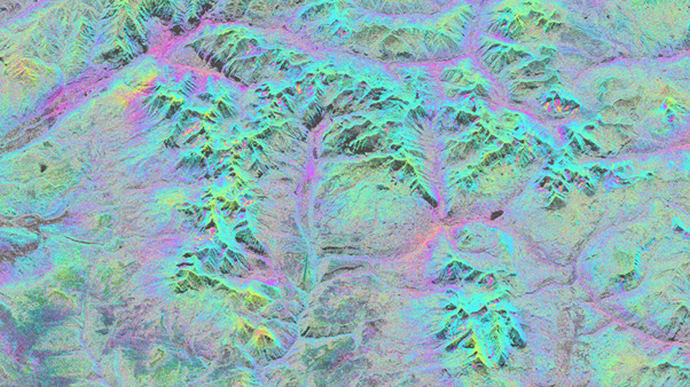
Rock glaciers are speeding up
The new time series shows that rock glaciers in mountains in the western part of the United States have accelerated significantly over the past six to seven decades. The researchers found that some of the rock glaciers have increased their speed by up to 2-3 times. This means that the rock glaciers are moving much faster than they did in the 1950s and 1960s.
Scientists believe that this acceleration is most likely due to a higher air temperature in the regions where the rock glaciers and permafrost are located. In particular, summer temperatures have increased, from June to August, by 0.4 degrees per decade.
Does this have major implications for climate research?
The new time series and analysis show that rock glaciers can be very sensitive to climate change. Just like glaciers, rock glaciers respond to changes in temperature.
But unlike glaciers, which melt and retreat, rock glaciers can accelerate forwards when the temperature rises, as the frozen rock mass, more precisely its ice content, becomes softer and easier to move.
Not all rock glaciers react the same
The new time series also showed that not all rock glaciers respond equally to climate change. Variations between the individual time series show that local and internal conditions in the frozen rock mass can have a significant impact on how the rock glacier reacts to rising temperatures.

This means that although rising temperatures are the main driving force behind the acceleration, other factors can have an impact, such as the ice content of the rock glacier, the geology of the mountain, location and more.
Environmental changes in mountain areas
The new study suggests that fundamental long-term environmental changes are occurring in mountainous areas of North America. As permafrost thaws and rock glaciers accelerate and change, it can affect everything from water runoff to vegetation and wildlife in these areas. Moving rock glaciers can also make mountainous areas unsafe for animal and human traffic.
Monitoring rock glaciers and understanding their response to climate change could be important for understanding and monitoring these natural ‘thermometers’ to better predict and adapt to future environmental changes in the future, the researchers emphasise.
The scientific article:
Kääb, A.M., Røste, J. 2024. Rock glaciers across the United States predominantly accelerate coincident with rise in air temperatures. Nature Communications, 15, 7581. https://doi.org/10.1038/s41467-024-52093-z