
About the project
The Arctic is warming much faster than the rest of the world, up to ten times in the Barents Sea region. Facing the fast warming of the Arctic, we need to advance our understanding of abrupt changes in the Arctic and their consequences. The Barents Sea is the region on Earth that exhibits by far the strongest air temperature increase, up to 8 °C over the recent 40 years – that is up to 10 times the global average. This has already set in motion a myriad of widespread and often dramatic changes, including massive reductions in Arctic sea ice, accelerated ice mass loss from glaciers and the Greenland ice sheet and carbon release from permafrost thaw. Shifts in the Arctic energy balance influence global warming.
Melt of ice from glaciers and the Greenland ice sheet have a direct impact on global sea levels. The carbon cycle is perturbed through permafrost thaw and an intensified hydrological cycle – accelerating climate change through release of greenhouse gasses. A number of physical amplifications conspire to make climate change particularly impactful, sudden and visible in the Arctic, rendering it the “early warning system” of Earth’s climate. Besides their common focus on Arctic climate transitions, the three studies in the ACT-Pilot effort are interconnected by a common approach of data-model integration and an overlapping set of data used. The three studies rely on efficient collection, management and analyses of large observational- and model-generated data sets that are difficult to handle for a single project alone.
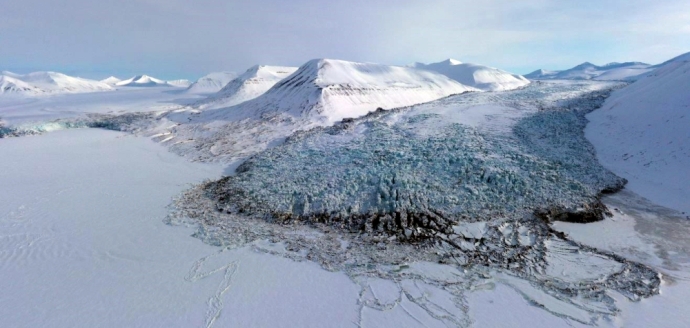
ACT-Pilot will contribute to a number of UN’s sustainable development goals (SDGs), most directly to: SDG13, climate action: ACT-Pilot contributes understanding and prediction of climate changes necessary to combat these changes and their impacts. SDG14, life below water: Both temperature effects per se, but also indirect effects by changes in precipitation and runoff will affect aquatic ecosystems. SDG15, life on land: Permafrost thaw strongly impacts Arctic land ecosystems and human infrastructure. Glacier changes impact geohazards and travel, not least on Svalbard.
Objectives
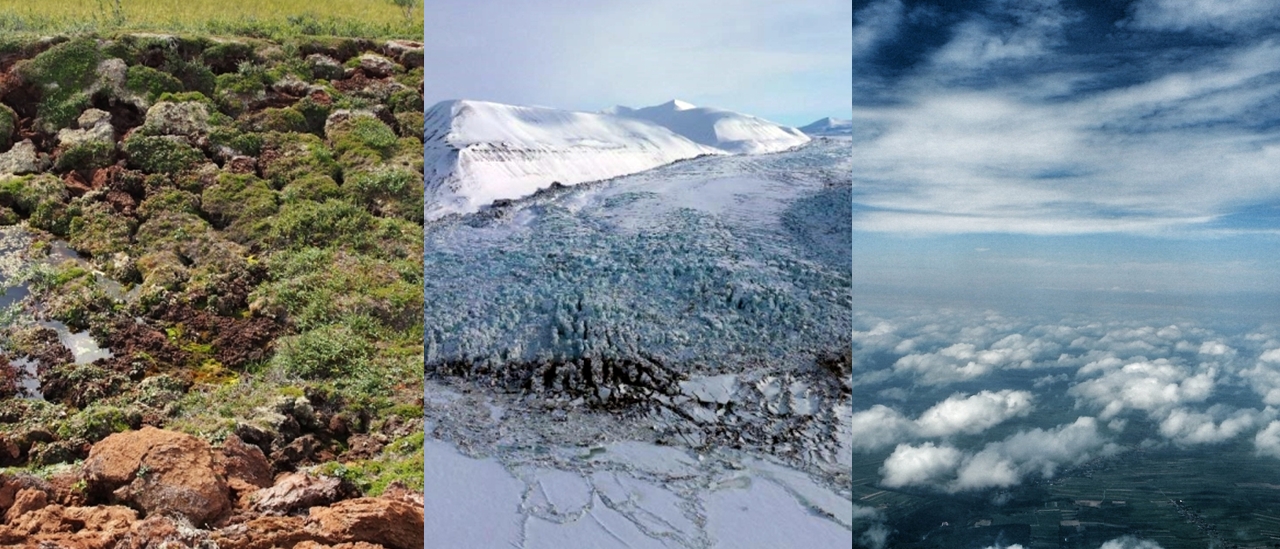
The Arctic will likely be sea-ice free at least once within the next 30 years. This has wide-reaching implications for the Arctic, but large remaining uncertainties hinder mitigation and adaptation efforts required to secure a sustainable development in the Arctic region. In the ACT-Pilot project we aim to simulate the concequenses for the warming Arctic. The approach consist of three interconnected studies: (1) on cloud – sea-ice interactions, (2) on rapid permafrost thaw through ground-ice loss, and (3) on ice-dynamic feedbacks on glacier mass loss.
We will collaborate closely with Center for Computational and Data Science (dScience) at University of Oslo. Our PhD students will be affiliated with the center and benefit from training opportunities and computational expertise in dScience.
Background
The Understanding climate transitions and limits to sustainability in the Arctic (ACT-Pilot)' project is part of the The Faculty of Mathematics and Natural Sciences’, University of Oslo (UiO)' initiative on sustainability research. The research are hosted by the GeoHyd-section and the Section for meteorology and oceanography (MetOs), Dept of Geosciences.
The research is divided into three studies (doctoral research projects) carried out by doctoral students supervised by senior scientists in the field, mainly from Dept of Geosciences. The three PhD studies in the ACT-pilot project are:
ACT-Pilot study 1: Reducing uncertainties in Arctic climate projections through observational constraints on cloud – sea-ice interactions
ACT-Pilot study 2: Quantifying and projecting rapid permafrost thaw through ground-ice loss
ACT-Pilot study 3: Are Svalbard glaciers at a tipping point towards irreversible mass loss?