The UN Decade of Action on Cryospheric Sciences aims to reduce uncertainties regarding the causes and effects of changes in snow, ice, and permafrost. Snow is a major contributor to these uncertainties due to the incomplete understanding and representation of snow processes in climate models. SnowShifts seeks to significantly enhance our comprehension of snow volume and mass, their non-linear dynamics and properties and, specifically, snow regime shifts within the Earth and climate systems. This will be achieved through a novel combination of in-situ and remote sensing observations, along with high-end numeric model developments. Innovative technologies such as photon-counting space-borne laser altimeters, terrestrial superconducting gravimeters, and novel scale-bridging approaches and downscaling of satellite gravimetry in extreme snow environments will be integrated with the latest multi-sensor satellite data and modelling. This will enable the retrieval of snow volume, mass, extent, and other properties, such as snow albedo, at unprecedented spatio-temporal resolutions. The combined observational and modelling advancements will define and describe trends and shifts in snow climates ranging from high-latitude polar regions to mid-latitude high-mountain ranges. This project will provide future snow scenarios for at least three socio-economic pathways refining current global and regional climate models, exploring and defining potential non-linearities in snow changes. SnowShifts will not only demonstrate the accuracy of our new models in reproducing snow quantities and dynamics, but will also generate extensive datasets characterising snow in remote and understudied regions. The new representations of snow processes will be a major outcome permitting the scientific community to incorporate the knowledge gained into climate and land surface models, and to replace in parts computationally expensive model components with machine learning emulators.
SnowShifts ERC Synergy Grant SnowShifts
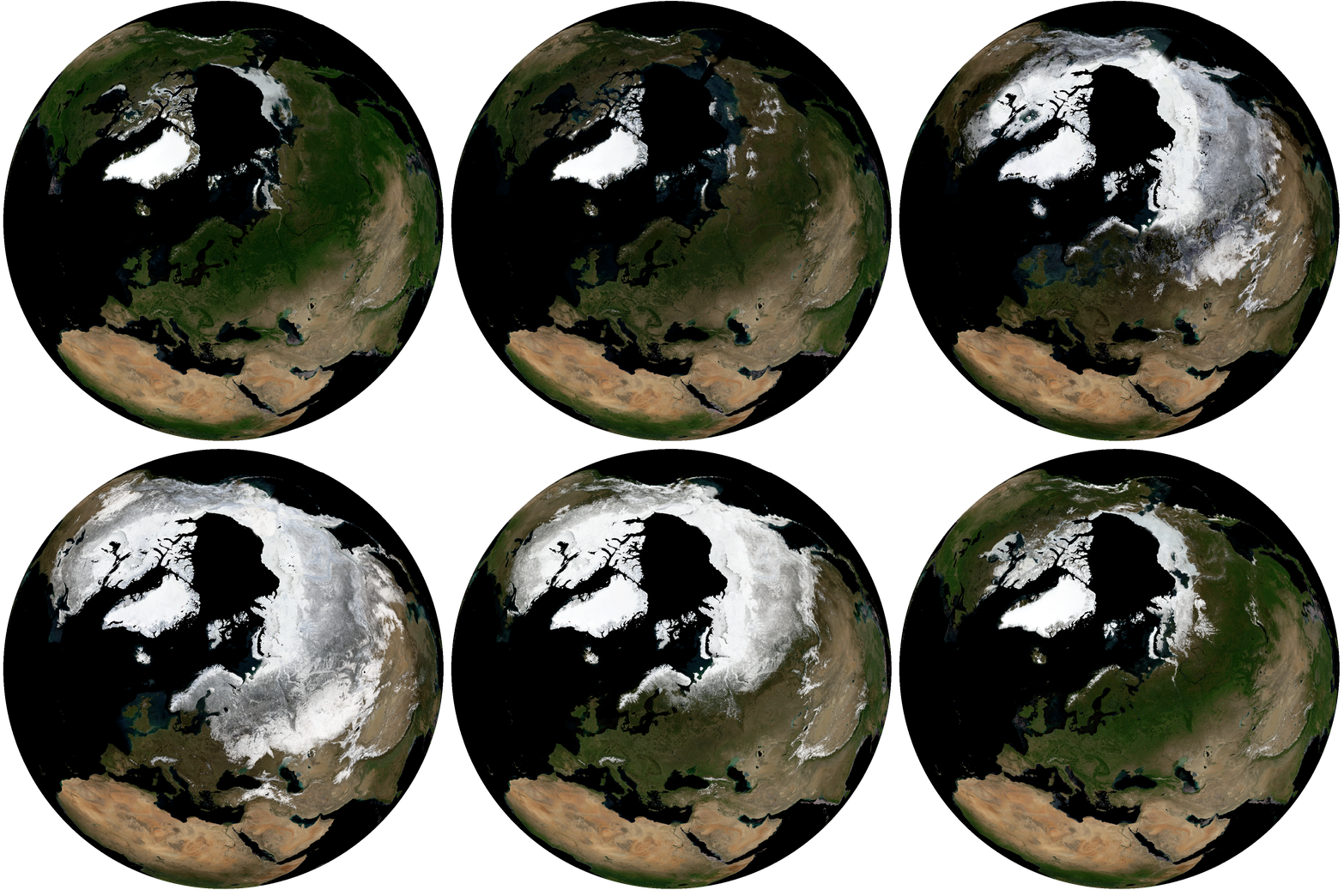
Snow - the nervous interface and a key regulator at the Earth surface
Current and future shifts of snow regimes in extreme environments. SnowShifts will quantify snow volumes and snow mass on local to regional scales with high spatio-temporal resolution in order to reconstruct the snow regimes of extreme environments model their future shifts, and investigate their non-linearities.
Participants
-
 Désirée Treichler University of Oslo
 -
 Yeliz Yilmaz University of Oslo
 -
 Kristoffer Aalstad University of Oslo
 -
 Andreas Max Kääb University of Oslo
 -
 Franziska Koch BOKU Vienna
 -
 Michael Lehning EPFL Lausanne
 -
Christian Voigt GFZ Potsdam
-
Simon Gascoin CESBIO Toulouse
-
Patrick Henkel ANavS Munich
Funding

Funded by the European Union (ERC, SnowShifts, 101224858). Views and opinions expressed are however those of the author(s) only and do not necessarily reflect those of the European Union or the European Research Council Executive Agency. Neither the European Union nor the granting authority can be held responsible for them.