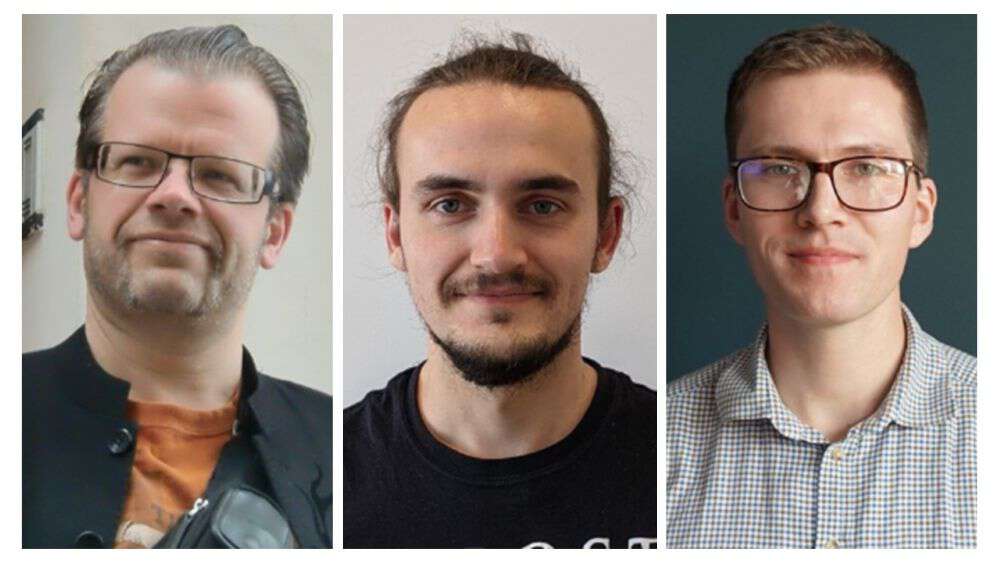
Program
Chair: Professor Luca Frediani, Co-director of the Hylleraas Centre
12:00: MSc. Quentin Pitteloud. Bringing spinors to the real space: implementation and solution of 2-component relativistic Hamiltonians using multiwavelets
12:30: MSc. Oliver Macphail Bohle. Regularised Hohenberg–Kohn mapping in periodic systems: Applications in one-dimensional systems
13:00: Professor Trond Saue. Does chemistry need more physics?
Almlöf—Gropen Lecturer 2026
Professor Trond Saue

Laboratoire de Chimie et Physique Quantique, CNRS & Université de Toulouse 3 (Paul Sabatier), France.
Trond Saue is a senior researcher (directeur de recherche) in Laboratoire de Chimie et Physique Quantiques (LCPQ; CNRS and Université de Toulouse, France. Born December 7, 1964, in Harstad, Norway, he obtained both his Cand.scient. (1991) and Dr.scient. (1996) at the University of Oslo, under the direction of Knut Fægri and Odd Gropen. He next had a one-year postdoctoral stay at the University of Southern Denmark, working with Hans Jørgen Aagaard Jensen.
From 1997 to 1999 he had a postdoctoral stay at LCPQ in Toulouse, where he also obtained Habilitation à diriger des recherches (required for supervision of PhD students and full professorship) in 2000. He spent two years as an assistant professor at the University of Tromsø before being hired in 2001 by the French National Centre for Scientific Research (CNRS). He was affiliated with Laboratoire de Chimie Quantique in Strasbourg until 2010, when he returned to the LCPQ in Toulouse.
Since 2011 he is director of the highly popular European summerschool in quantum chemistry (ESQC). Since 2010 he organizes, with Patrick Norman and Kenneth Ruud, schools on molecular properties. In 2016 he was elected member of the International Academy of Quantum Molecular Science (IAQMS), where he served as treasurer 2018 - 2023. In 2021 he was awarded an ERC Advanced Grant for the project Highly Accurate Molecular Properties using variational Quantum Electrodynamics (HAMP-vQED).
Trond Saue is known for his numerous contributions to relativistic molecular quantum chemistry, in particular in the domain of molecular properties, parity violation in chiral molecules, as well as the exact 2-component relativistic Hamiltonian (X2C). He is one of five main authors of the DIRAC code for relativistic molecular calculations, initiated by the 4-component relativistic Hartree-Fock code written during his Master’s thesis. With H. J. Aa. Jensen, he devised an ingenious scheme, based on quaternion algebra, for exploiting spatial and time reversal symmetry in molecular calculations. His ERC project HAMP-vQED aims to set new standards for accurate molecular properties. This involves on the one hand the automatic generation of high-order coupled cluster code, on the other hand an investigation of the possible role of quantum electrodynamics (QED) in chemistry.
Title: Does chemistry need more physics?
Abstract
Quantum mechanics is needed to understand the structure of the periodic table. Special relativity is indispensable for a correct description of the chemistry of the heavy elements. With increased accuracy of quantum chemical calculations, it is natural to ask if chemistry needs more physics.
Further reading: T. Saue, Pure and Applied Chemistry 97 (2025) 1255
Almlöf—Gropen Young Speaker
MSc. Quentin Pitteloud
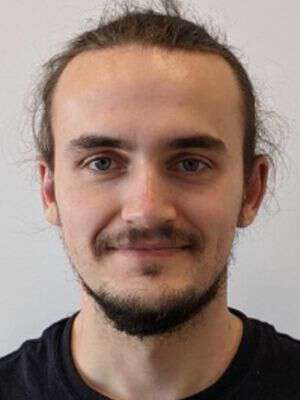
Hylleraas Centre, Department of Chemistry, UiT—The Arctic University of Norway, Tromsø.
Quentin is a Ph.D. candidate at the Hylleraas Centre at UiT The Arctic University of Norway. He obtained his bachelor’s and master’s degrees in physics at EPFL in Lausanne, Switzerland. For his master’s thesis, he had the opportunity to work conjointly with CERN's Openlab in quantum information theory, on the efficient classical approximation of qubit states. With a growing interest in relativistic effects in quantum physics, he moved to Tromsø to follow this path and now works on the development and implementation of 2-component approximations of the Dirac Hamiltonian in multiwavelet bases.
Title: Bringing spinors to the real space: implementation and solution of 2-component relativistic Hamiltonians using multiwavelets
Abstract
The Dirac equation is one of the most important theoretical developments of the 20th century. However, its structure proves inconvenient for numerical applications as it requires costly 4-by-4 matrix algebra or hypercomplex number fields. Fortunately, it is possible to greatly reduce the cost of this method by decoupling its positive energy solutions from the negative ones. Yet this decoupling has a cost and can only be performed unitarily knowing the exact energy solution. Thus, many energy-independent approximations to this decoupling method have been developed. Notably, the ZORA method has historically been a successful approximation but has been supplanted by the more accurate X2C method, which relies on matrix representation of operators to decouple the Dirac spectrum. For multiwavelets, an adaptive grid-based basis, the latter method is not practical, and operator-based methods, such as ZORA, are necessary.
In this talk, I will introduce a self-consistent method of solving the 2-component ZORA equation for the ground state solution in a multiwavelet basis. I will discuss the consequences of using complex-valued spinors in this basis and the compromises it requires. Furthermore, I will introduce an iterative method to reproduce the exact decoupling in operator form known as the Cowan-Griffin method. Finally, I will present numerical results obtained from both ZORA and Cowan-Griffin methods implemented in the MRChem software, and the road ahead for higher accuracy methods in multiwavelet basis.
Almlöf—Gropen Young Speaker
MSc. Oliver Macphail Bohle

Hylleraas Centre, Department of Chemistry, University of Oslo
Oliver Bohle is a PhD candidate at the Hylleraas center at the University of Oslo. He received his master’s degree in Physics from the University of Dundee, Scotland, in 2022. His PhD work specialises in inverse calculations in density-functional theory, working predominantly inperiodic systems.
Title: Regularised Hohenberg–Kohn mapping in periodic systems: Applications in one-dimensional systems
Abstract
The success of Kohn–Sham density-functional theory is rooted in both the relatively low computational cost and accuracy of approximate exchange-correlation functionals. The Hohenberg–Kohn mapping (density-potential inversion) determines the effective potential corresponding to a given ground-state density. Studying this map can provide a deeper understanding between densities and potentials along with generating accurate reference data for the construction of approximate density functionals. The work presented utilises a penalty term approach using Moreau–Yosida regularisation. A brief overview of density-functional theory for periodic systems will be presented. A proof-of-principle implementation at the level of Hartree–Fock theory for one-dimensional periodic systems is presented, allowing the numerical calculation of exchange potentials.
Error analysis is discussed for the inversion algorithm, quantifying how noise in the ground-state density propagates through the Hohenberg–Kohn map. The method also provides a tool for detecting failures of N-/v-representability. More recent work from this project will also be covered, as well as some of the practical challenges encountered along the way.