Katrine Borgå - Professor Toxicology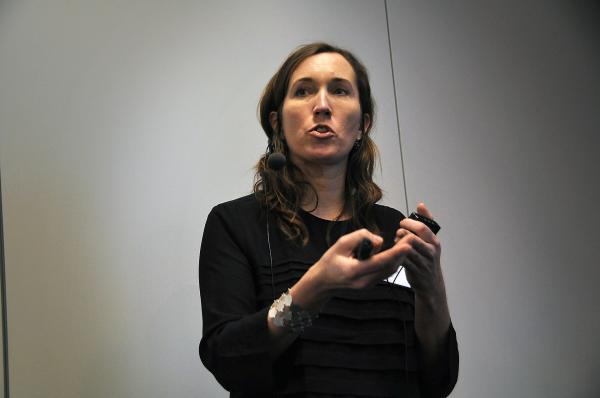 As an ecotoxicologist my research focuses on understanding mechanisms and processes for contaminant distribution and accumulation in the environment. This includes the influence of food web ecology, migration, life history traits, and biogeochemistry on (re)distribution of contaminants in the context of a changing climate. My research is oriented towards Arctic and Antarctic ecosystems, coastal marine and lakes, as well as recent involvement in terrestrial systems and the ecological effect of pesticides on pollinators. Target substances are legacy, current use and emerging contaminants, and plastics. |
PhD students |
Daniel Hitchcock Daniel is studying how variation in life-history affects contaminant levels in Arctic species. For example, how do species in the Arctic allocate energy toward reproduction? How does this affect contaminant levels? What differences do we see between males and females? Will additional stressors such as climate change lead to differences in life-history strategies and contaminant levels? Daniel aims to answer these research questions in three ways. First, he will conduct a systematic review to assess the literature and carry out a meta-analysis to compare scientific data against one another. Secondly, he will collect data either in the field or in the lab. Lastly, he hopes to develop models which explain how life-history and climate effects influence the bioaccumulation of contaminants. Daniel is an Australian who undertook his Bachelor degree at the University of Melbourne and Master degree at the University of Bergen. The supervisors for his PhD project are Katrine Borgå (UiO), Tom Andersen (UiO) and Øystein Varpe (UNIS). |
Norith Eckbo Norith is studying contaminants in Arctic and Antarctic seabirds. She is particularly interested in the intersection of ecotoxicology, ecology and evolution, how we communicate science, and the role of research in nature management and policy making. After spending three and a half year at the Norwegian Environment Agency monitoring the environment and working with ocean management, she returned to research with renewed motivation and ideas. The project, POLAR-ECOTOX, is funded through the ØKOSYSTEM call by the Norwegian Research Council. Supervisors are Katrine Borgå (UiO) and Geir Wing Gabrielsen (Norwegian Polar Institute). Our collaborators are Celine LeBohec (IPEV), Dorte Herzke (NILU) and Jan Ove Bustnes (NINA). |
Torben Lode Torben is doing his PhD as a member of the Dept of Biosciences prioritised research project LUMS: Life-history variation under multiple stressors: separating the effects on development, growth, maturation and survival. He is studying the combined effect of ecological and toxicological stressors on coastal copepod life history variation. The project is a collaboration between members of Section for Aquatic Biology and Toxicology, Josefin Titelman, Katrine Borgå, Tom Andersen, Ketil Hylland and Jan Heuschele |
|
|
Master of Science students |
Ane Haarr
|
Hilde Karin MidthaugHilde will examine and compare levels and patterns of persistent organic pollutants (POPs) in South Polar Skua blood, sampled in 2001/2002 and in 2013/2014 from Svarthamaren in Dronning Maud Land, Antarctic. The working title of her thesis is "Persistent organic pollutants in the Antarctic top predator, South Polar Skua (Catharacta maccormicki), over the past decade". |
Julie Sørlie Paus-Knudsen Observe the potential behavioural effects of pesticide on bees, under or at the value given by EPPO, Scientific committee for pesticides and the Professional group for pesticides. Investigate foraging behavior on other pollinators than honeybees (Apis mellifera), preferably bumblebees (Bombus terrestris) or orchard mason bee (Osmia lingnaria) exposed to more than one pesticide. Sypervisors: Anders Nielsen, Katrine Borgå, Merete Grung |
Silje Marie Kristansen
|
Cathrine Hoel In my master´s degree in ecotoxicology at the University of Oslo I am interested in getting a better understanding of the driving factors in the transport, bioavailability, uptake and transfer of mercury in boreal lake food webs, with the focus at the base of the food web. There has been an increasing trend in mercury concentration found in fish in many regions in northern lake ecosystems. The mercury cycle will lead to the mercury emission ending up in the cold northern areas, where it will bind to dissolve organic carbon (DOC) and may accumulate in biota. Climate change may enhance the mobility of mercury by increasing the deposition of DOC to surface waters and hence the associated mercury. Trying to get a better understanding of the driving factors I will conduct intense and detailed studies at the base of the food web, including bacteria, primary producers and zooplankton. Water and biota samples will be taken from two different lakes with contrasting levels of DOC, one clear water and one humus-rich lake. This will take place over the course of spring, summer and fall of 2016. Supervisors: Katrine Borgå (UiO), Amanda Poste (NIVA), Tom Andersen (UiO) |
Ellen Kristine Keilen |
Participants
 I am undertaking a Master’s degree in toxicology at the University of Oslo. During my bachelor degree, I spent one year at UNIS, Svalbard where I studied Arctic terrestrial and marine biology, ecology and Arctic environmental management. I am interested in how the Arctic is affected by human activity and global change both in terms of a warming climate and the long-range transport of contaminants from industrialised areas. For my project I will study genetic damage in relation to contaminant exposure in different Arctic birds. Birds are important study organisms in ecotoxicology as they are both vectors of transport and victims of pollutants; they possess various physiological adaptions and occupy different trophic levels; and they are important indicators of our oceans´ health.
  Silje is taking a master’s degree in toxicology and studying the transport of marine contaminants via seabird colonies to tundra communities in Svalbard. Many persistent contaminants accumulate and biomagnify up the food chain and as seabirds often are at a high trophic position, there are high concentrations of pollutants found in many seabirds. Seabirds transfer nutrients and contaminants from sea to land mainly via guano, but also carcasses, egg shells and feathers. Silje will study the contaminant load in springtails (Collembola) inhabited below bird cliffs in Svalbard, and also the concentrations in their habitat (soil/vegetation). She will also study the amount of DNA damage in the springtails to establish a possible correlation with the presence and level of contamination.
Published Nov. 1, 2016 9:31 PM
- Last modified Apr. 28, 2023 2:19 PM