
There is a sense of high expectation as staff and students from the Department of Chemistry prepare to move into Norway’s largest research building — the Life Sciences Building. The facility will bring together several research environments from the University of Oslo and Oslo University Hospital. Co‑location of research groups, with the aim of strengthening interdisciplinary work, is one of the University of Oslo’s and Norway’s largest investments in research and education.
Academic strength
Head of department Stian Svelle is proud of the expertise at the Department of Chemistry:
- We are well anchored in several convergence environments, which are UiO’s interdisciplinary projects. The Life Sciences Building will of course provide new informal meeting places — and naturally new research ideas will emerge.
Svelle emphasizes that to contribute effectively to convergence environments and other interdisciplinary work, chemists must maintain strong subject knowledge. Without solid disciplinary foundations, there is no interdisciplinary gain to be unlocked.
- We remain chemists at heart, and we will continue to uphold our discipline,” he says.
The Department of Chemistry through the years
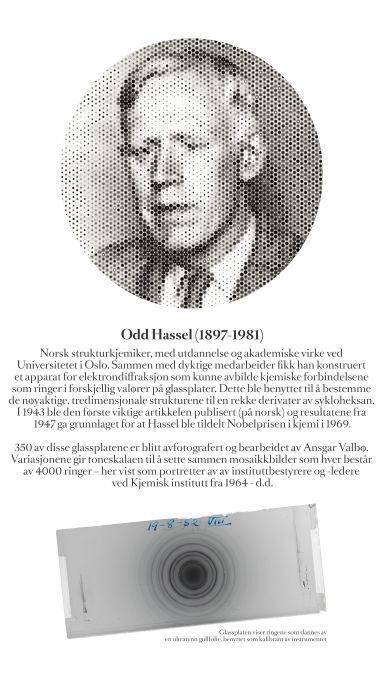
In one of the department’s many corridors at Blindern hangs a portrait installation showing department heads and directors through the years up to the present day. But the portraits reveal more than faces — they tell a unique story.
From electron‑diffraction plates and molecular structures to portraits in grayscale Odd Hassel was a Norwegian structural chemist educated and active at the University of Oslo. Together with skilled colleagues he developed an electron‑diffraction apparatus that could render chemical compounds as rings of different tones on glass plates. This technique was used to determine the precise three‑dimensional structures of a number of cyclohexane derivatives. The first important paper was published in 1943 (in Norwegian), and the results from 1947 formed the basis for Hassel’s Nobel Prize in Chemistry in 1969.
Photographer Ansgar Valbø has digitized and processed 350 of these glass plates to create portraits of the department’s heads and directors from 1964 to the present.
The variations provide the tonal range used to assemble mosaic images, each composed of 4,000 rings — shown here as 21 portraits.
Making new history
Head of department Stian Svelle, together with professor and former head Einar Uggerud, has played a leading role in coordinating the move of chemists into the new building. The relocation brings together a unique research and teaching environment, including technicians, administrative staff and students.
- We are a strong and capable team, he says with a smile.
And that smile is also the final image in the portrait series on the wall.
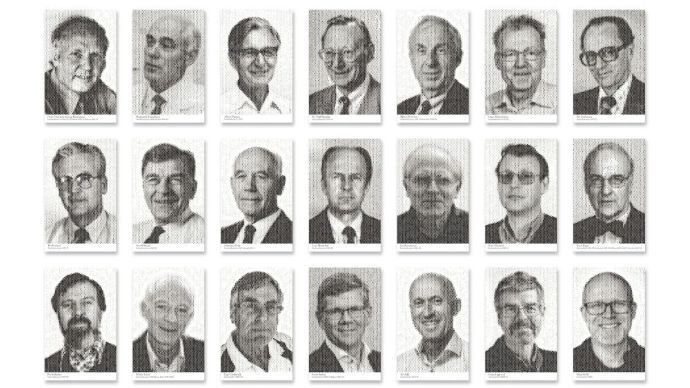
Heads and directors of the Department of Chemistry from 1964 to the present:
Dep. Director 1964–65: Otto Christian Astrup Bastiansen. Dep. Director 1966: Haakon Haraldsen. Dep. Director 1969: Alexis Pappas. Dep. Director 1970–72: Per Njål Skancke. Dep. Director 1972–73: Bjørn Pedersen. Dep. Director 1973–75: Hans Martin Seip. Dep. Director 1975–77: Per Andersen. Dep. Director 1977–79: Per Kofstad. Dep. Director 1980–81: Jorolf Alstad. Dep. Director 1967–68 and 1982–83: Johannes Dale. Dep. Director 1984–85: Lars Skattebøl. Dep. Director 1986–88: Jan Skramstad. Dep. Director 1988–91: Arne Haaland. Head of Dep. 1991–95: Knut Fægri. Head of Dep. 1995–97: Per Kolsaker. Dep. Director / Head 1985–86 and 1997–2005: Walter Lund. Head of Dep. 2005–2009: Tyge Greibrokk. Head of Dep. 2009–2012: Svein Stølen. Head of Dep. 2013–2019: Jo Døhl. Head of Dep. 2020–2023: Einar Uggerud. Head of Dep. 2024– : Stian Svelle.