Bioanalytical chemistry, sensors and lab-on-a-chip technology
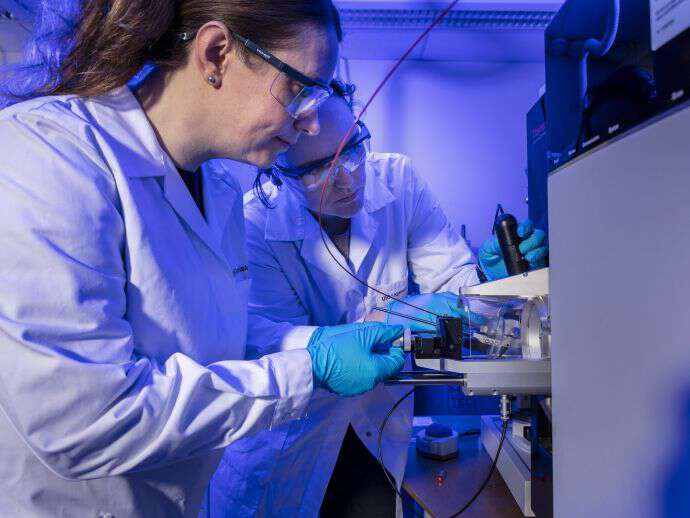
“From organ-on-a-chip to real patients: developing new tools for chemical analysis.”
Precision medicine, smaller samples (e.g. single cells) and high throughput testing of drugs places significant challenges on chemical analysis. How can we perform measurements more automated, faster, and sensitive?
We develop novel systems for sample preparation, separation science, mass spectrometry, typically tailored for microphysiological systems (organoids, organ-on-a-chip). We have active commercialization projects, developing advanced chips for performing chemical analysis. Omics platforms are developed for proteins, lipids, and metabolites, and the exposome, based on mass spectrometry or nuclear magnetic resonance spectroscopy.
We have formal collaborations with e.g. Oslo University Hospital, The Norwegian Institute of Public Health and SINTEF. We are members of several major research initiatives, including a center of excellence (Hybrid Technology Hub). We receive funding for basic research from e.g. the Research Council of Norway, as well as various innovation-based brants e.g. from the Novo Nordisk Foundation.
Related thematic research areas in the Life Science Building strategy
One Health; Personalized Medicine; Innovative Health Technology and Drug Development.
Molecular design, synthesis, and characterization
.jpg)
“Designing tomorrow’s medicines and catalysts, molecule by molecule.”
How can we design and synthesize molecules that address society’s needs, from sustainable catalysts and green chemistry to new drug candidates and molecular probes? And how can advanced characterization methods contribute to deeper understandings of living systems?
We develop new methods for the synthesis of organic and organometallic compounds, with a particular focus on sustainable catalysis. An additional emphasis is placed on state-of-the-art characterizations, where nuclear magnetic resonance (NMR) spectroscopy provides detailed structural and dynamic insight, e.g. for metabolomics studies. Through these initiatives, we create direct entry points for applications in areas such as drug discovery and chemical biology.
We collaborate nationally with partners in e.g. clinical research and pharmacy. We are part of the emerging NMR Life network, which sets out to strengthen the link between organic chemistry and life sciences. Funding sources include the Research Council of Norway and industry collaborations.
Related thematic research areas in the Life Science Building strategy
One Health; Personalized Medicine; Innovative Health Technology and Drug Development.
Biochemical mechanisms of life - molecular interactions and dynamics
-(4x3-web).jpg)
“Peering into life’s machinery: from atomic details to whole proteins at work”.
Integrative structural biology, combined with artificial intelligence (AI), is currently revolutionizing biochemistry. Still, how do we gain deep insight into biological systems—their molecular mechanisms and functions—across various scales in space and time?
We use a combination of experimental and computational methods to gain deep insight into important biological mechanisms and contribute to developing new treatments. We are experts in protein crystallography, small-angle X-ray and neutron scattering (SAXS/SANS) and computational modelling in an integrative structural biology context. The main focus is on proteins of medical interest particularly on enzymes, protein-carbohydrate interactions and membrane biophysics that includes work on the mode-of-action of antimicrobial peptides. Our work spans simplified biological mimics, native biomolecules and complexes, and artificially evolved systems.
The different methods have different strengths, and are most powerful when combined: X-ray crystallography usually provides the highest resolution and precision; SAXS/SANS provides low-resolution and time-resolved information of molecular interactions and structures in solution and the possibility to selectively characterize individual components via contrast variation, NMR gives insight into the local structure and dynamics; cryo-EM provides detailed structural information for large complexes; structural mass spectrometry maps interaction surfaces, and multiscale molecular modelling provides resolution in time and space.
We are internationally well connected and have long-term collaborations with research groups from the US and across Europe as well as nationally (e.g., with Norwegian University of Life Science NMBU and Oslo University Hospital). Funding sources (other than the Research Council of Norway) include the European Framework Programs, the Swiss National Science Foundation (SNF), and the National Institute of Health. We are part of the Hylleraas Centre of Excellence, national core facilities, and PhD Schools.
Related thematic research areas in the Life Science Building strategy
The Machinery of Life - Molecular Mechanisms and Organism Biology; Digital Life Science; Microbiology and Antimicrobial Resistance; Neuroscience; Innovative Health Technologies and Drug Development.
Sustainability, green chemistry, and environmental chemistry
-(4x3-w).jpg)
“Chemistry is a climate solution.”
The vast majority of chemical production occurs in industrial catalytic processes. At the same time, chemical manufacturing contributes significantly to our global footprint, and the drivers for developing new, greener, and cleaner are obvious. We strive to develop sustainable processes for production of critical chemical products through fundamental insights into the working mechanisms of catalysts and catalytic processes. Nevertheless, human activity is placing our planet under pressure by introducing greenhouse gases, microplastics, and other pollutants into the environment. Environmental chemistry is crucial for a sustainable transition: it reveals what is present, how it transforms, and which actions most effectively reduce harm. How can we develop green and sustainable chemistry to be part of the climate solution?
Our catalysis research centers on the rational design of new and improved catalysts based on fundamental mechanistic insights. We work with heterogeneous catalysts, such as zeolites and metal organic frameworks, and we are proud to have discovered the series of UiO-66 metal organic framework compounds. Moreover, we seek to bridge the gaps between homogeneous organometallics, enzymes and solid catalysts. Within environmental chemistry, we develop advanced instruments to detect trace substances in the environment, investigate the composition, reactions, and fate of chemicals in air from local to global scales, and provide environmental expertise to energy-transition industries to help them monitor, manage, and reduce their impact.
We collaborate with leading European universities and research heavy industry and start-ups, Norwegian research institutes (NIVA, NILU, SINTEF), and the Center for Materials Science and Nanotechnology. Our research is funded by the private sector, the Research Council of Norway and the European Union.
Related thematic research areas in the Life Science Building strategy
One Health; Open Life Sciences or free projects in Life Sciences.
Nanomaterials and soft matter for life science
.jpg)
“From lipids to quantum dots: chemistry at the nanoscale for future healthcare.”
Soft matter encompasses the study of polymers, lipids, peptides, and colloids, which all tend to self-organize into nanostructured particles, gels, and (bio)materials that are valuable in life sciences. Many applications of soft matter are found within the field of nanomedicine, an interdisciplinary area that integrates nanotechnology with medical science, e.g. to create precisely targeted drug-delivery system with reduced side effects. However, the design into new materials require a full understanding and control of molecular interactions to craft stable functional systems. How can we utilize chemistry to create new platforms for therapeutics and biomedical applications?
We investigate the fundamental mechanisms of self-assembly in synthetic and biomolecular systems. By fine-tuning molecular interactions, we can engineer innovative carriers for drugs, including antibiotics and chemotherapeutics, as well as develop biocompatible and bacteriostatic materials for implants, tissue engineering, and various biomedical applications. Our work focuses on chemical design of assemblies such as micelles, peptide/peptoid nanostructures, and lipid membranes. Understanding their structure and dynamics allows us to develop new nanomaterials with specific biological functions, such as lipid nanoparticles designed for treatments and vaccines. Specifically, we aim to create antimicrobial materials targeting resistant bacteria and innovative nanocarrier systems for drug delivery against cancer cells, fungi, and bacteria. In our work we are drawing on polymer/peptide/peptoid synthesis and advanced characterization methods based on X-rays, neutrons and light.
Plasmonic nanoparticles, quantum dots, and magnetic nanoparticles are key nanomaterials in life sciences. Using colloidal approaches, we synthesize inorganic monodisperse nanoparticles with precise control over size, atomic arrangement, chemical composition, element distribution, and surface functionalization. Plasmonic nanoparticles enhance optical signals for sensitive biosensing and imaging, quantum dots provide stable, size-tunable fluorescence for multiplexed diagnostics, and magnetic nanoparticles enable targeted delivery, MRI contrast, and hyperthermia therapy. We aim to collaborate with hospitals to translate these colloidally engineered and well-characterized nanomaterials into biomedical imaging, diagnostics, and therapeutic applications.
We are broadly involved with international partners (Europe, US) that includes long-term collaborations as well as nationally (e.g., with Norwegian University of Science and Technology and Oslo University Hospital). Funding sources (other than the Research Council of Norway) include EU-MSCA and NordForsk. We are part of the Hylleraas Centre of Excellence, the Center for Materials Science and Nanotechnology, and national core facilities and PhD Schools.
Related thematic research areas in the Life Science Building strategy
Microbiology and Antimicrobial Resistance; Personalised Medicine, Innovative Health Technologies and Drug Development.
Nanomedicine and drug discovery – new antibiotics
.jpg)
“Designing the next generation of antibiotics to outsmart resistant bacteria.”
At the Department of Chemistry, University of Oslo, we are at the forefront of research that bridges molecular science with medical innovation. Our focus on nanomedicine and drug discovery is driven by one of the most pressing global health challenges: antibiotic resistance.
Through interdisciplinary collaboration and cutting-edge chemical research, we are developing next-generation antibiotics and targeted drug delivery systems that harness the power of nanotechnology. Our scientists explore how nanoscale materials can be engineered to interact precisely with a diverse array of biological systems—opening new pathways for treating infections that no longer respond to conventional therapies.
We combine expertise in synthetic chemistry, molecular biology, and biophysics to design molecules that not only fight resistant bacteria but also minimize side effects and environmental impact. This work is not only about molecules—it’s about transforming medicine, protecting public health, and training the next generation of researchers to tackle tomorrow’s challenges.
Whether you're a student, researcher, or industry partner, we invite you to explore our work and join us in shaping the future of healthcare through chemistry.
Related thematic research areas in the Life Science Building strategy
Microbiology and Antimicrobial Resistance; Personalized Medicine, Innovative Health Technologies and Drug Development.