Home

Research
The Centre for Materials Science and Nanotechnology (SMN) comprises UiO’s focus on renewable energy, materials science, and nanotechnology. The Centre is an interdisciplinary collaboration between four research groups in physics and chemistry, and spearheads the MN Faculty's efforts for sustainable energy solutions.
The main activity of the Centre is competitively funded basic research, financed by external grant agencies such as the Research Council of Norway, the European Union and private companies. The Centre has an annual turnover of approximately 75 MNOK, and hosts around 140 PhD students, postdocs, researchers, and permanent technical-administrative and academic staff.
Highlighted publications
-
Operando X-Ray Diffraction and Total Scattering Characterization of Battery Materials: Not Just a Pretty Picture Apr. 28, 2026 2:45 PM
The development of rechargeable batteries can be accelerated by the fundamental understanding of their chemistries. Multiple characterization techniques have been deployed to study the chemical processes in batteries, but structural studies at the atomic level using X-ray diffraction (XRD) and total X-ray scattering (TXS) show enduring popularity. These methods are relatively easy to apply in operando mode, where structural data is collected alongside electrochemical data under operating conditions. With a growing interest in this powerful methodology, it is important to review the general principles of operando XRD/TXS characterization and develop a set of guidelines for the collection, analysis, and presentation of data that are acceptable to the community and can lead to reliable, representative, and reproducible results that are easy to judge and compare. This Review aims to survey and discuss important steps in operando XRD and TXS. From cell and electrode design to data treatment, we survey the major experimental aspects of operando studies, pointing out potential pitfalls and identifying best-practice. In addition, in the present review, the researchers from UiO conducted some unconventional experiments in operando mode to illustrate how such methods can be used beyond studies of the early-stage cycling mechanisms of battery active materials.
-
Leveraging Diamines to Unlock the Mn-MACHO Catalyst in the Reduction of CO2 to Methanol Apr. 28, 2026 2:04 PM
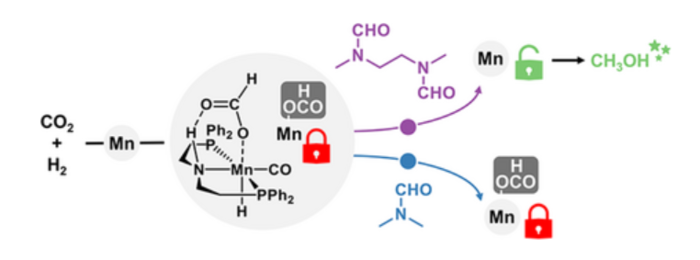
The conversion of CO2 into energy-dense liquid fuels, such as methanol, represents a cornerstone of sustainable chemistry; however, most homogeneous catalytic systems still rely on noble metals or Lewis acid additives. Here, we report the first protocol for amine-assisted CO2 hydrogenation to methanol using a Mn–MACHO catalyst without any Lewis acid co-catalyst, achieving turnover numbers up to 45.2, the highest reported for Mn systems. A combined computational, microkinetic, and experimental study reveals that diamines dramatically enhance activity compared to monoamines by promoting a highly exergonic double amidation step. This thermodynamic driving force shifts the equilibrium away from formate resting states toward the active catalyst, thereby accelerating methanol formation. The correlation established between amidation free energies and methanol productivity provides a rational design principle for tailoring amine promoters across Ru- and Mn-based MACHO catalysts. These insights advance the development of sustainable, base-metal-catalyzed CO2 conversion strategies and open opportunities for integrated carbon capture and utilization.
-
Nickel-Induced Lattice Defects Limit Proton Uptake in Barium Zirconate Electrolytes Apr. 28, 2026 11:21 AM
Nickel provides essential catalytic properties for hydrogen electrodes in proton-conducting ceramic electrochemical cells. However, Ni diminishes the hydration capability and proton conductivity when incorporated into electrolyte materials including BaZr0.8Yb0.2O3−δ studied here. Through semiquantitative atomic-resolution scanning transmission electron microscopy, density functional theory simulations, X-ray total scattering, and absorption spectroscopy, we reveal that Ni forms point defect clusters with the Yb acceptors wherein oxygen vacancies are trapped and resist hydration. The resulting effective acceptor concentration is described by point defect reactions in quantitative agreement with thermogravimetric measurements of hydration for samples substituted with 2–5 mol % Ni by BaNiO2 addition. Moreover, excess B-site cations due to NiO addition induce the formation of antiphase boundaries (APBs) that are enriched in Yb and thereby deplete the bulk of acceptors, further suppressing hydration. The adverse effects of Ni are thereby resolved into two novel mechanisms, opening new avenues in point defect engineering for high-performance electrolytes.


Related study programmes
Events
Vacancies
-
Rådgiver innen forskingsadministrasjonAvdeling: Senter for materialvitenskap og nanoteknologi (SMN)Fakultet: Det matematisk-naturvitenskapelige fakultetSpråk: BokmålSøknadsfrist: mandag 26. oktober 2026
-
Seniorrådgiver innen forskingsadministrasjonAvdeling: Senter for materialvitenskap og nanoteknologi (SMN)Fakultet: Det matematisk-naturvitenskapelige fakultetSpråk: BokmålSøknadsfrist: mandag 26. oktober 2026