Delta på disputasen
PhD disputasen og prøveforelesningen vil foregå 100% hybrid. Deltakerne kan velge å enten delta i person eller via Zoom Webinar (lenken under). Rommet åpnes for deltakelse like før disputasen starter, og stenger for nye deltakere omtrent 15 minutter etter at disputasen har startet.
Delta på prøveforelesning - 18. september kl. 10:15 (Aud. 209, Svein Rosselands Hus/Zoom)
"Applications of machine learning in cosmology -- promise and perils"
Kreeringssammendrag
Standardmodellen for Universet inneholder flere ingredienser som er lite forstått i partikkelfysikken. Flere alternative modeller som belyser deres egenskaper, kan samsvare med empirisk data, og må utforskes ved bruk av numeriske simuleringer. Dette arbeidet har utforsket en klasse modeller som gjennomgår en faseovergang i de senere stadiene av universets utvikling, og har funnet relevante signaturer i strukturdannelse og gravitasjonsbølger.
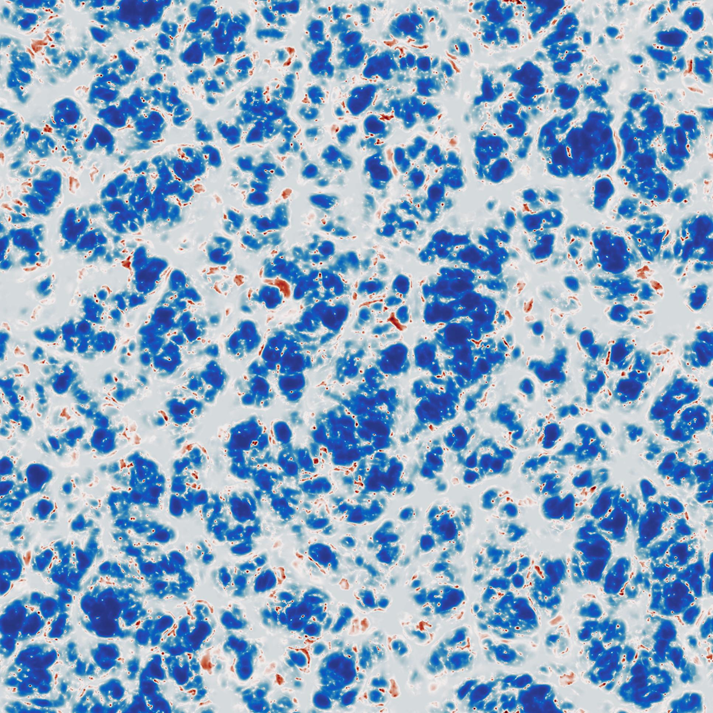
Kosmologiske domenevegger i simuleringer
"The dark sector" of cosmology refers to exotic dark components that modify the gravitational dynamics in the Universe to align with empirical observations. These dark components are not unique in producing the observed behaviour, and several alternative models will produce additional effects that can be used to distinguish them in upcoming surveys. This work explores in detail a class of models that brings the Universe through a dark phase transition, that produces dark topological defects, gravitational waves and boosts structure formation.
To better understand these models, I develop simulation software that captures the relevant gravitational dynamics and structure formation. The software is applied to find clear signatures of the alternative ingredients, which can be detected in upcoming experiments, such as imprints on the cosmic microwave background, boosted structure formation, and production of gravitational waves. I then continue to propose and simulate a novel and complex mechanism in which this class of models can produce the observed late-time cosmic acceleration. Such models would have far-reaching implications for both the origins and the ultimate future of the Universe