Disputas og prøveforelesning avholdes hybrid, slik at deltakere kan delta enten via Zoom eller fysisk. Zoom-lenken legges ut dagen før disputasen. Verten av Zoom-møtet vil moderere det tekniske mens disputasleder moderer disputasen. Zoom-lenken vil bli publisert senest dagen før disputasen.
Ex auditorio-spørsmål: Disputasleder inviterer til ex auditorio-spørsmål, og disse kan foretas enten skriftlig eller muntlig ved å trykke på "Participants -> Raise hand".
Delta på disputasen 
Møtet åpnes for deltakelse like før disputasen starter, og stenger for nye deltakere omtrent 15 minutter etter at disputasen har startet.
Delta på prøveforelesning - 16. september kl. 10:15 (Aud. 209, Svein Rosselands Hus)
"The multiscale nature of the solar wind"
Kreeringssammendrag
Solutbrudd er blant de mest energirike hendelsene i solsystemet og drives av magnetisk omkobling i solens atmosfære. I sitt doktorgradsarbeid har Michael Haahr utviklet en ny simuleringsmodell som kombinerer stor-skala væskedynamikk med små-skala partikkelfysikk for å forstå hvordan slik energi frigjøres. Arbeidet gir ny innsikt i hvordan mikrofysiske prosesser påvirker globale strukturer i solens korona.
Linking Big and Small to Understand Solar Flares
Solar flares are powerful explosions in the Sun’s atmosphere that can disrupt satellites, GPS, and power grids on Earth. They are caused by magnetic reconnection, where magnetic field lines suddenly break and release stored magnetic energy. But the details of how energy is released remain poorly understood.
One key reason is that most models treat plasma as a fluid—a method called magnetohydrodynamics (MHD). This works well on large scales but cannot capture the plasma dynamics near the reconnection site. To see the full picture, more accurate plasma models are needed.
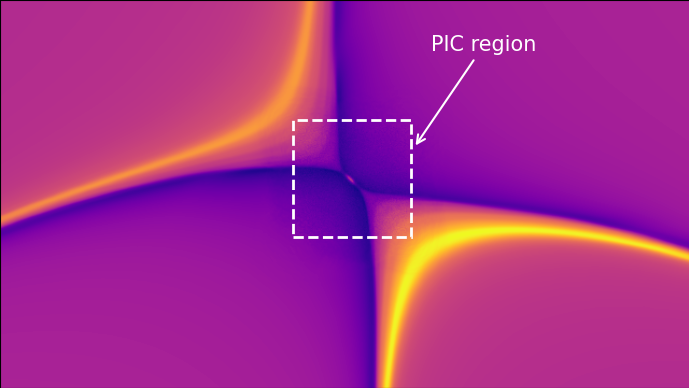
This thesis combines MHD with a particle-in-cell (PIC) model, which tracks individual particles. In our MHD–PIC hybrid solver, MHD captures the global evolution, while PIC is used locally near the reconnection site.
We applied the new model to a solar flare setup using conditions from the solar corona. This is the first time such coupling has been successfully demonstrated in a realistic configuration. The results show how the reconnection site changes depending on physical scaling, and reveal particle acceleration—especially of protons—as well as magnetic field patterns that extend far beyond the PIC region.
This work provides a powerful new tool for understanding solar flares and improving space weather forecasting.