Delta på disputasen
PhD disputasen og prøveforelesningen vil foregå 100% fysisk. Rommet åpnes for deltakelse like før disputasen starter, og stenger for nye deltakere omtrent 15 minutter etter at disputasen har startet.
Delta på prøveforelesning - 20. mars kl. 10:15 (Aud. 209, Svein Rosselands Hus)
"Quasi-Periodic Pulsations in Solar and Stellar Flares"
Kreeringssammendrag
Soleksplosjoner er plutselige fenomener, hvor enorme mengder energi blir raskt frigjort i form av stråling og akselerering av høy-energiske partikler ved magnetisk omkobling. Avhandlingen analyserer små-skala strukturer forbundet med fotpunktene til soleksplosjoner, og støtter teoretiske modeller som beskriver formasjonen av disse strukturene.
Hovedfunn:
Solar flares are sudden bursts of energy on the Sun that happen when twisted magnetic fields snap and reconnect. These explosions release huge amounts of magnetic energy into the Sun’s atmosphere and can disrupt Earth’s communications and power systems. Despite their importance, we still do not fully understand how the energy is released and carried down through the atmosphere.
The Swedish 1-meter Solar Telescope (SST) studies the Sun’s lower layers—the photosphere and chromosphere—at very high resolution. Observations from the SST help us see how and where flare energy is deposited, especially in the chromosphere, where bright “flare ribbons” appear.
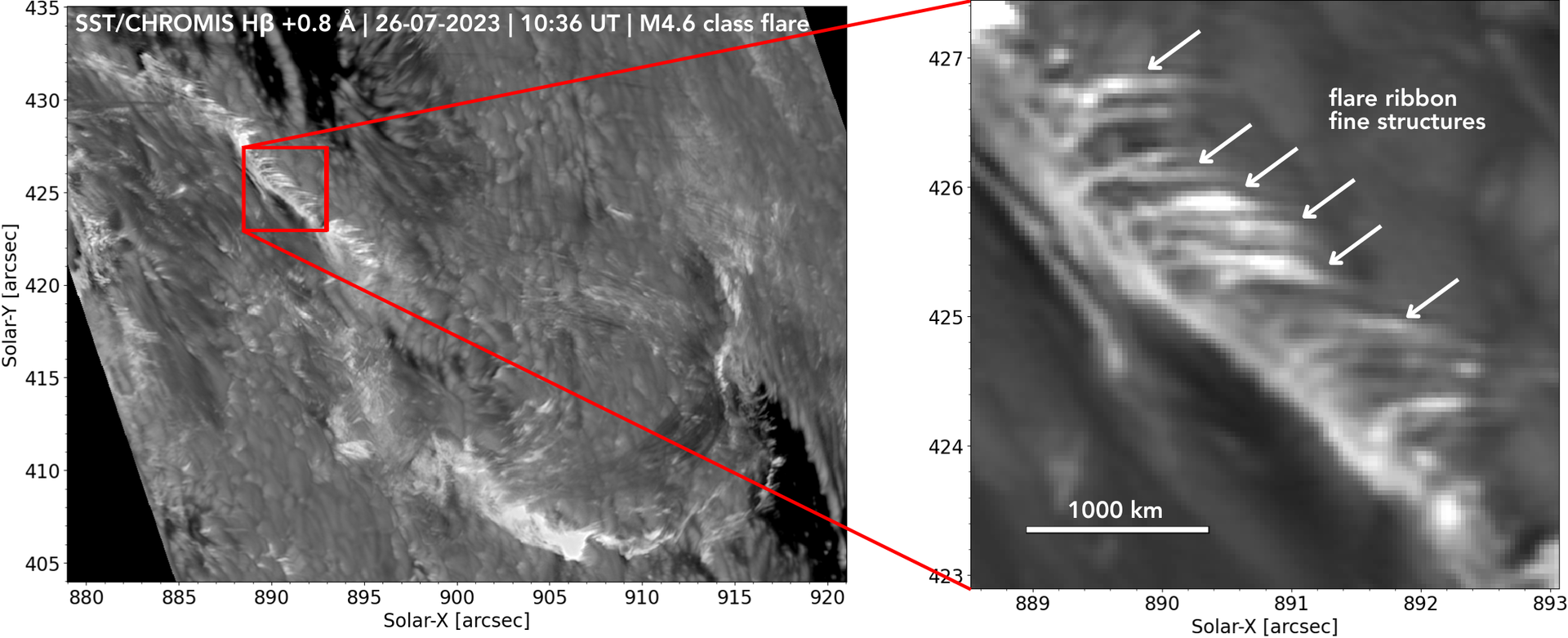
This thesis examines flare ribbons from five different events using mainly SST data. Each flare differs in strength and position on the Sun, but the ribbons show similar behaviour. Detailed images reveal that ribbons are made of many tiny, short-lived strands. These fine structures are closely spaced, extend vertically, and are often hidden in the cores of chromospheric spectral lines.
The findings support the idea that energy travels from the corona to the chromosphere in a fragmented, patchy way—likely because magnetic reconnection happens in many small, separate sites rather than in a single smooth process.