
Tómas Zoëga is a PhD Candidate at the Meteorology group, Department of Geosciences, UiO. He is also part of the CompSci doctoral program. He will be defending his thesis for the degree of PhD, which was submitted for evaluation on the 29th of January of 2025.
From the CompSci team we wish you good luck and all the best in your future endeavors!
→ Read more about the disputation in the website of the Department of Geosciences
Programme
10:15 – Trial lecture: "The physical science of climate intervention: benefits, perils, and pitfalls" – Aud 1, The Geology Building
13:15 – Disputation: "The climate response to high-latitude effusive volcanic eruptions" – Aud 1, The Geology Building
This event is open for everyone. No registration needed.
The Disputation will be live streamed via Zoom.
The livestream will be activated 15 minutes before the Defense starts.
PhD candidate
Research group | Meteorology
Main supervisor | Kirstin Krüger
Co-supervisor | Trude Storelvmo
Affiliation | Department of Geosciences, UiO
Contact | tomas.zoega@geo.uio.no
Adjudication committee
Professor Anja Schmidt, Institute of Atmospheric Physics, Earth System Modelling for Aeronautics, Space, Transport and Energy
Professor Jim Haywood, Faculty of Environment, Science and Economics, University of Exeter
Professor Joseph Lacasce, Department of Geosciences, University of Oslo
Chair of defense
Professor Joseph Lacasce, Department of Geosciences, University of Oslo
Short summary
The climate response to high-latitude effusive volcanic eruptions
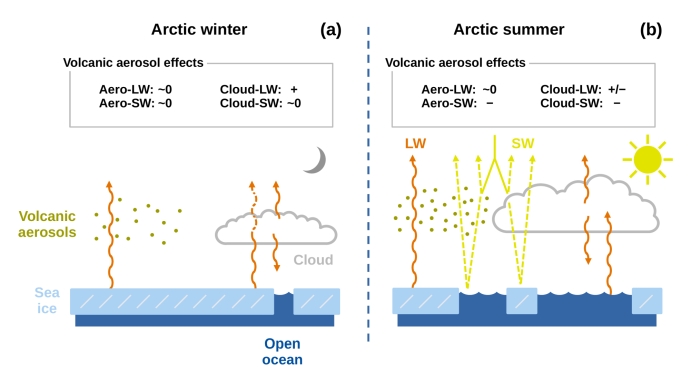
Effusive volcanic eruptions are characterised by non-explosive activity. They are relatively gentle compared to their explosive counterparts, often resembling boiling stews rather than fireworks. They can impact climate through their emission of gases into the troposphere and the subsequent formation of aerosols. These aerosols, which are small particles suspended in air, reflect sunlight (shortwave radiation; SW) back to space, leading to cooling of the climate. They also interact with clouds and change their properties. This can lead to clouds reflecting more sunlight, resulting in cooling (the cloud albedo effect), but also increase their ability to trap thermal radiation from the Earth (longwave radiation; LW) close to the ground, resulting in warming (the cloud blanket effect).
In this doctoral thesis, Tómas Zoëga investigates the climate response to high-latitude, long-lasting, effusive volcanic eruptions. This is systematically explored through modelling and observational evidence. The results reveal a highly regional response with a strong seasonal dependency. In agreement with previous studies, these eruptions are found to cause cooling during summer across latitudes. During winter, however, this study finds that effusive volcanic eruptions lead to surface warming in the Arctic through enhanced trapping of terrestrial thermal radiation by thin low-level clouds under limited sunlight. These results highlight processes which play disproportionally large roles in the Arctic, such as the cloud blanket effect mentioned above, and can help us better understand this vulnerable part of the Earth system under the ongoing climate change.
Figure: Radiative fluxes in the Arctic during (a) winter and (b) summer. The text in the grey boxes indicates the impacts of volcanic aerosol perturbations, both directly (Aero-LW/SW) and indirectly through aerosol-cloud interactions (Cloud-LW/SW), on LW (wavy orange arrows) and SW (straight yellow arrows) surface radiative fluxes. Dashed arrows indicate radiation which has been partially absorbed or scattered. Credit: Tómas Zoëga
