Previous events - Page 34

Doctoral candidate Thomas Barnes at the Department of Geosciences, Faculty of Mathematics and Natural Sciences, is defending the thesis Subglacial geomorphology of Norway: ribbed moraines, the bedform continuum and localised geomorphological reconstruction of the Fennoscandian deglaciation for the degree of Philosophiae Doctor.

Doctoral candidate Luca Boretto at the Department of Informatics, Faculty of Mathematics and Natural Sciences, is defending the thesis Multi-Modal Laparoscopic Liver Navigation for the degree of Philosophiae Doctor.

This seminar serie is part of a collaboration between the Japanese research institutions, the Japanese embassy, the Japanese Society for the Promotion of Science, and the Hylleraas Centre. The Japan-Norway seminar will be held at the Hylleraas Centre, Oslo.

Clelia is a professor at the Physics Departement of Bologna University in Italy.
Welcome to our GeoHyd Lunch Seminar on Friday 24th of October @ 12:15 in Aud. 2 in the Geology Building. The seminar is held by Ugo Nanni (UiO)

This was an internal workshop for the section of Statistics and Data Science at the department where we both discussed new/hot topics within statistics and discussed what we wanted with our section.
Organizers: Camilla Lingjærde, Yael Friedman, Johan de Aguas, Leiv Rønneberg, Clara Bertinelli Salucci
Webinar Friday October 24th, 2025
09:00-09:30 CET
Teams link to the session here
Session description
Heterogeneous data management practices have left the research data ecosystem messy and cluttered, worsening the problem of data reuse.
To enable effective reuse, this ecosystem needs to be decluttered and organised. Efforts to address this include making data FAIR by promoting standard research data management practices.
Yet, while these efforts have received significant support, they have also encountered some resistance. Typically, reasons for such resistance pertain to the resource-intensive nature of data management.
In this special Open Access Week edition of the Research Data Insider, Anamika Chatterjee (PhD) will explore another reason for such resistance: scientists hold differing definitions of ‘purity’ and ‘pollution’.

Join this hands-on workshop to learn the essentials of crafting clear, engaging scientific posters.
Webinar Thursday October 23rd, 2025
13:00-14:00 CET
Meeting ID: 979 3586 5586
Passcode: 086300
Session description
Research funders, institutions, and academic journals increasingly require that raw data, where possible, be shared openly through public repositories. This boosts transparency and reproducibility of research, but also unlocks new possibilities through re-use, i.e. secondary data analysis.
When data is reused for purposes beyond its original intent, it can lead to unexpected breakthroughs. What’s more, by combining datasets from different sources, researchers can uncover insights no single team would have been able to achieve alone, or build consensus on complex scientific questions.
Yet, making sense of someone else’s data isn’t always easy. What are the challenges of interpreting and integrating datasets generated by others? Why is it crucial that the FAIR principles – Findable, Accessible, Interoperable, and Resuable, are followed when data are shared?
In this session, we’ll hear from two experienced practitioners of secondary data analysis. Join us to learn how FAIR data can lead to new discoveries — and what it takes to make that happen.
By Dr. Anja Røyne, Department of Physics, UiO

Welcome to this week's lunch seminar with August Arnstad and Sigurd Holmsen, PhD Candidates at Integreat – Norwegian Centre for Knowledge-Driven Machine Learning. They will introduce the centre and their current work.
Learn more about possible topics for master's thesis and meet the scientists who can supervise them!

How will AI impact IFI and other organisations in the future? Technological factors was one of the key external strategic factors we discussed, at the department seminar, and in this talk, Petr Špecián (Charles University, Czech Republic), will provide an in-depth analysis of how AI challenges established organisational frames and provides the impetus for change.
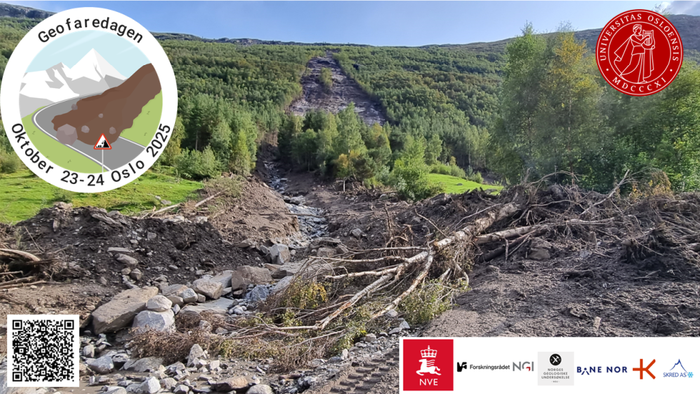
The Geohazard day 2025 will take place on October 23rd-24th in Oslo. The organiser of this year's conference is the Department of Geosciences at the University of Oslo.
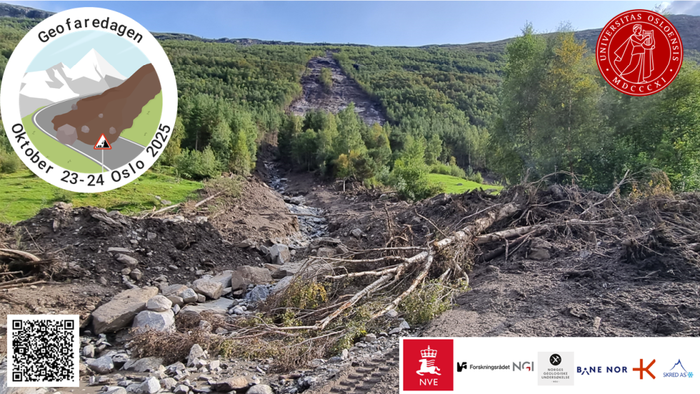
Geofaredagen 2025 går av stabelen 23.-24. oktober i Oslo. Arrangør av årets konferanse er Institutt for geofag ved Universitetet i Oslo.

Spend a day with great science, innovation and networking opportunities at this meeting place for academia, hospitals, the institute sector, the public sector, start-ups and industry. The conference is a part of Oslo Innovation Week 2025. Topics: antimicrobial resistance, cancer, neuroscience, materials science, social innovation, and women's health.
Cecilie Glittum:
The groundbreaking ideas of the resonant valence bond (RVB) liquid initiated a transformative shift in modern physics. Extensive implications influenced a broad spectrum of fields, from high-temperature superconductors to quantum computing, and gave birth to key concepts in physics, such as quantum spin liquids, emergent gauge symmetries, topological order, and fractionalisation. Despite extensive efforts to demonstrate the existence of an RVB phase, a definitive realisation has proven elusive.

Per August Jarval Moen is a Doctoral Research Fellow at the Department of Mathematics at the University of Oslo. He defended his PhD thesis in June 2025. Per August is mainly working within theoretical and methodological change and anomaly detection problems. More broadly, he is interested in high-dimensional problems, computational statistics and optimality theory.
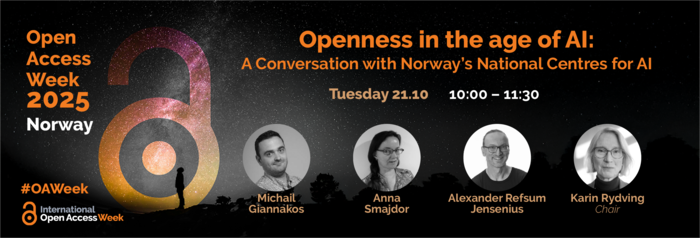
Webinar Tuesday October 21st, 2025
10:00-11:30 CET
Teams link to the session here
Meeting ID: 395 641 130 312 3
Passcode: 4va7mi2J
Session description
Artificial intelligence is making its way into the research landscape, and in this OA week event we will explore whether it is possible to maintain open science ideals, such as openness, transparency, collaboration, and reproducibility alongside AI?
We will ask the question: How open can AI research be? Voices from several of Norway’s newly established national AI research centres will join us to discuss how they work with open science ideals.
Long-term effects of clear-cut forestry on fungal spruce litter decomposer communities in boreal forests
Generative AI is here to stay. For physics educators, the question isn’t whether to use it, but rather how. In this talk I will reflect on the opportunities and challenges of integrating AI into physics education.

The 2025 annual meeting of the Quantum and Computational Chemistry Chapter of the Norwegian Chemical Society will take place "lunch to lunch" on October 20th-21st at UiT The Arctic University of Norway.
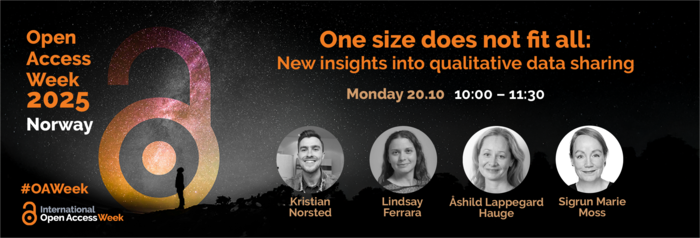
Webinar Monday October 20th, 2025
10:00-11:30 CET
Meeting ID: 611 5509 7518
Passcode: 220761
Sharing qualitative data poses many ethical, legal and practical challenges. At the same time, many qualitative datasets, for example rich interview data or video recordings, have a high reuse value and could provide unique benefits for researchers and communities when shared.
In this webinar we will be joined by three special guests from different disciplines and different areas of qualitative inquiry to discuss the unique contexts in which qualitative data sharing should not only be considered but also encouraged and those where a push for openness can lead to many ethical dilemmas or even harm.
Our answer is that one solution simply cannot fit all and qualitative data sharing should be assessed individually, taking into consideration contextual information on the background, method, research tradition and participating communities.
At the same time, we will also strive to provide here some general suggestions, guidance and/or inspiration for students, researchers and research support staff working with qualitative approaches or data sharing more broadly.