
The national research project GoNorth will conduct its fourth and final research cruise with the icebreaker RV Kronprins Haakon to the Arctic Ocean (in Norwegian Polhavet) from 27 November to 17 December 2025. The cruise will go to the sea areas north and west of Svalbard. In particular, the Eurasian Basin and the Fram Strait are areas the researchers want to learn more about.
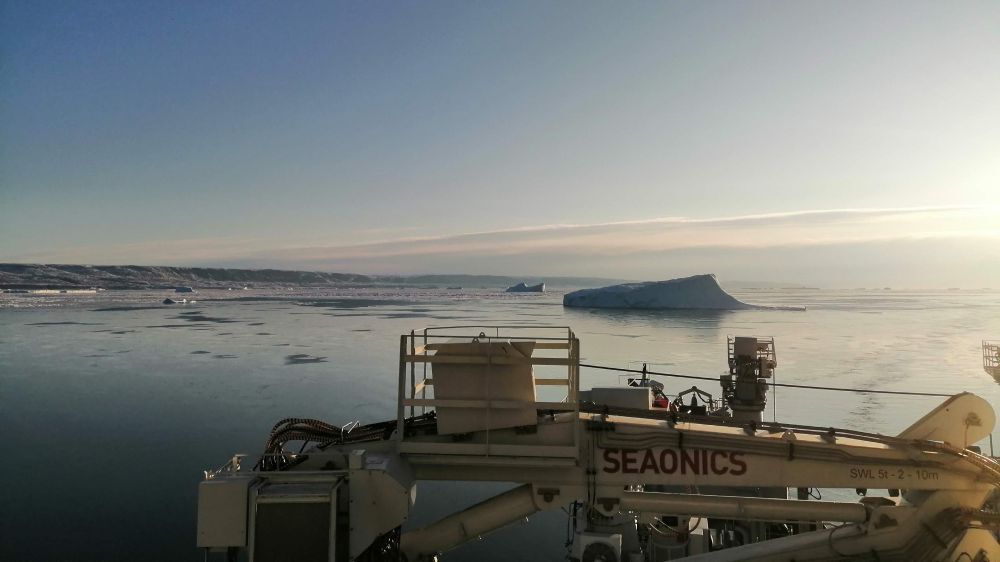
Because it is so late in the year, the cruise will not go as far as Greenland as it did in 2024 — this is due to sea ice having formed. The main objective is therefore Ultima Thule, the hydrothermal vents that researchers discovered in 2023, Daniel Albert from GoNorth says. If they get that far, there may also be challenges here with sea ice so late in the season.
Nearly 30 researchers are on the cruise, including the ROV pilots and other personnel. They represent up to 30 research projects in geology, geophysics and biology, and research on the seafloor and the deep sea.
From the Department of Geosciences, University of Oslo, Carmen Gaina and Alexander Minakov are participating in the cruise. They represent the DYPOLE project, a FRIPRO project led by Gaina, Professor of marine geophysics at the Dept. of Geosciences and the SFF Centre PHAB, one of the Norwegian Centres of Excellences (SFF).
Interaction between tectonic, magmatic and sedimentary processes and their impact on the climate

The two researchers, Gaina and Minakov, will collect samples and data for the interdisciplinary research project DYPOLE, whose full name is; Dynamics of Polar Confined Basins – The Eurasia Basin from breakup in greenhouse to present in icehouse conditions. Professor (emeritus) Jan Inge Faleide, Department of Geosciences, is also involved in the project.
One aim of DYPOLE is to gain an understanding of the complex interaction between different geological processes that have shaped the continental margin north of Svalbard/Barents Sea and adjacent areas of the Artic Ocean.
They are interested in the impact these geodynamic processes had on the climate about 55 million years ago. Key questions they ask include, among others:
- When was a deep-water connection established between the Arctic Ocean and the Atlantic Ocean through the Fram Strait, and how did this affect geological and oceanographic conditions?
- How has this development influenced the climate, from “greenhouse” conditions with surface water temperatures of up to 25°C in a closed basin to “icehouse” conditions with extensive land and sea ice cover over the last 10–15 million years?
“Understanding the past, especially during periods of rapid warming like today, is crucial for accurate predictions of future climate,” says Carmen Gaina.
The Arctic Ocean, a poorly explored area — sea ice, a challenge!
As with previous expeditions, the goal of the GoNorth cruise is to collect data and take samples to investigate geological conditions on the seafloor (continental margins, rifts and rises), take seabed samples, and look for lifeforms in the deep sea.
Research on the Arctic Ocean, especially regarding the seafloor, has relatively little data available. This is because sea ice has made — and still makes — collecting samples and data much more difficult than in other parts of the world. Other factors also play a role when planning a cruise, says Minakov.
"A research ship must be used all year round since it is very expensive to operate the icebreaker. The GoNorth project is also special because of its broad interdisciplinary collaboration, as well as the importance of collecting different types of data (biological, water samples, water chemistry and structure) all year round, to better understand how changes arising from climate change occur."

The Eurasian Basin lies between the Svalbard archipelago and the North Pole, and was formed about 53 million years ago. At that time the Arctic Ocean was more isolated than it is today, with limited water exchange with the world’s oceans. Then the Fram Strait opened — a deep channel connecting the Polhavet and the Atlantic Ocean between Greenland and Svalbard.
There is limited knowledge about how and why these plate-tectonic events that changed the shape of the basin occurred, and about the consequences they had. But research is ongoing:
“During the GoNorth cruise in 2024 the seafloor of Independence Fjord in northern Greenland was investigated. This fjord has never previously been surveyed. Sediment samples were taken from the seafloor to reveal traces of glaciers and glacial processes. This research provides insight into processes related to glacier dynamics on Greenland’s continental margin,” says Alexander Minakov. He has participated in almost all GoNorth expeditions from 2022 until the last one in 2025, with the exception of the 2023 expedition.
Follow the GoNorth-expedition 2025 here:
Also on this year’s GoNorth cruise you can follow the researchers, view photos, and receive updates about the work and life aboard the FF Kronprins Haakon:
Get daily reports from the GoNorth cruise 2025, and life on board!!
Read more about the research:
The research project DYPOLE Dynamics of polar confined basins – The Eurasia Basin from breakup in greenhouse to present in icehouse conditions.
Om GoNorth-satsningen og toktene: Exploring the Arctic Ocean - Gathering essential knowledge for responsible management of the Arctic region