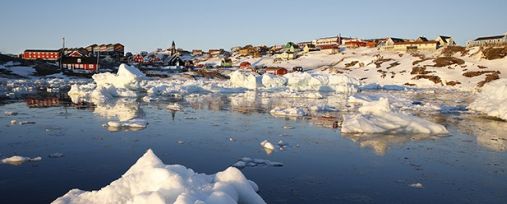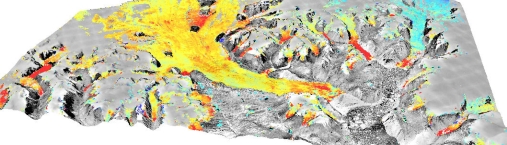
Recently, a Danish-Norwegian research team re-processed thousands of aerial photos into 3D Digital Elevation Models (DEM) surrounding the entire coastline of Greenland. The new data extends the precise geometric record of Greenland glacier margins to the late 1970s and 80s and can be used to quantify the decline in the ice mass, for example. The data is freely available to the public domain.
Research news - Page 7
International team of climate researchers reconstructs global cooling in the reign of the Roman emperor Justinian. Ice-cores and data about sulfate flux at Greenland and Artica reveils the pasts climate disasters. Their research presented at EGU 2016; Vienna recently.
Many glaciers on Svalbard behave very differently from other glaciers worldwide. They advance massively for some years and then quickly retreat – and then remain quiescent for fifty to a hundred years – before they once again start to advance.
A decrease in permafrost (cryotic soil) will follow climate change and a rise in temperature. This could have serious consequences. We might see an increase in greenhouse gasses, a greater possibility of landslides and live under the threat of monster waves.
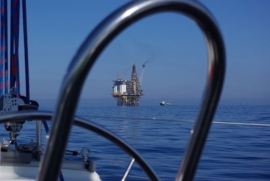
In August, Professor Emeritus Knut Bjørlykke at the Department of Geosciences finally got the result after a lot of work; A 2nd edition and expanded textbook in Petroleum Geoscience (2015). The book spans over a wide range of petroleum geology, from geophysics to sedimentary depositional environment to environmental geology. Several collegues contributed with articles in the book, which will be translated into Chinese.
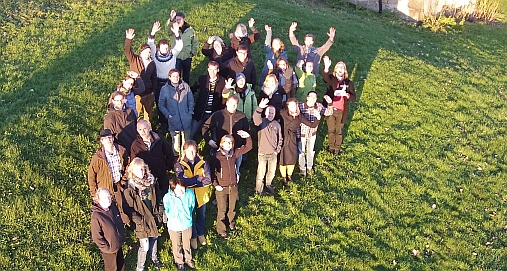
At the beginning of June, Ilulissat, Greenland, played host to the international Climate Days. The final conference of the Nordic Centre of Excellence SVALI was part of the programme.
The Department of Geosciences has been ranked high for two subject areas in the QS World University Rankings (QS) for 2015. The research environment in geography, hydrology and geomatics (picture) advanced to 50th place, and the research environment for geology ranked between 51 and 100 based on criteria such as citations and academic reputation.
After over 35 years the Chinese Chang’E-3 mission is the first to visit and land on the lunar surface. CEED, University of Oslo postdoctoral researcher Zhiyong Xiao participates in the mission team, which has just published their first results in Science this week that reveals a vivid geological picture of the landing site on the moon.
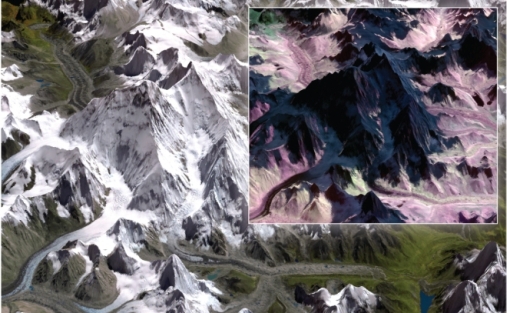
A large international study - Global Land Ice Measurements from Space (GLIMS) shows that Earth’s glaciers are shrinking with only a few exceptions. The scientists behind the study have applied satellite images to study the glaciers over the recent decades. The comprehensive report is now published as a book and an e-book.
Researchers from the project SEISMOGLAC, Department of Geosciences had good luck when they captured on film the calving of Kronebreen, one of Svalbard's fastest glaciers. They added the soundtrack of the seismic recordings. Seismic Sounds of Calving published on YouTube has now 1200 views.