.jpeg)
The paper was published the 30 April 2024 by the Hylleraas members (authors): Simen Kvaal and Thomas Bondo Pedersen in collaboration with Aleksander Wozniak (University of Warsaw) and Ludwik Adamowicz (University of Arizona).
Read the article at: https://pubs.acs.org/doi/full/10.1021/acs.jpca.4c00364
Summary/conclusion
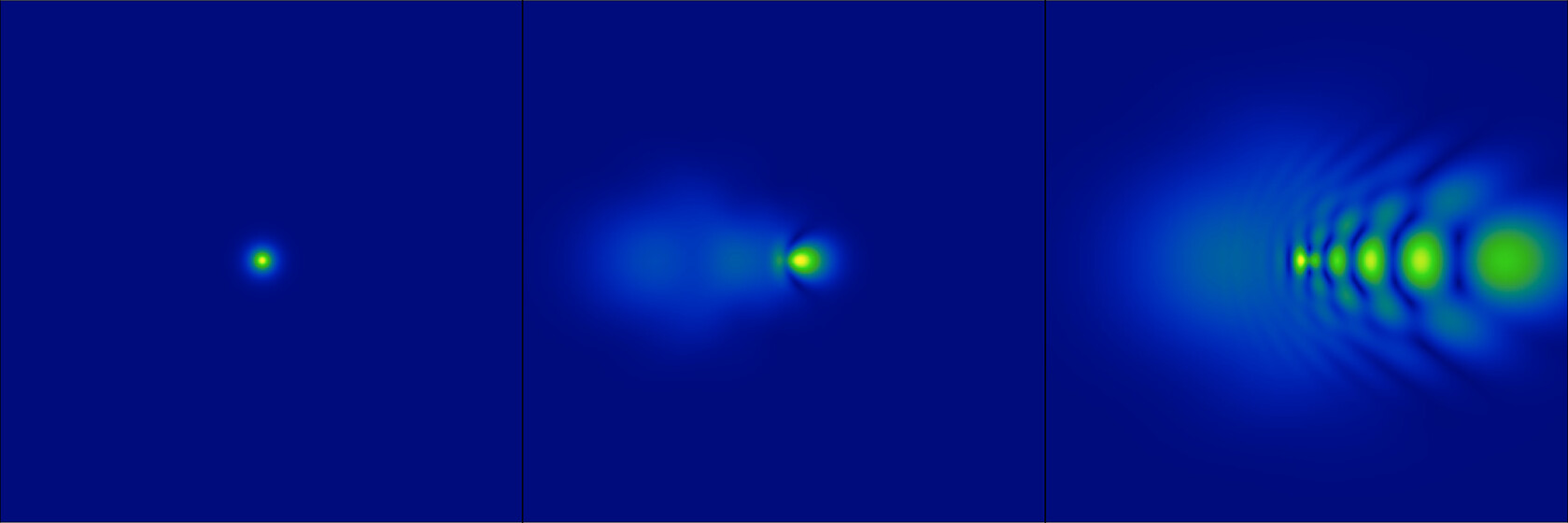
Using two-dimensional model systems mimicking a hydrogenic electron and the coupled rotational and vibrational motion of a diatomic molecule, it is demonstrated that complicated ionization and bond-dissociation dynamics induced by strong laser pulses can be accurately described using relatively few Gaussian wave packets. This is achieved by fitting linear combinations of Gaussian wave packets to high-quality grid-based solutions of the time-dependent Schrödinger equation.
The results indicate that attosecond laser-driven electronic-nuclear quantum dynamics can be simulated by generalizing existing methodology from the time-independent to the time-dependent domain without assuming the Born-Oppenheimer approximation at any stage.