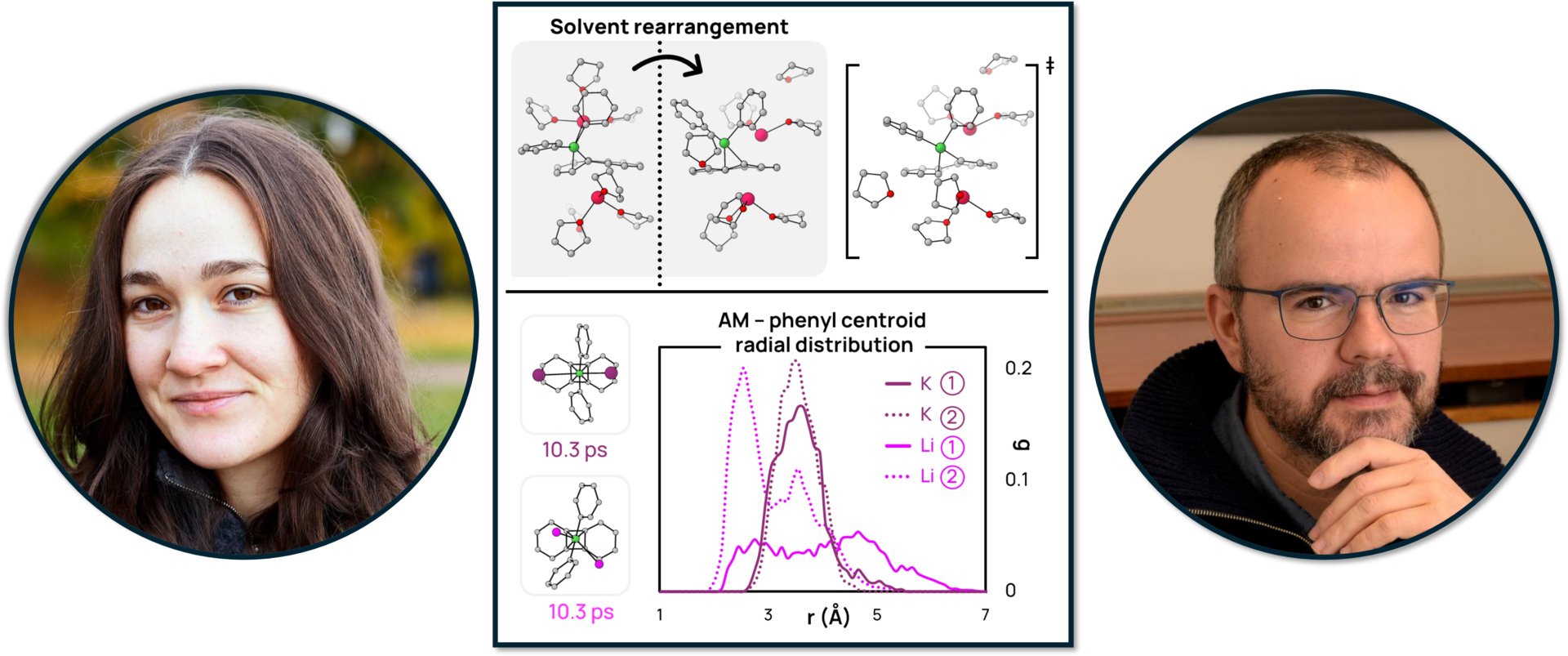
Nickelates are nickel organometallics with anionic charges that can be stabilized with alkali metal cations in various solvents. This charge density can be used to introduce unusual properties in the metal-bound ligands. For example, biphenylene, which, in neutral form is anti-aromatic, can be pushed into an aromatic dianionic state. Further, this and other ligands around the metal center, for example, anionic phenyl ligands, show interesting reactivity in C-C bond formation and cleavage reactions. Interestingly, the kinetics of these reactions are strongly dependent on the nature of the alkali metal cations that form close-contact ion pairs with the nickelates. In this work, we rationalized these properties by means of quantitative measures of aromaticity, electron donor-acceptor interactions, and solvation dynamics based on DFT calculations and AIMD simulations.
The work was carried out in collaboration with the experimental group of Eva Hevia at the University of Bern, Switzerland, including contributions from Andryj Boris and Luca Vedani.
Abstract
The pre-coordination of substrates to heterobimetallic complexes plays a key role in facilitating challenging bond activations and catalytic reactions. Herein, we report a family of low-valent phenyl-alkali-metal nickelates containing a η4-coordinated biphenylene ligand and demonstrate how the coordination and solvation preferences of the alkali-metal cation (Li, Na, or K) influence the rate of C─C bond oxidative addition at nickel through combined structural, spectroscopic and computational studies. The rate of C─C bond cleavage can be further manipulated by replacing the two phenyl-carbanionic ligands with a cyclic 2,2′-biphenyl scaffold, which affords thermally stable and symmetric spirocyclic nickelates upon ring-opening.
Reference
Borys, A. M.; Denjean, A. E. F.; Vedani, L.; Balcells, D.; Hevia, E. Biphenylene Coordination and Ring-Opening by Alkali-Metal Nickelates Angew. Chem. Int. Ed. 2025, DOI: 10.1002/anie.202501995.
First published online: 25 February 2025.