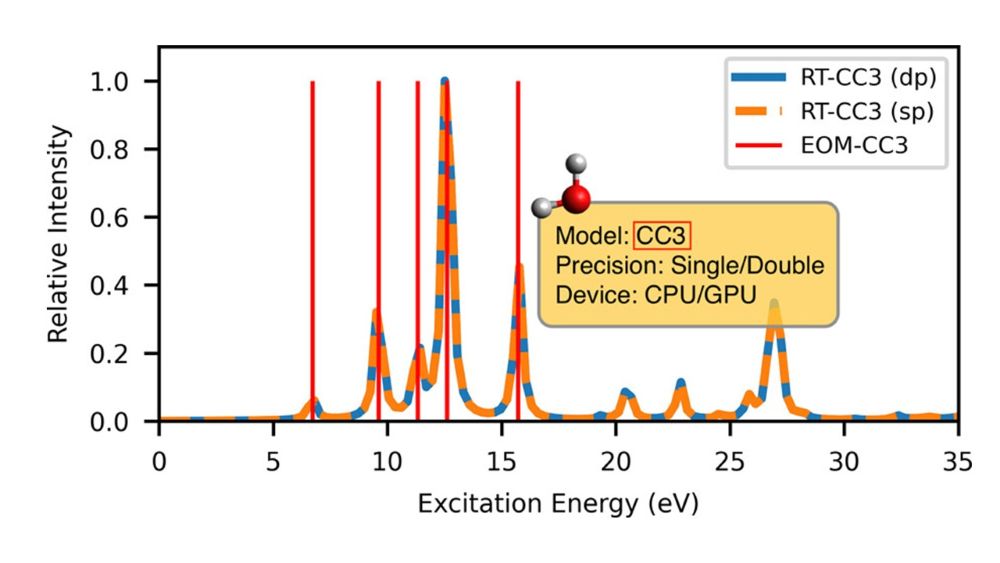
The CC3 method, which approximates the full coupled-cluster singles-doubles-and-triples method, is generally considered to be of benchmark quality for frequency-dependent molecular response properties and one- and two-photon processes.
In this paper, published in the Rodney J. Bartlett Festschrift – a Virtual Special Issue of the Journal of Physical Chemistry A honoring Prof. Rodney J. Bartlett, an explicitly time-dependent formulation and computer implementation of the CC3 method is presented. The implementation is used to compute electronic absorption spectra and linear and nonlinear optical properties, including magnetic optical rotation parameters. A key point of the paper is to reduce the significant computational cost of the CC3 method using single-precision arithmetic on Graphical Processing Units (GPUs) without significant loss of accuracy of the response properties.
Date of puplication: 8th February 2025.