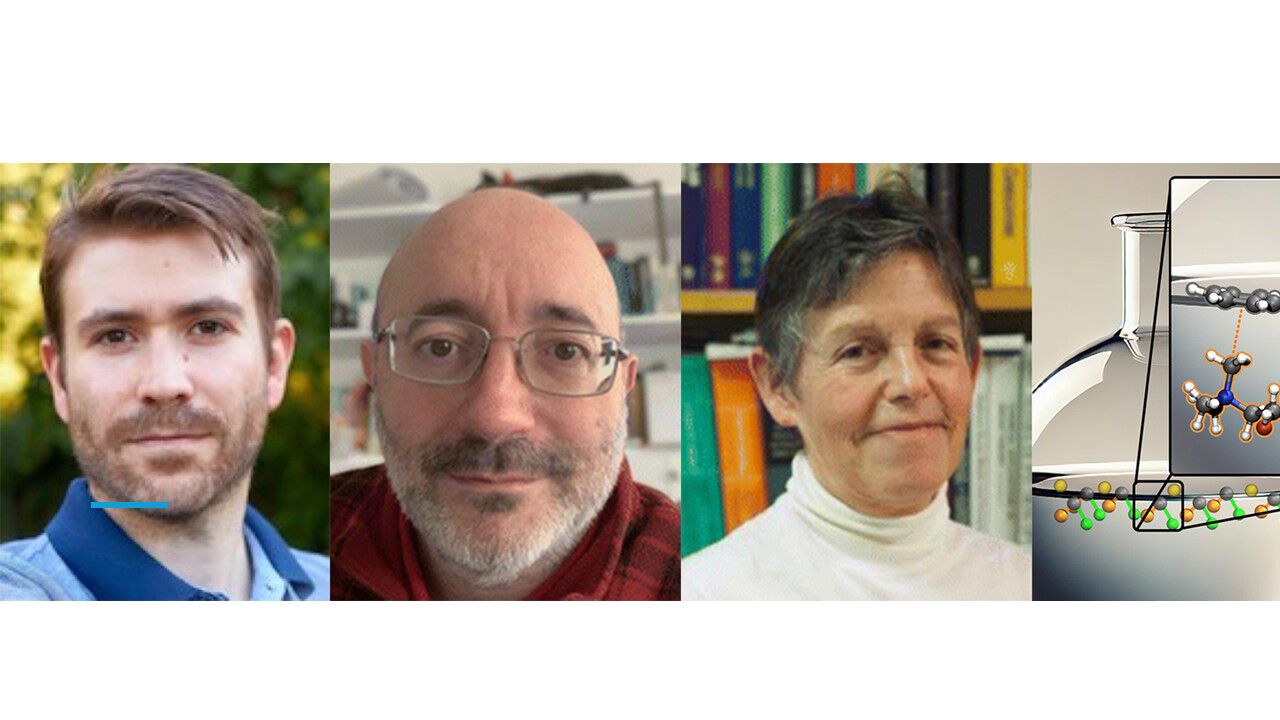
Background
Grignard chemistry is usually carried out in organic media at low temperature. Recently, the addition of Grignard solution in THF to a deep eutectic solvent showed improved reactivity and selectivity, also when working in air at room temperature. No clear explanation was given to these surprising effects.
In this work, a collaboration between experimental and theoretical work, managed to outline the fundamental principles that provide the enhanced reactivity for a mixed system containing a choline chloride and glycerol solution as the deep eutectic solvent and THF as the organic part. The combination of lab measurements and calculations unveiled a clear link between the structure of the deep eutectic solvent and the localisation of the species at the interface, both of which contribute to the observed improved effects.
Abstract
Due to their high reactivity, organolithium and organomagnesium addition to ketones is usually performed under inert atmosphere at low temperature. Recent work has shown that, by dissolving the substrate in deep eutectic solvents (DES), these processes can be carried out on the benchtop, in air at room temperature. Surprisingly, the organometallic reagent, added to the DES from an organic solution, works in these conditions and gives better yields than in the standard setup.
Here, we investigated acetophenone in a (1:2) choline chloride:glycerol (ChCl:Gly) DES solution by experimental liquid diffraction, neutron reflectometry, NMR, interfacial tension measurements, and by computational modelling.
Our data show that this DES is a poor solvent for the ketone and promotes its accumulation at the surface of the liquid or its escape into the organic solvent. Molecular dynamics simulations of Grignard reagent i-PrMgCl in the (ChCl:Gly)/tetrahydrofuran biphasic system indicate also preference for its localisation at the interface. These results pinpoint why this combination of solvents promote the reaction, require stirring, and account for the lack of rapid decomposition of the organometallic reagents.
Authors
Iva Manasi , Marco Bortoli, Daniel T. Bowron, Mario Campana, Oliver S. Hammond, Thomas F. Headen, Jake Hooton, Eva Hevia, Michele Cascella, Odile Eisenstein, and Karen J. Edler.
Read the paper
Funding
The research was funded by the Research Council of Norway through the Centre of Excellence Hylleraas Centre for Quantum Molecular Sciences (Grant Number 262695) and the Pioneer Research Grant MetalSynergy (Grant Number 314009), and of Sigma 2–the National Infrastructure for High-Performance Computing and Data Storage in Norway for computing hours and storage facilities (Grant Numbers NN4654K, NS4654K), the European Commission through the MSCA-IF RATIO (Grant Number 101059679), and computer time from the EURO-HPC JU (Grant Number EHPC-REG-2023R02-064).