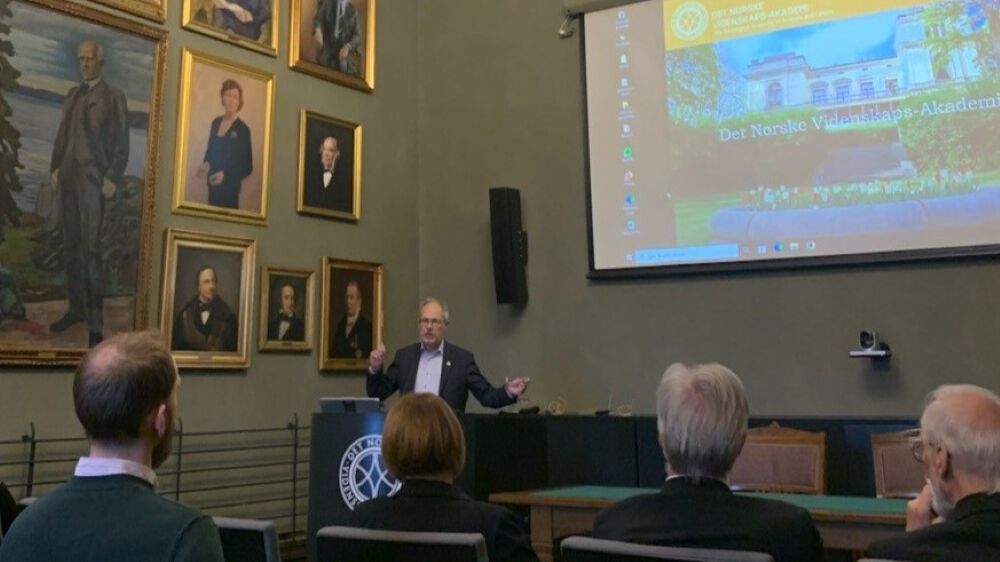
On 30 October, the Norwegian Academy of Science and Letters (DNVA) hosted a full-day interdisciplinary meeting to mark the United Nations’ International Year of Quantum Science and Technology. The meeting was held in Norwegian under the title «Kvantemekanikken 100 år: fra usikkerhetsrelasjonen til høyteknologi».
The meeting featured nine invited lectures addressing the birth of quantum mechanics around 1925, its theoretical foundations, and its central role in modern science and technology. Speakers represented a broad range of disciplines—including philosophy, history, physics, chemistry, computer science, and cryptography—highlighting the enduring reach and relevance of quantum science across fields.
The audience was broad, ranging from leading experts in the field to interested laypersons. The talks were designed to address this diversity, and the program offered both depth and accessibility, ensuring that all participants found material of interest and value.
The meeting was opened by Marit Westergaard, Secretary General of the Norwegian Academy of Science and Letters and a linguist by training. In her remarks, she drew on perspectives from linguistics to illuminate foundational questions in quantum mechanics, setting the stage for several of the themes explored throughout the day.
The first session, with contributions from Hans Herlof Grelland (University of Agder) and Trygve Helgaker (Hylleraas Centre, University of Oslo), revisited the early quantum revolution. The talks offered historical perspectives on the development of quantum mechanics and included a presentation on Egil Hylleraas, Norway’s first quantum physicist.
The second session, featuring Asle Sudbø (NTNU) and Thomas Bondo Pedersen (Hylleraas Centre, University of Oslo), focused on the scientific significance of quantum mechanics in contemporary research, ranging from first-generation quantum technologies to quantum chemistry and advanced electronic-structure simulations.
Fundamental conceptual issues formed a central theme of the meeting. In the first session after lunch, lectures by Anders Kvellestad (University of Oslo) and Jørn Kløvfell Mjelva (University of Oslo) addressed the interpretation of quantum mechanics and the nature of quantum correlations, engaging with long-standing questions that remain at the core of the theory.
The final session turned to second-generation quantum technologies, with presentations on quantum sensors (Marianne Etzelmüller Bathen, University of Oslo), quantum computing (Franz Fuchs, SINTEF), and the implications of quantum technologies for secure cryptography (Martin Strand, Norwegian Defence Research Establishment).
The meeting was well attended, with approximately 70 registered participants. Around 50 participants also took part in the concluding dinner at the Academy, which provided an opportunity for continued discussion among speakers and attendees.
The meeting was jointly organized by the Chemistry Group and the Physics Group of the Norwegian Academy of Science and Letters. The organizing committee consisted of Arne Brataas (Physics), Trygve Helgaker (Chemistry), Kenneth Ruud (Chemistry), and Susanne Viefers (Physics), with Helgaker serving as chair.
The event received financial support from the Norwegian Academy of Science and Letters and the Hylleraas Centre. Overall, the meeting offered a timely and wide-ranging perspective on quantum mechanics—as both a foundational scientific theory and a driving force behind emerging technologies in a new quantum era.