Published: 18th October 2026:
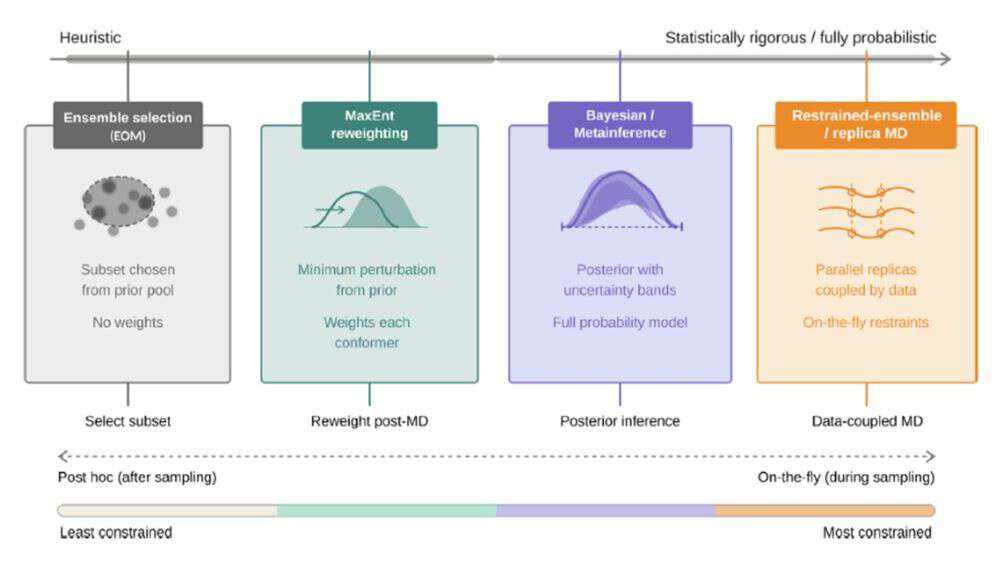
Small-angle X-ray and neutron scattering (SAXS/SANS), combined with molecular dynamics (MD) simulations, have matured into a quantitative framework for refining protein structural ensembles, supported by methodologies spanning ensemble selection, maximum-entropy reweighting, Bayesian inference, and replica-averaged restrained simulations. Their extension to lipid membranes has lagged considerably.
In this Perspective, we argue that this lag is conceptual rather than algorithmic: protein scattering reports on finite particles with a rich structural information content, whereas membrane scattering probes a quasi-two-dimensional fluctuating interface governed by collective elastic modes, with only a handful of independent structural channels accessible from the one-dimensional bilayer form factor.
Six methodological directions are identified,that together define a tractable agenda for placing membrane ensemble refinement on the same statistical footing now established for proteins.