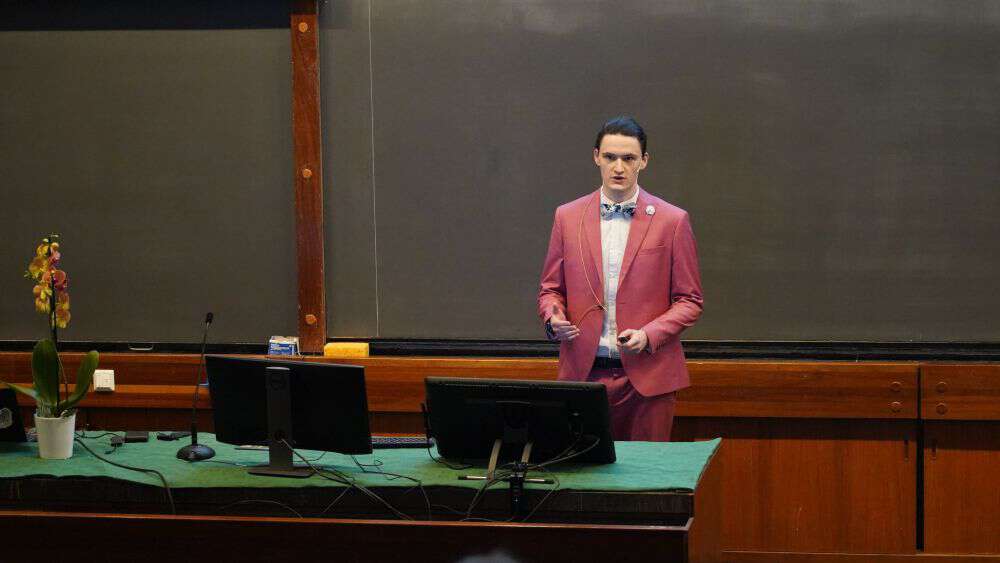
Time and place: Apr. 10, 2026 1:15 PM – 4:00 PM, Chemistry Building, UiO.
Main research findings
To understand how atoms and molecules interact with intense laser fields, one must solve the time-dependent Schrödinger equation numerically. This is computationally demanding and often requires supercomputers. This thesis presents a new computational approach to reduce that cost.
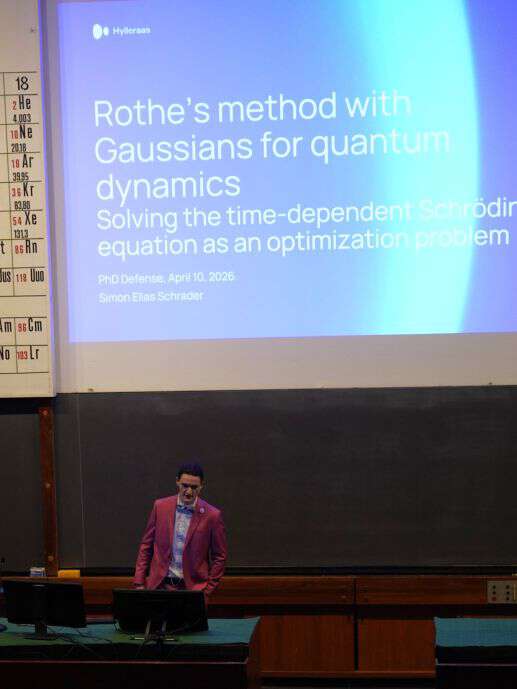
Its main result is that Rothe’s method can be successfully applied to quantum dynamics using Gaussian functions, which offer a compact representation of quantum states and are already widely used for time-independent problems.
The thesis develops the theory and computational protocols needed to apply this approach to single- and many-electron systems, including density functional theory, as well as to nuclear quantum states represented by explicitly correlated Gaussians.
Overall, Rothe’s method emerges as a viable alternative to existing frameworks for simulating time-dependent quantum states.
Committees
Chair/leader of the defense
Professor Ute Krengel. Department of Chemistry, University of Oslo, Norway.
Members of the evaluation committee
Professor Edit Mátyus (first opponent), Eötvös Loránd University, Hungary
Professor Lars Bojer Madsen (second opponent), Department of Physics and Astronomy, Aarhus Universitet, Denmark
Professor Steven Ray Haakon Wilson (administrative leader), Department of Chemistry, University of Oslo, Norway
Members of the supervisors committee
Associate professor Simen Kvaal, Department of Chemistry, University of Oslo, Norway
Professor Thomas Bondo Pedersen, Department of Chemistry, University of Oslo, Norway
Professor Morten Hjorth-Jensen, Department of Physics, University of Oslo, Norway