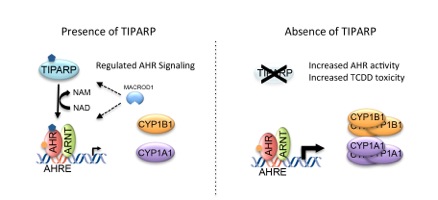
The aryl hydrocarbon receptor (AHR) is a ligand activated transcription factor that mediates the toxic effects of the environmental contaminant, dioxin. Dioxin causes a range of toxic responses in laboratory rodents, including steatohepatitis and a lethal wasting syndrome; though, the mechanisms are still unclear. In humans, AHR activation is associated with increased risk for diabetes. AHR regulates the expression of many genes including TCDD-inducible poly(ADP-ribose) polymerase (TIPARP/PARP7/ARTD14). TIPARP is a member of the PARP family of enzymes that use NAD+ as a substrate to catalyse the transfer of single units of ADP-ribose or long chains of ADP-ribose onto themselves and onto their protein substrates in processes referred to as mono- or poly-ADP-ribosylation, respectively. I will present our recent studies characterizing TIPARP activity and its role in AHR-dependent transcription and function. We have shown that TIPARP is mono-ADP-ribosyltransferase and as part of a negative feedback loop regulates AHR activity. Tiparp-/- and hepatocyte specific TiparpHep-/- mice show increased sensitivity to dioxin-induced gene expression, toxicity, steatohepatitis and lethality. The mono-ADP-ribosylase, MacroD1, reversed TIPARP-dependent ADP-ribosylation of AHR and the repressive effects of TIPARP on AHR activity. Collectively, these data reveal previously unidentified roles for TIPARP, MacroD1, and ADP-ribosylation in AHR-mediated steatohepatitis and lethality in response to dioxin, and implicate TIPARP and mono-ADP-ribosylation as key regulators of AHR-dependent transcription. On going work reveals that TIPARP also regulates the activity of other ligand activated transcription factors, in particular members of the nuclear receptor family, suggesting that TIPARP is a more general regulator of transcription factor activity.
For more info on Matthews research visit link.