Nettsider med emneord «language technology»

Research centers from across Northern Europe, the US-based Common Crawl Foundation, and the Nordic e-Infrastructure Collaboration (NeIC) work together to enable very large-scale computational experimentation in natural language processing. This one-day workshop serves to kick off the collaboration, discuss community needs, and—through an open, popular-science session towards the end of the day—generate broader visibility.
An important priority for LTG in recent years has been to create NLP resources for the Norwegian language, both in terms of modeling and datasets. This page provides an overview of our existing and ongoing projects to support Norwegian NLP.

A biweekly seminar run by and for LTG's master's students.
.jpeg?alt=listing)
NLP researchers both from and outside LTG are presenting their findings in an informal environment, followed by questions and discussions.

In joint work, SANT and NLPL/EOSC-Nordic have trained and released the first large-scale transformer-based language model for Norwegian: NorBERT!


The SANT project will be presented at the Cutting Edge Festival.

The SANT project develops resources for Sentiment Analysis for Norwegian Text. While coordinated by the Language Technology Group (LTG) at IFI/UiO, collaborating partners include NRK, Schibsted and Aller Media.
Denne sida vert dessverre ikkje vedlikehalden på norsk. Les meir frå prosjektet på den engelske prosjektsida.
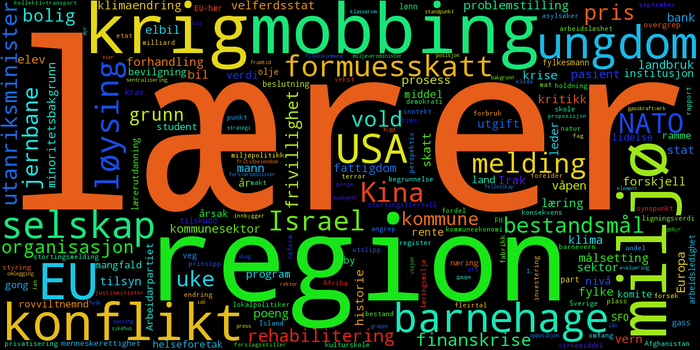
The Talk of Norway (ToN) is now publicly available.
In this ongoing cross-disciplinary collaboration, researchers in Language Technology (LT) and Political Science (PS) are applying supervised and unsupervised machine learning methods to data from the Norwegian parliament in order to gather knowledge spanning across different dimensions.
Graph representations of word embedding models: evaluating existing approaches and possible applications in language data processing and visualization.

The Language Analysis Portal gives non-technical researchers in the Humanities and Social Sciences easy-to-use access to automated language analysis tools that are invoked at the click of a few buttons and execute ‘behind the scenes’ on a national supercomputer.
The objective of this project is to create an on-line portal for language analysis, called LAP. The effort forms part of the CLARINO infrastructure project and one of the overall goals is to make language technology readily accessible and usable for researchers from the humanities and social sciences.