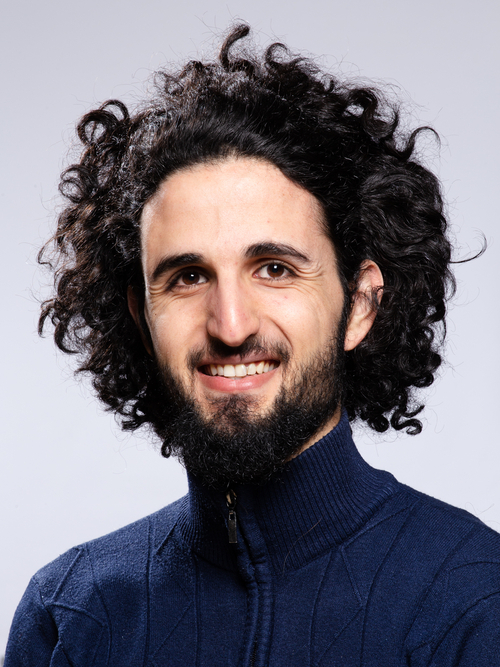
The PhD defence will be partially digital, in Kristen Nygaards sal (5370), Ole-Johan Dahls hus and streamed directly using Zoom. The host of the session will moderate the technicalities while the chair of the defence will moderate the disputation.
Ex auditorio questions: the chair of the defence will invite the attending audience at Kristen Nygaards sal to ask ex auditorio questions.
Trial lecture
"Diffusion Models"
Time and place: September 16, 2024 11:15 AM, Kristen Nygaards sal (5370), Ole-Johan Dahls hus.
Main research findings
Thanks to computing, data, and networking advances, artificial intelligence (AI), particularly machine learning (ML), has rapidly evolved and is transforming many fields, including medical sciences. In immunology, for example, researchers are working on AI-based diagnostic tools, but one major challenge remains: ensuring that these ML models work well with new, unseen data.
One promising approach to tackling the challenge of generalization involves leveraging insights from causal inference (CI). CI offers a powerful framework for understanding the data-generating process and how models behave under different conditions, such as shifts in data or potential biases. This makes it valuable for improving generalization using a systematic approach.
Another promising approach is integrating domain knowledge—information outside the raw data—into ML models. This can help enhance model performance by capturing insights not directly reflected in the dataset. Together, CI and external knowledge represent two important strategies for improving the adaptability and robustness of AI models, particularly in sensitive fields like immunodiagnostics.
This thesis focuses on these two ideas—causality and domain knowledge. It introduces a Python tool for simulating data based on causal structures and explores how causal insights can enhance ML models with the help of that tool. Finally, it investigates how external domain knowledge can improve deep learning models, with a case from immunodiagnostics.
Adjudication committee
- Associate Professor Jakub M. Tomczak, Eindhoven University of Technology, the Netherlands
- Assistant Professor Sara Magliacane, University of Amsterdam, the Netherlands
- Professor Adin Ramirez Rivera, Department of Informatics, University of Oslo, Norway
Supervisors
-
Professor Geir Kjetil Ferkingstas Sandve, Department of Informatics, University of Oslo, Norway
-
Professor Anne Helene Schistad Solberg, Department of Informatics, University of Oslo, Norway
-
Associate Professor Johan Pensar, Department of Mathematics, University of Oslo
Chair of defence:
Professor Andreas Austeng
Contact information at Department: Mozhdeh Sheibani Harat