CO2Basalt: Flow and mineral sequestration of carbon dioxide in basalts offshore Norway received funding for three early career positions funded by the Faculty of Mathematics and Natural Sciences at the University of Oslo. The main goal of CO2Basalt is to evaluate the hypothesis that the multiscale flow pathways in basalts can host voluminous flows of carbon dioxide mixed with water that will react with the host rock to produce carbonate minerals.
The CO2Basalt project is working across scales, from km-scale mapping of lineaments and fractures to reservoirs properties at mm-scale to fracture propagation at the nanoscale.
About the project
Storing carbon in basalt comes with many benefits. The CO2 will quickly react with the divalent cations (Ca2+, Mg2+, and Fe2+) from dissolving minerals in the basalt and form carbonate minerals. In comparison, it might take several thousand years for significant amounts of CO2 to mineralize in a sandstone reservoir. Once mineralized, the carbon will be immobilized over geological timescales. Storing carbon in basalt also provides large reservoir volumes worldwide. Estimates suggest that mid-ocean ridges worldwide can store up to 100,000 Gt of CO2. This is more than 2000 times the annual global emissions of CO2, and the possibilities of carbon storage in volcanic sequences are therefore important to study further.
Sketch showing carbon dioxide being injected into a basalt reservoir offshore Norway. The basalt sequence (pink, purple) is overlain by clay sediments (brown) and underlain by clastic sediments (green) that have been intruded by sills and dykes (red). Borehole 642E, drilled as part of the Ocean Drilling Program, is indicated. In the Faroe Islands, similar basaltic sequences outcrop at the surface allowing us to study them in great detail. (Rosenqvist et al., 2023).
CO2Basalt is led by Professor François Renard and will involve an interdisciplinary group of researchers in geosciences, physics, and computational science. The project involves 1) physicists and geologists of the Njord Centre at the University of Oslo; 2) the company Volcanic Basin Petroleum Research AS (VBPR), which will provide seismic data and scientific and industry cores and borehole data from the Norwegian Sea; 3) the Norwegian national infrastructure “Goldschmidt Laboratory”, hosted by UiO, which will provide microscale porosity characterization with electron microscopy; and 4) the European Synchrotron Radiation Facility (ESRF) where we will perform dynamic microtomography experiments.
Objectives
The project aims to answer the following questions:
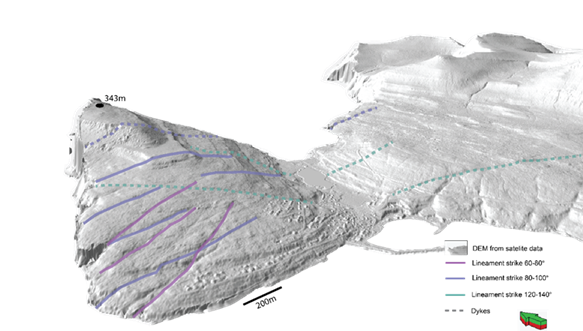
What role do fractures, and lineaments play in a potential basaltic CO2 reservoir? A site study on the Faroe Islands Basalt Group.
Figure: Largescale mapping of lineaments on Eiðiskollur, Faroe Islands (Johannesen et al. 2023)
What are the petrophysical properties of the basalts and how will these affect fluid flow migration and reactivity in a CO2 storage scenario?
Figure: CT-scan of a porous basalt showing the separated porespace (Rosenqvist et al., 2023)
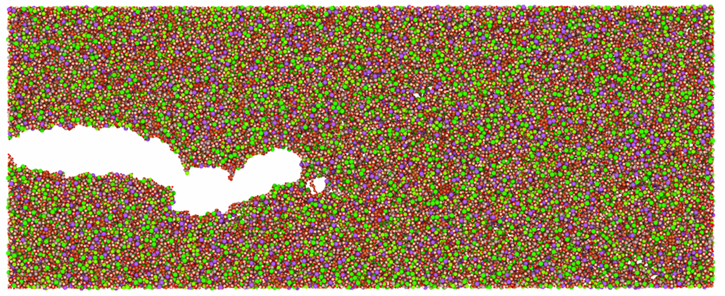
How do dynamic fractures damage basaltic glass at the nanoscale and how does the water enter these fractures in the wake of the rupture?
Figure: Nanoscale fracture propagation in basaltic glass (Guren et al., 2023).
Financing
The project is funded by the Faculty of Mathematics and Natural Sciences at the University of Oslo.
Betlem, P., Rosenqvist, M. P., Millett, J., Griffiths, L., Filina, I., Park, J., ... & Skurtveit, E. (2026). Fluid flow behaviour in vesicular basalt samples from the Skoll High, Vøring Margin. Geomechanics and Geophysics for Geo-energy and Geo-resources, 12(1), 7.
Guren, M. G., Bore, S. L., Renard, F., & Sveinsson, H. A. (2026). Energy dissipation at the atomic scale explains how fracture energy depends on crack velocity in silica glass. arXiv e-prints, arXiv-2605.
Johannesen, R. (2026). CO2 storage potential of flood basalts - A multiscale, structural reservoir study of the Faroe Island Basalt Group. PhD thesis University of Oslo, defended June 23, 2026.
Johannesen, Rakul Maria Ingunardóttir; Galland, Olivier; Kjøll, Hans Jørgen; Ólavsdóttir, Jana; Eidesgaard, Óluva & Planke, Sverre (2026). Impact of fractures on basaltic reservoirs - Field characterisation of fracture distribution in lava flows, Faroe Islands. International Journal of Greenhouse Gas Control. ISSN 1750-5836. 151. doi: 10.1016/j.ijggc.2026.104620.
Polteau, S., Craig Smalley, P., Devegowda, V. N., Johansen, I., Millett, J. M., Rosenqvist, M. P., ... & Planke, S. (2026). Well-connected basalt sequences as potential reservoirs for large-scale carbon sequestration revealed by strontium isotopes. Communications Earth & Environment, 7(1), 33.
Rosenqvist, M. (2026). Multiscale flow pathways in basalts of the North Atlantic Igneous Province. PhD thesis University of Oslo, defended September 4, 2026.
Rosenqvist, Marija Plahter; Dunkel, Kristina; Nogueira, Liebert Parreiras; Planke, Sverre; Polteau, Stephane; Ardit, M.; Nestola, F. & Menegon, Luca (2026). Natural CO2 sequestration: mechanisms and conditions of carbonate precipitation in basalt. Geochimica et Cosmochimica Acta. ISSN 0016-7037. 427, p. 381–402. doi: 10.1016/j.gca.2026.07.013.
Xu, Y., Moura, M., Flekkøy, E. G., & Måløy, K. J. (2026). A comparison of different image analysis techniques for mapping spatiotemporal pH and carbon dissolution in density-driven convection of CO2 in water. Advances in Water Resources, 105296.
Birgisson, H. Y., Xu, Y., Moura, M., Flekkøy, E. G., & Måløy, K. J. (2025). Mapping dissolved carbon in space and time: An experimental technique for the measurement of pH and total carbon concentration in density driven convection of CO2 dissolved in water. Advances in Water Resources, 198, 104916.
Johannesen, Rakul Maria Ingunardóttir; Ólavsdóttir, Jana; Boldreel, Lars Ole; Eidesgaard, Óluva; Senger, Kim & Galland, Olivier (2025). Revisiting the Stratigraphy and Structure of the Faroe Islands Flood Basalts for Large-Scale CO2 Storage in Basalt Reservoirs. Basin Research. ISSN 0950-091X. 37(3). doi: 10.1111/bre.70032.
Millett, J. M., Rossetti, L., Bischoff, A., Rossetti, M., Rosenqvist, M. P., Avseth, P., ... & Planke, S. (2024). Lava flow-hosted reservoirs: a review. In Kilhams, B., Holford, S., Gardiner, D., Gozzard, S., Layfield, L., McLean, C., Thackrey, S. and Watson, D. (eds) 2024. The Impacts of Igneous Systems on Sedimentary Basins and their Energy Resources. Geological Society, London, Special Publications, 547, 357–387.
Rosenqvist, M. P., Millett, J. M., Planke, S., Johannesen, R. M., Passey, S. R., Sørensen, E. V., ... & Jamtveit, B. (2024). The architecture of basalt reservoirs in the North Atlantic Igneous Province with implications for basalt carbon sequestration. In Kilhams, B., Holford, S., Gardiner, D., Gozzard, S., Layfield, L., McLean, C., Thackrey, S. and Watson, D. (eds) 2024. The Impacts of Igneous Systems on Sedimentary Basins and their Energy Resources. Geological Society, London, Special Publications, 547, 389–413.
Guren, Marthe Grønlie; Renard, Francois & Noiriel, Catherine (2023). Dissolution rate variability at carbonate surfaces: 4D X-ray micro-tomography and stochastic modeling investigations. Frontiers in water. 5. doi: 10.3389/frwa.2023.1185608.
Rosenqvist, M. P., Meakins, M. W., Planke, S., Millett, J. M., Kjøll, H. J., Voigt, M. J., & Jamtveit, B. (2023). Reservoir properties and reactivity of the Faroe Islands Basalt Group: Investigating the potential for CO2 storage in the North Atlantic Igneous Province. International journal of greenhouse gas control, 123, 103838.
Guren, M. G., Sveinsson, H. A., Malthe-Sørenssen, A., Caracas, R., and Renard, F. (2023). Machine-learned interatomic potentials for modelling nanoscale fracturing in silica and basalt, EGU General Assembly 2023, Vienna, Austria, EGU23-6256, https://doi.org/10.5194/egusphere-egu23-6256.
Guren, M. G., Sveinsson, H. A., Malthe-Sørensse, A., & Renard, F. (2022). Nanoscale damage production by dynamic tensile rupture in α-quartz. Geophysical Research Letters, 49(20), e2022GL100468, https://doi.org/10.1029/2022GL100468
Johannesen, R. M., Galland, Olivier, Ólavsdóttir, J., Kjøll, H. J., Eidesgaard, Ó., Planke, S. (2023). Fractures in basalt as a reservoir for permanent CO2 storage on the Faroe Islands, Nordic Geological Winter Meeting 2022, Trondheim, Norway
Planke, S., et al. (2021). Permanent Carbon Sequestration Potential in Offshore Basalt Sequences on the NW European Continental Margins. In 82nd EAGE Annual Conference & Exhibition (v. 2021, 1, pp. 1-5). European Association of Geoscientists & Engineers.
Rosenqvist, M. P., Meakins, M. W., Planke, S., Millett, J. M., Kjøll, H. J., Voigt, M. J., & Jamtveit, B. (2023). Reservoir properties and reactivity of the Faroe Islands Basalt Group: Investigating the potential for CO2 storage in the North Atlantic Igneous Province. International journal of greenhouse gas control, 123, 103838, https://doi.org/10.1016/j.ijggc.2023.103838.
PublishedJan. 20, 2022 10:06 AM
- Last modifiedOct. 15, 2026 2:36 PM