Nettsider med emneord «gravitational waves»

José Ricardo Correia arrived in Oslo in September 2025 to become a postdoctoral researcher at ITA. A Portuguese physicist with a master’s (2016) and PhD (2022) from the University of Porto, he now works with the Cosmology group to model the violent phase transitions that may have rippled through the infant Universe.

José Ricardo Correia, Institute of Theoretical Astrophysics, University of Oslo.
José Ricardo Correia, Institute of Theoretical Astrophysics, University of Oslo.
How did the universe evolve from the Big Bang to today — and why is its expansion accelerating? Professor of Cosmology David Fonseca Mota and researcher Farbod Hassani at the University of Oslo have received NOK 40 million from the Research Council to investigate these questions.

Maxence Corman, Max Planck Institute for Gravitational Physics (Albert Einstein Institute), Germany.

Stan Bentvelsen, Professor at University of Amsterdam, Scientific director, Einstein Telescope Meuse-Rhine;
Jürgen Van Gorp, Senior Project Manager, Einstein Telescope Vlaanderen.

"Being involved with science is a fulfilling endeavor, and astrophysics takes it further by exploring phenomena in both space and time" - Ana Isabel Silva Martins, new PhD student in cosmology.


Nils Siemonsen, Associate Research Scholar in the Gravity Initiative at Princeton University.

Øyvind Christiansen, Institute of Theoretical Astrophysics, University of Oslo.
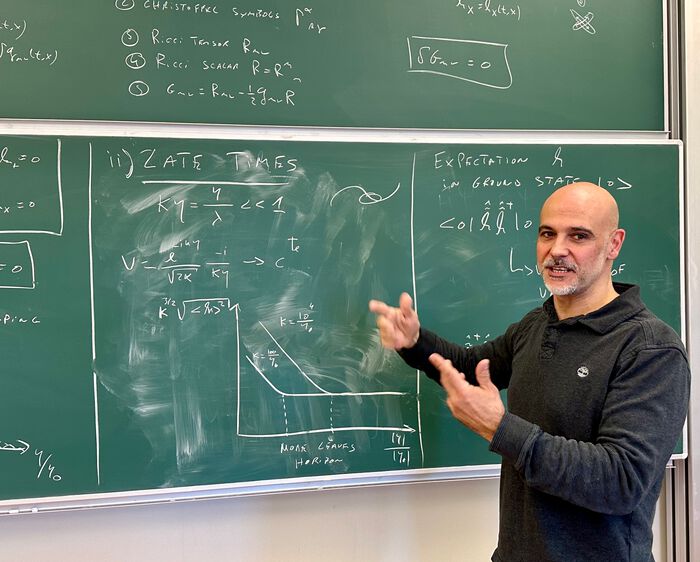
Does the universe look completely different than we have believed so far? Norwegian astrophysicists will help find out.
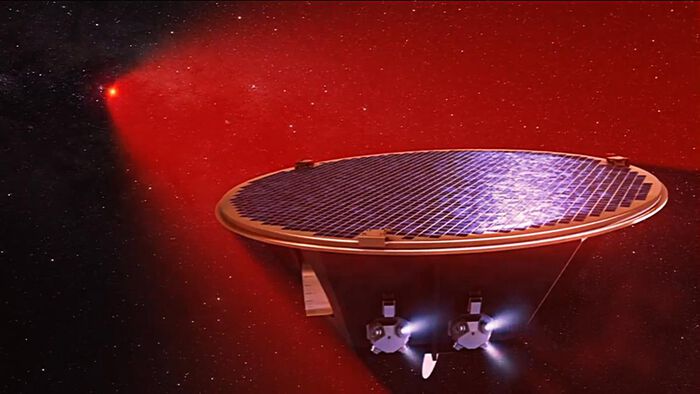
The European Space Agency has greenlit LISA, the first space-based observatory of gravitational waves. Norway joins the endeavour to detect the ripples in the fabric of space-time.

Federico Urban, Institute of Physics, Czech Academy of Sciences.

Haakon Andresen, Max Planck Institute for Gravitational Physics, Germany

Miguel Zumalacarregui, Max Planck Institute for Gravitational Physics, Germany.
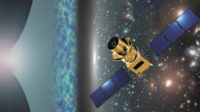
The Japanese Institute of Space and Astronautical Science has chosen for its next strategic mission LiteBIRD, a small space observatory. Six researches of the Institute of Theoretical Astrophysics are involved in the project.
David Kaplan is an associate professor at the University of Wisconsin, Milwaukee.