Previous events - Page 105
Welcome to our weekly lunch seminar held in the dScience lounge area! This event is open to PhD candidates and postdocs.
Felleskollokvium by Prof. Sverre Holm, Dept. of Physics, UiO
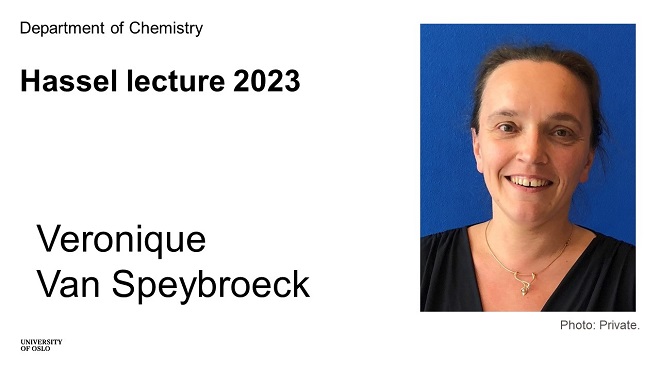
This year's Hassel lecture is headed by Professor Veronique Van Speybroeck. The first day Professor Speybroeck will present the lecture "Operando modeling of functional nanostructured materials for sustainable chemistry, nanosensing and clean energy."

by
Bill Lukens
James Madison University (USA)
Hosted by Anne Hope Jahren
Online changepoint detection algorithms based on likelihood-ratio tests have excellent statistical properties. However, a simple exact online implementation is computationally infeasible as, at time T, it involves considering O(T) possible locations for the change. To improve on this, we use functional pruning ideas to reduce the set of changepoint locations that need to be stored at time T to approximately log T. Furthermore, we show how we need only maximise the likelihood-ratio test statistic over a small subset of these possible locations. Empirical results show that the resulting exact online algorithm, which can detect changes under a wide range of models, has a constant-per-iteration cost on average. We consider applications of this algorithm in the context of detecting increases in radiation count that represent astronomical or nuclear events of interest.
Joseph Pradler, ÖAW Vienna
Weekly Theory Seminar.

Title: Using simple integrated assessment models to explore human and earth system feedbacks
Speaker: Sibel Eker, Radboud University and International Institute for Applied Systems Analysis (IIASA)

The Kolmogorov N-width describes the best possible error one can achieve by elements of an N-dimensional linear space. Its decay has extensively been studied in Approximation Theory and for the solution of Partial Differential Equations (PDEs). Particular interest has occurred within Model Order Reduction (MOR) of parameterized PDEs e.g. by the Reduced Basis Method (RBM). While it is known that the N-width decays exponentially fast (and thus admits efficient MOR) for certain problems, there are examples of the linear transport and the wave equation, where the decay rate deteriorates to N-1/2. On the other hand, it is widely accepted that a smooth parameter dependence admits a fast decay of the N-width. However, a detailed analysis of the influence of properties of the data (such as regularity or slope) on the rate of the N-width seems to lack. In this work, we use techniques from Fourier Analysis to derive exact representations of the N-width in terms of initial and boundary conditions of the linear transport equation modeled by some function g for half-wave symmetric data. For arbitrary functions g, we derive bounds and prove that these bounds are sharp. In particular, we prove that the N-width decays as cr N(-r-1/2) for functions in the Sobolev space, g ∈ Hr. Our theoretical investigations are complemented by numerical experiments which confirm the sharpness of our bounds and give additional quantitative insigh.

Employees at the University of Oslo (UiO) and Oslo University Hospital (OUS), who will relocate to the Life Sciences Building when it is completed in 2027, are invited to the seminar "How do we live together?"

Meet researchers from the University of Oslo, Oslo University Hospital and SINTEF as well as start-ups from the health incubator Aleap that are developing new sensor technology solutions for future healthcare.
The workshop Molecular Quantum Dynamics is organized as part of the Centre for Advanced Study (CAS) project Attosecond Quantum Dynamics Beyond the Born–Oppenheimer approximation, and will cover a broad range of topics. We welcome the participants to the beautiful and historical hotel Lysebu, situated at the rooftop of Oslo.

Every second Tuesday, CBA members gather for lunch and a talk. On May 23rd 2023, we have an early career presentation given by two PhD students Eira Carlsen and Elisabeth Wörner.

Communication is key - and science is no exception. We can communicate our research via written words, sounds, and visuals. Since a picture gets processed 60.000 times faster than written words, the use of visuals is the most effective way of making your audience understand your message - whether it is an oral presentation, a poster, or a paper. This course aims to teach scientists how to create and present an award-winning poster, increasing the impact of their research.

Doctoral candidate Alise Danielle Midtfjord at the Department of Mathematics will be defending the thesis Machine learning methods for safety-critical systems with time dependency for the degree of Philosophiae Doctor.

Fermi problems (also known as Fermi estimation problems or estimation problems) are a classic type of exercise that have been used in physics education for decades.
At UiO we have begun using them in our first-semester physics course as a gentle start to “thinking like a physicist." But Fermi problems can also be a rich site for building modeling skills across the STEM disciplines, and when combined with a little statistics and computation can quickly turn into simple Monte Carlo problems.
This ODD seminar will be partly a Fermi problem workshop and partly a demonstration of the new class of computational Fermi problems we are developing for our physics and STEM courses.
Also, there will be cake!
Audun Jøsang (DIS/SEC) and Magdalena Ivanovska (BI) will present the theory of subjective logic and applications of reasoning under uncertainty.
Njord Seminar with talk by:
Andreas Carlson Professor at the Department of Mathematics, UiO.
Hylleraas seminar, hosted in Oslo

PhD candidate Oliver Kersten at the Department of Biosciences will be defending the thesis "Sea Parrot Genomics: Linking past and present population structure and demography of the Atlantic puffin (Fratercula arctica)" for the degree of PhD.
Welcome to our GEOHYD Lunch Seminar Friday 12th of May @ 12:15 in Aud. 2, Geology building, or via video link using Zoom. The seminar is held by Ugo Nanni, GEO, UiO.

Doctoral candidate Emilie Willoch Olstad at the Department of Pharmacy, Faculty of Mathematics and Natural Sciences, is defending the thesis "Prenatal Medication Exposure, DNA Methylation and Child Neurodevelopment" for the degree of Philosophiae Doctor.
On Thursday the 11th of May at 13:30, we host a double AQUA/CEES seminar! Katerina Guschanski and David Richardson are visiting our department as opponents for the disputation of Oliver Kersten and they were happy to give a talk the day before.

Title: A Lagrangian view of MOSAIC, the largest polar expedition: one year of atmospheric transport in the Arctic seen through trajectories
Speaker: Silvia Bucci, University of Vienna


Welcome to our dScience lunch seminar in the Science Library! This event is open to everyone.