Arrangementer
Kommende

Join us for the launch of a new roadmap: "HOW TO" Unlock Innovation from Research-Intensive Biotechnology in Norway.
Tidligere
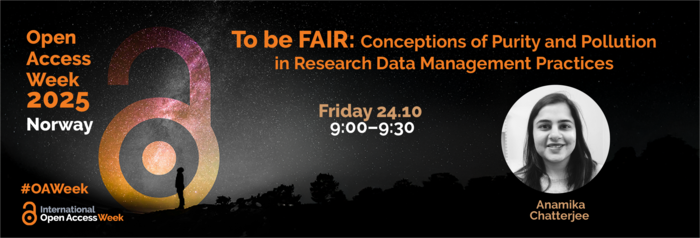
Tid og sted:
–,
webinar
Webinar Friday October 24th, 2025
09:00-09:30 CET
Teams link to the session here
Session description
Heterogeneous data management practices have left the research data ecosystem messy and cluttered, worsening the problem of data reuse.
To enable effective reuse, this ecosystem needs to be decluttered and organised. Efforts to address this include making data FAIR by promoting standard research data management practices.
Yet, while these efforts have received significant support, they have also encountered some resistance. Typically, reasons for such resistance pertain to the resource-intensive nature of data management.
In this special Open Access Week edition of the Research Data Insider, Anamika Chatterjee (PhD) will explore another reason for such resistance: scientists hold differing definitions of ‘purity’ and ‘pollution’.
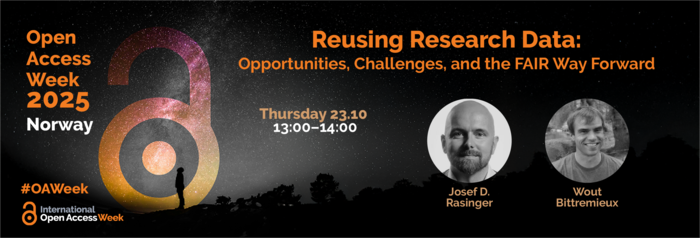
Tid og sted:
–,
webinar
Webinar Thursday October 23rd, 2025
13:00-14:00 CET
Meeting ID: 979 3586 5586
Passcode: 086300
Session description
Research funders, institutions, and academic journals increasingly require that raw data, where possible, be shared openly through public repositories. This boosts transparency and reproducibility of research, but also unlocks new possibilities through re-use, i.e. secondary data analysis.
When data is reused for purposes beyond its original intent, it can lead to unexpected breakthroughs. What’s more, by combining datasets from different sources, researchers can uncover insights no single team would have been able to achieve alone, or build consensus on complex scientific questions.
Yet, making sense of someone else’s data isn’t always easy. What are the challenges of interpreting and integrating datasets generated by others? Why is it crucial that the FAIR principles – Findable, Accessible, Interoperable, and Resuable, are followed when data are shared?
In this session, we’ll hear from two experienced practitioners of secondary data analysis. Join us to learn how FAIR data can lead to new discoveries — and what it takes to make that happen.
Tid og sted:
–,
webinar
Webinar Tuesday October 21st, 2025
10:00-11:30 CET
Teams link to the session here
Meeting ID: 395 641 130 312 3
Passcode: 4va7mi2J
Session description
Artificial intelligence is making its way into the research landscape, and in this OA week event we will explore whether it is possible to maintain open science ideals, such as openness, transparency, collaboration, and reproducibility alongside AI?
We will ask the question: How open can AI research be? Voices from several of Norway’s newly established national AI research centres will join us to discuss how they work with open science ideals.
Tid og sted:
–,
Webinar
Webinar Monday October 20th, 2025
10:00-11:30 CET
Meeting ID: 611 5509 7518
Passcode: 220761
Sharing qualitative data poses many ethical, legal and practical challenges. At the same time, many qualitative datasets, for example rich interview data or video recordings, have a high reuse value and could provide unique benefits for researchers and communities when shared.
In this webinar we will be joined by three special guests from different disciplines and different areas of qualitative inquiry to discuss the unique contexts in which qualitative data sharing should not only be considered but also encouraged and those where a push for openness can lead to many ethical dilemmas or even harm.
Our answer is that one solution simply cannot fit all and qualitative data sharing should be assessed individually, taking into consideration contextual information on the background, method, research tradition and participating communities.
At the same time, we will also strive to provide here some general suggestions, guidance and/or inspiration for students, researchers and research support staff working with qualitative approaches or data sharing more broadly.
Tid og sted:
–,
online
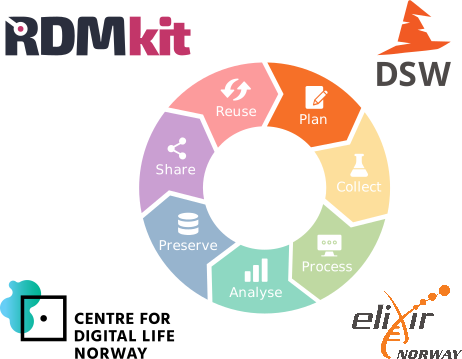
Generate a data management plan for a Life Science research project that will meet the requirements of Norwegian institutions
Tired of manually moving files? You want to be able to efficiently analyze data and create fancy plots? You want to learn programming but you do not know where to start? You would like to make your data analysis more reproducible? This is the course for you!

The final annual DLN Research School Conference for and by the members of the research school.
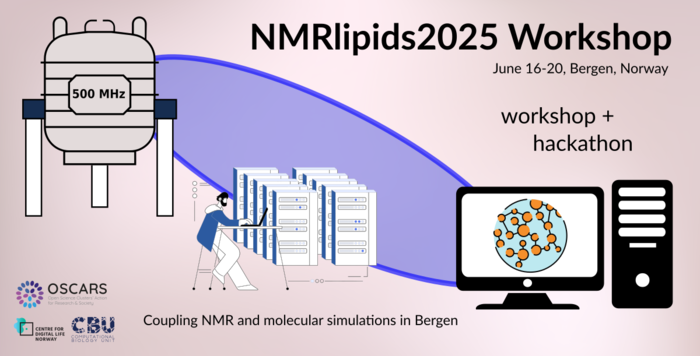
The NMRlipids 2025 Hackathon and Workshop is organized as a part of the OSCARS FAIRMD project focused on Streamlining Biomolecule Simulation Re-Use with the FAIR NMRlipids Databank. The latter is an established collaborative open-science databank maintained by the NMRlipids project. Currently, NMRlipids Databank hosts both simulation and experimental data on lipid bilayers with the extensive possibility of quality evaluation of simulations and giving both API and GUI access to the hosted data. In FAIRMD project, the databank will be extended also to intrinsically disordered proteins (IDPs).
Are you:
- working with research software or data infrastructure? - Sounds like you are the perfect person to join this event
- Struggling with a a tool for RDM? - Apply with your project and get the opportunity to work with it for three days together with a team.
- Curious about research data management and how to make the tools useful? - You’re welcome to join, just be aware that you need some programming skills for this.
Forskning spiller en nøkkelrolle i møte med globale utfordringer som klima, helse og teknologi. Hvordan bør samfunnet legge til rette for at forskning faktisk kommer til nytte? Hvilke konsekvenser får det når staten styrer forskningen gjennom finansiering? Og hva mener forskerne selv?


Tid og sted:
–,
Trondheim
DLN was funded to be a “learning arena.” In 2025, the Legacy Workshop was the concluding meeting with select members from the DLN community invited to engage in deep dives on what the centre has accomplished and critically reflect on our experiences. Together, we drew lessons that can be used to shape future national scientific partnerships and influence biotechnology in Norway in the years to come.
Tid og sted:
–,
Online
Do you want to share your research with people outside academia, but don't quite know how to do it? Then this workshop is for you.
Tid og sted:
–,
online
Generate a data management plan for a Life Science research project that will meet the requirements of Norwegian institutions
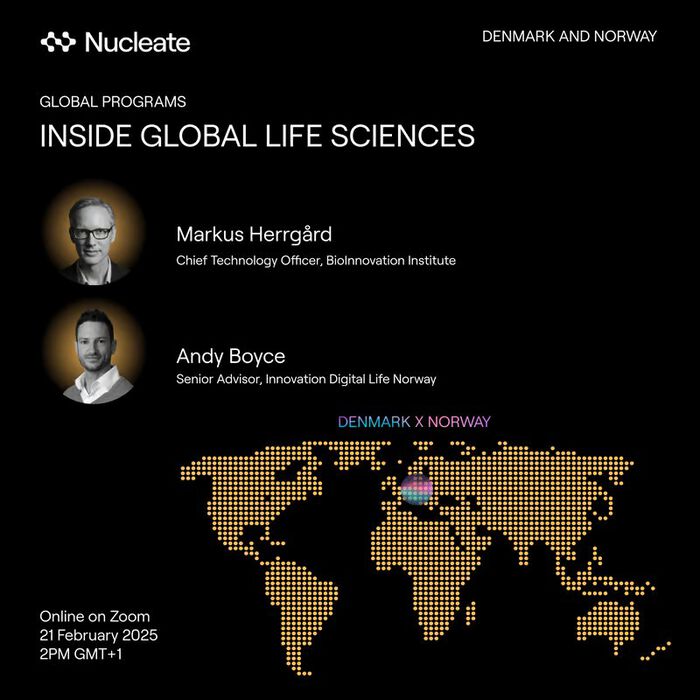
Nucleate is starting an online series called Inside Global Life Sciences. They will spotlight biotech ecosystems of various Nucleate chapters across the world, and the inaugural chat features Markus Herrgård from BioInnovation Institute and Digital Life Norway's Andy Boyce.
Under the heading "Why Innovation Is the Safer and More Fun Career Option," Andy Boyce, who works with Innovation roadmap in DLN, will present why innovation is an excellent career option for researchers. Come join us!
Tired of manually moving files? You want to be able to efficiently analyze data and create fancy plots? You want to learn programming but you do not know where to start? You would like to make your data analysis more reproducible? This is the course for you!
The annual conference for and by the members of the research school.

The annual Centre Digital Life Norway conference will be held at Hurdalsjøen Hotel October 14.-15. 2024
Tid og sted:
–,
Bergen
DLN is organizing a workshop to bring together DLN-affiliated scholars specialising in the fields of philosophy of science, and Science, Technology, and Society (STS) studies. The aim of the workshop is to inculcate the skills needed to conduct training in epistemic catharsis.
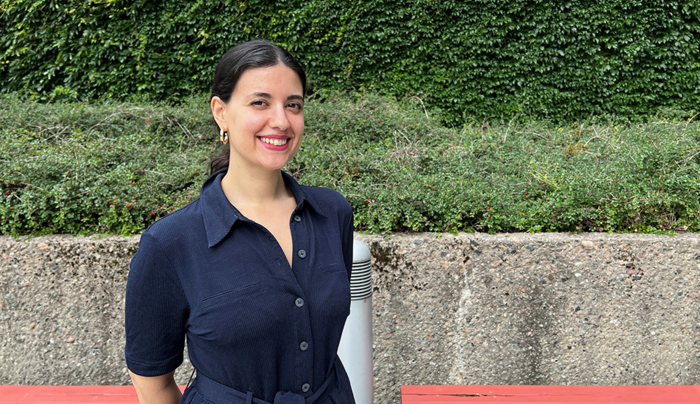
What are digital twins and how can they be used to fight cancer? Join us at the Norwegian Museum of Science and Technology (Teknisk museum) when DLN project Druglogics’ Eirini Tsirvouli talks about her research on digital twins and treating patients based on computer models!