Webpages tagged with «CERN»
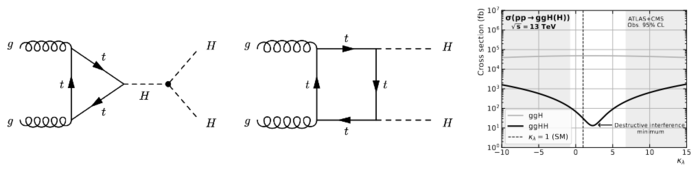
After the discovery of the Higgs boson by the ATLAS and CMS experiments at the Large Hadron Collider, one of the major challenges in high energy physics is to confirm the form of the Higgs potential energy term in the Lagrangian of the Standard Model of fundamental particles and interactions and test the universality of the Higgs self-coupling parameter λ. This is done by observing and measuring a significant excess of events with two Higgs bosons in the final state above the background. In Oslo we focus on applying cutting-edge machine learning to final states where one of the Higgs bosons decays to two photons and the second boson decays via pairs of τ leptons or W or Z bosons to various combinations of leptons.
Open charm mesons, such as the D0, have not been measured yet in heavy-ion collisions in the CERN-SPS energy domain. The recent upgrade of the NA61/SHINE experiment will allow this for the first time, adding strong constrains on the searches for the critical point of the phase diagram of nuclear matter.


/qcd-phase-diagram.jpg?alt=listing)
Ultra-relativistic heavy-ion collisions offer a unique opportunity to study the nuclear phase diagram at high temperatures and densities. The matter under such extreme conditions probably has existed in the early Universe within the first few fm/c after the Big Bang. Therefore, it is very tempting to investigate the properties of the Little Big Bang in the laboratory, and to search for a new state of matter, predicted by the fundamental theory of strong interactions - Quantum Chromodynamics (QCD), namely, a plasma of deconfined quarks and gluons or quark-gluon plasma (QGP).