
About the group

The Section for Biophysics and Medical Physics at the University of Oslo conducts interdisciplinary research at the interface of physics, biology, and medicine. The effects of ionizing radiation are a common factor in most of our research, which is focused on understanding, modeling, and improving the biological effectiveness and safety of ionizing radiation in medical and space-related applications.
Our aim is to understand the fundamental interactions between ionizing radiation and biological matter in order to better utilize radiation in cancer treatment and to improve the assessment of health effects following exposure to low dose and low dose-rate radiation. By combining experimental radiobiology, advanced radiation technologies, and state-of-the-art simulations, our research converges on improving radiotherapy—both as a standalone treatment and in combination with immunotherapy or other drugs—for more effective cancer treatment with fewer side effects.
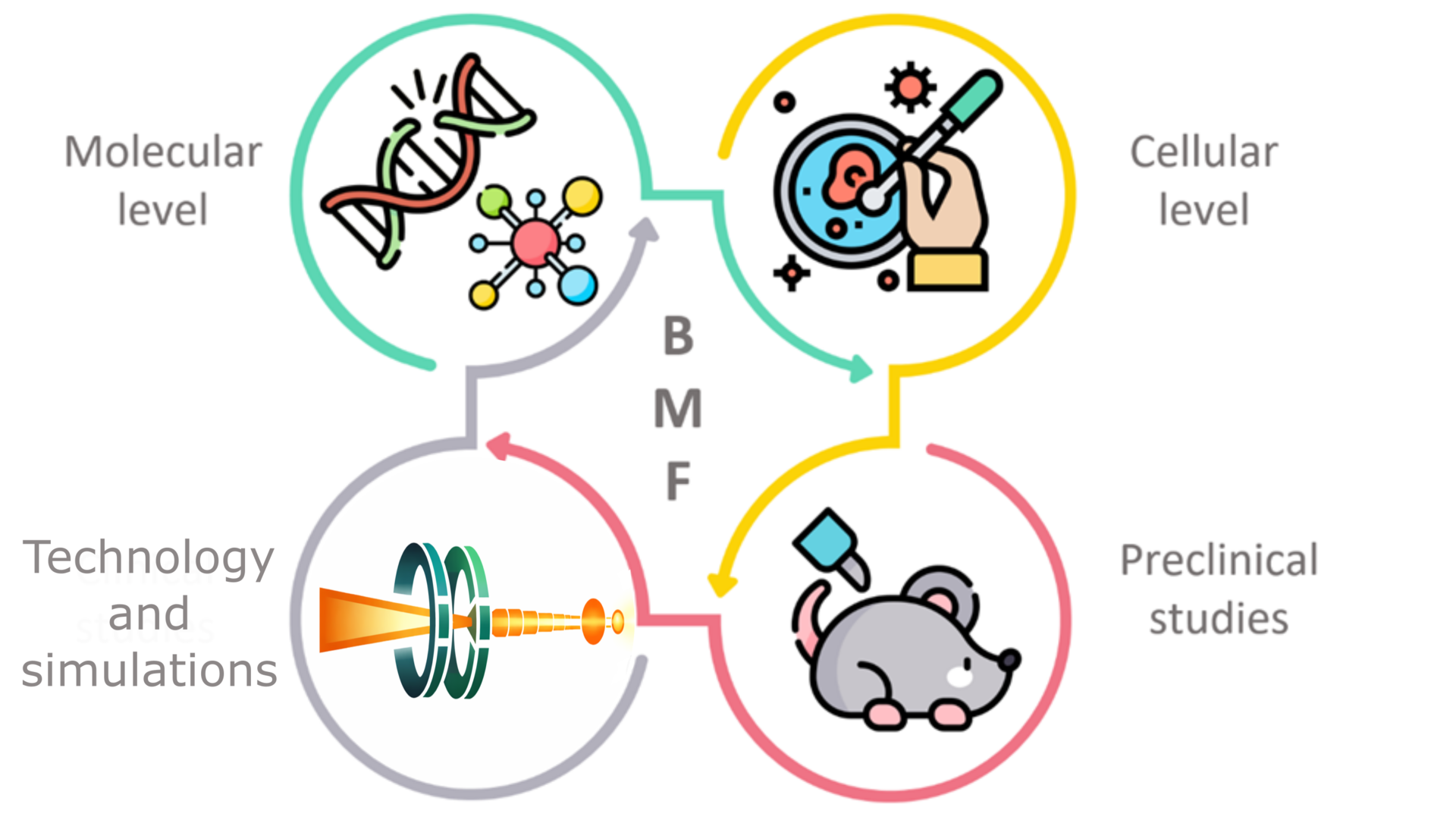
The BMF group is involved in research on the effects of ionizing radiation across all biological levels, including molecular, cellular, preclinical, and clinical studies, with primary focus on the molecular, cellular, and preclinical scales. We place strong emphasis on dosimetry and radiation quality, integrating experimental activities with simulations and modeling.
Research Focus
Our research spans fundamental mechanisms, technology development, and translational applications of radiation in medicine and space.
Our key research questions are:
How can radiotherapy enhance immunotherapy?
We investigate how radiation can be used to stimulate anti-tumor immune responses, with particular focus on spatially fractionated irradiation using protons and helium ions. By targeting only specific regions of the tumor rather than irradiating the entire volume, immune cells can be preserved and activated, potentially improving the effectiveness of immunotherapy.
How can new radiation technologies improve treatment precision and safety?
We develop and evaluate technologies for spatial fractionation and ultra-high dose rate (FLASH) radiotherapy, including beam shaping, beam sharpening, and advanced dosimetry systems. These developments are applied at the cyclotron facilities at the Department of Physics and at the proton therapy center at the Radium Hospital, using both protons and helium ions.
How can late effects after cancer treatment be reduced?
We study the biological mechanisms underlying late radiation effects and their potential link to accelerated aging. This includes testing mitigation strategies and interventions developed in aging research in irradiated animal models and patient-related studies, with the goal of improving long-term quality of life after cancer therapy.
What drives radiation resistance, and how can it be overcome?
We aim to better understand the molecular and cellular mechanisms responsible for radiation resistance. Identifying these mechanisms may reveal targets for novel drugs to protect or rescue individuals exposed to high doses of radiation, including in accidental or medical exposure scenarios.
What are the biological effects of low-dose ion radiation?
We investigate the effects of low-dose and low dose-rate exposure to ions such as protons, alpha particles, and carbon ions, with relevance for radiation protection in human space travel and for terrestrial exposure scenarios such as radon.
Building on these key questions, research areas include:
Radiobiology of Particle Radiation
We investigate cellular, molecular, and tissue-level responses to photons, protons, and heavier ions, with emphasis on DNA damage induction and repair, cell survival, normal tissue toxicity, immune signaling, and tumor response.
Advanced Particle and Proton Therapy Concepts
Our work supports the development and biological evaluation of novel radiation therapy approaches, including:
Spatially fractionated radiation therapy (SFRT)
Studying minibeam and microbeam irradiation concepts to exploit spatial dose modulation for improved normal tissue sparing.
FLASH radiotherapy
Investigating ultra-high dose rate irradiation, focusing on biological mechanisms, normal tissue protection, and translational potential.
Combination treatments
Exploring interactions between radiation and immunotherapy or other systemic treatments to enhance therapeutic efficacy.
Radiation Protection and Risk Assessment
We study radiation-induced health risks relevant to both medical exposures and human space flight, including exposure to complex mixed radiation fields. This includes biological effectiveness, dose-response relationships, and uncertainties associated with space radiation environments.
Modeling and Simulation
Computational methods are a central pillar of the group’s research, covering:
- Monte Carlo simulations for radiation transport and dosimetry
- Micro- and nanodosimetric modeling to link physical dose patterns to biological effects
- Radiobiological modeling across different dose rates and spatial dose distributions
- Support of therapy planning and treatment optimization, including advanced proton and particle therapy concepts
These simulations are closely integrated with experimental and translational studies.
Experimental Infrastructure and Collaborations
Our research is supported by access to a broad range of irradiation facilities and experimental platforms through strong national and international collaborations:
- Radiobiology laboratories at UiO, with facilities for in vitro and in vivo radiobiological experiments. For more information see the cell-laboratory webpage
- Cyclotron facilities at UiO, enabling experimental studies with charged particles.
- Proton Center at the Radium Hospital, Oslo University Hospital, access to clinical proton therapy infrastructure for translational research and animal stalling.
- MiniBEE beamline at Helmholtz-Zentrum Berlin, a dedicated beamline for spatially fractionated particle irradiation.
- Millipede beamline at IBC, Helmholtz-Zentrum Dresden-Rossendorf, for high-precision irradiation in radiobiological studies using ions from proton to carbon.
- BioMicro beamline at IBC, Helmholtz-Zentrum Dresden-Rossendorf, Microbeam-based investigations of radiation response.
Academic programmes and courses
Our masterstudents are part of the Master program in Physics, with the programme option Biological and Medical Physics.
The bachelor course FYS3700 (Biophysics and Medical Physics) is taught in the fall and can also be part of the master curriculum (FYS4700)
Master courses / phd courses - given by, or in close collaboration with, the BMF group:
| FYS4711 / FYS9711 | Radiation and dosimetry | fall |
| FYS4720 / FYS9720 | Cellular radiobiology | fall |
| FYS4730 / FYS9730 | Medical radiation physics for radiotherapy | spring |
| FYS4740 / FYS9740 | MR-theory and medical diagnostics | spring |
| FYS4250 / FYS9250 | Biomedical instrumentation | fall |
| FYS4762 / FYS9762 | Medical imaging with ionising radiation | spring |