News and "In media" articles where researchers from the Section for Study of Sedimentary Basins have contributed. The list is not exhaustive and postings are mostly Norwegian.
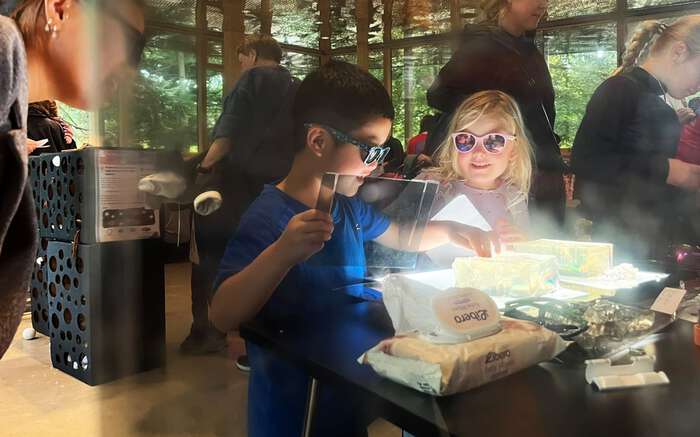
Through experiments and play, researchers from the University of Oslo brought geoscience closer to visitors of all ages. The event took place at the Climate House, with several stations offering interactive activities and workshops. Many happy 3–6-year-olds enjoyed Trust the Rocks! that day!
Masterstudent i geofag ved UiO eller UiB, eller representant for en studentgruppe? Søk stipend fra Professor Annik M. Myhres stiftelse for geofagstudenter innen 15. oktober. Les mer her.
Da Ole-Jacob Evensen startet på masterstudiet ved Institutt for geofag, fant han drømmeprosjektet på listen over ledige oppgaver: feltarbeid i Patagonia for å undersøke gamle vulkansystemer.
A new study explains how kilometre-scale mud flows form at some of the world’s largest mud volcanoes. Evidence from the Lokbatan mud volcano in Azerbaijan shows that massive mud flows do not necessarily originate from single catastrophic eruptions, but instead grow gradually through repeated slow creep triggered by smaller eruptive events.
Norsk Geofysisk Forenings konferanse samlet 80 geofysikere fra hele landet i Georg Sverdrups hus 10.–12. juni, med presentasjoner av ny forskning, postersesjoner og diskusjoner. Vertskap var Universitetet i Oslo, og lokale koordinatorer var Britta Schäfer (GEO) og Vemund S. Thorkildsen (ITS).
The consequences of volcanic eruptions can be severe. Now researchers at the University of Oslo have made a surprising discovery: magma pressure can fold solid rock in less than a single day. They found the evidence on a mountainside.
The Arctic is warming far faster than the rest of the planet. A new study shows that gas hydrates are being exposed and releasing oil and methane from the seafloor off northeastern Greenland. Scientists, including Adriano Mazzini, Dept. of Geosciences, document hydrocarbon seepage that could impact marine ecosystems and the Arctic carbon cycle; the study has attracted media attention.
GoNorth has released a short film featuring interviews and insights from GoNorth’s research expedition in the Arctic Ocean (27 November–17 December 2025). Among those interviewed is Professor Carmen Gaina (University of Oslo, UiO/GEO/PHAB). The film was produced by NORCE and is available on Vimeo.
It is nearing the end of GoNorth’s research cruise in the Arctic Ocean. Recently, researchers Carmen Gaina and Alexander Minakov (University of Oslo) and Thomas Funck (GEUS) succeeded in collecting seismic data and ROV images from the Polarstern seamount in the deep sea.
The fourth expedition to the Arctic Ocean in the GoNorth initiative takes place in November–December. UiO researchers Carmen Gaina and Alexander Minakov are participating with research on the processes that shaped the Arctic Basin from 55 million years ago and their impact on the climate.