Proteomics
The proteome is defined as all the proteins related to a genome; in fact, due to processes such as alternative splicing and post-translational modifications, the proteome is even more complex that its corresponding genome. Proteomics is the study of the proteome and aims to describe and characterise all of the expressed proteins in a biological system.
Body fluid proteomics
Proteomics can be immensely useful in the discovery and detection of protein biomarkers. Many biomarker candidates have been explored in various studies in recent years, but the journey from discovery to approval and clinical use is steep. A biofluid is any fluid that a biological organism excretes or secretes. For humans this includes i.e. cerebrospinal fluid (CSF), blood, saliva, tears, and urine, to name the beast studied body fluids. They are predominantly comprised of water, but also contain proteins, lipids, salts, metabolites, sometimes cells, and more. Biofluids can be collected through various means, ranging from non invasive methods for fluids such as saliva, tears and urine, to microinvasive techniques as for blood, to highly invasive methods as for CSF.
Tears are a combination of secretions from the lacrimal gland, cornea, and goblet cells among others. They create a film over the ocular surface that helps focus light, and in addition protects the eye from drying out and against pathogens. The main use of tears in proteomics is to detect protein biomarkers that are related to various eye diseases.
Blood is a complex mixture of cells, proteins, and other components. The cellular components of blood are mainly the erythrocytes involved in oxygen transport, leukocytes involved in the immune system, and thrombocytes involved in wound healing. One of the main functions of the circulatory system is transporting substances, such as metabolites, gasses, ions, and waste, to and from all parts of the body. By its very nature, this far-reaching network thus accumulates the proteome of virtually all tissues, making blood possibly the most complex body fluid in the field of proteomics. Blood is for this reason highly prominent in clinical research and practice. Typically, the liquid portion of blood is collected, either as plasma or serum. However, the dynamic range, i.e. the ratio between the least and most abundant proteins, can be up to 12 orders of magnitude. The primary contributors to this large difference in range are albumin, apolipoproteins, complement factors, globulins, and immunoglobulins. The 22 most abundant proteins make up ∼99% of the plasma proteome mass, but the remaining 1% contains a few thousands other proteins known to be present in plasma. The comprehensive analysis of the less abundant proteins is one of the biggest challenes of mass spectremetry-based proteomics.
Therapeutic proteins
Therapeutic proteins are attractive agents against different diseases such as cancer, due to their high target specificity and minimal toxicity in comparison to small-molecule drugs. Of those, monoclonal antibodies (mAbs) and related products are the fastest growing class of therapeutic agents. Most therapeutic proteins are produced by recombinant DNA technology and purified from cells (often Chinese ovarian hamster cells), followed by product manufacturing in bioreactors and subsequent several steps of product purification. The production of therapeutic proteins can be associated with the generation of very similar protein forms, due to posttranslational modifications (PTMs) and single variant amino acids (SVA). Some of these results in poorly effective or even harmful products. Furthermore, impurities such as host cell proteins (HCPs) can remain from the production process. HCPs can be immunogenic, and biologically or enzymatically active with the potential to degrade either product molecules or excipients used in drug formulation. Consequently, HCPs, some PTMs and SVAs are classified as critical quality attributes in therapeutic mAb manufacturing. Therefore, protein analytical tools such as LCMS are required to guarantee the qualitative and quantitative detection of HCPs and protein variants.
Proteomics platform at IBV/UiO
The proteomics group uses a variety of techniques in their examination of therapeutic proteins and body fluid proteomes. An overall view of the proteomics platform is shown in the figure below, followed by brief descriptions of the techniques involved.
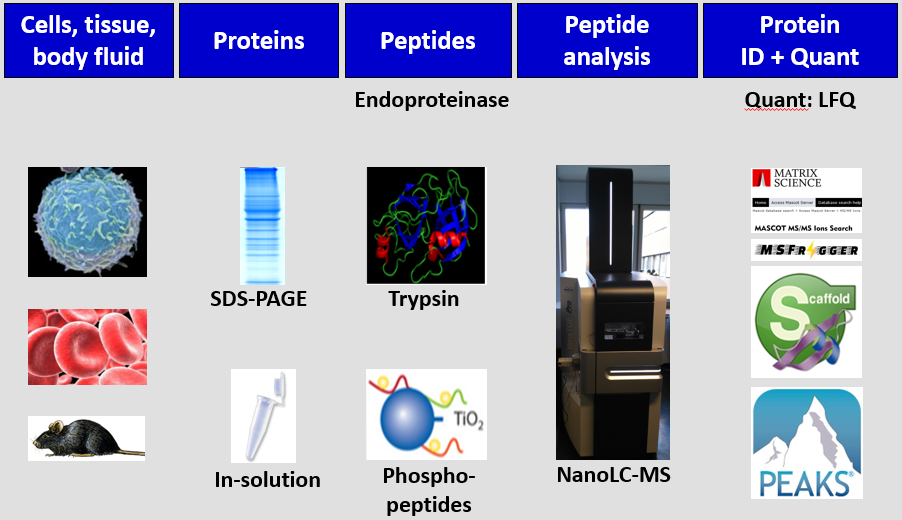
- Model organism - human tumour cell lines and body fluids.
- Protein separations - liquid chromatography; gel electrophoresis.
- Protein identification - by mass spectrometry:
- ESI mass spectrometry - used to identify complex protein samples, usually by direct coupling to nano-liquid chromatography, by sequencing with tandem-MS (MS/MS). Currently, we have a TimsTOF Pro system.
- Quantitative protein analysis:
- LFQ (Label-free quantification) - no labeling required.
- Posttranslational modifications: co-immunoprecipitation; affinity chromatography; IMAC-TiO2 beads; phosphoproteomics, glycopeptide analysis.
- Protein-protein interactions: co-immunoprecipitation. This technique is used in combination with proteomics approaches.
- Bioinformatics - several bioinformatics tools are used for handling and analysing the comprehensive data: Mascot; MSFragger; Scaffold; MaxQuant; and PEAKS.
- Proteomics databases: consolidation of published proteomics data (cancerproteomics.uio.no).
- IsobariQ - software designed by Thiede Group for relative quantification of IPTL, iTRAQ or TMT labelled peptides (download software).
Proteomics Service
The Thiede group also runs the UiO Proteomics Core Facility, with services available for both internal and external customers.