Tidligere arrangementer - Side 3
Decoupling Inter-Layer Communication in FPGA-Based Spiking CNNs
.jpg?alt=listing)
Fysisk institutt ønsker velkommen til årets bachelorseremoni. Seremonien er for alle som fullfører bachelorgraden i år, eller som er nær å fullføre og tilhører 2023-kullet.

All master's students at the Department of Physics who finish their degree in 2026, or who have already finished, are invited to a Ceremony to celebrate.
Self-Supervised Multi-Resolution Partitioning of Marine Acoustic Semantics
Predicting Transport Properties of Porous Media Using Neural Networks

Er det vanskelig å finne tid til å skrive? Akademisk skrivesenter arrangerer felles, strukturert skrivetid for stipendiater og postdoktorer.
CIPHER: AI-assisted identification & analysis of coordinated foreign influence and disinformation
2D Velocity Vector Estimation in Ultrasound Using Data-Adaptive Methods
Design of a Low-Cost Free Space Optical Communications System with Micro-Electro-Mechanical Systems Mirrors
Dark matter searches in two-lepton final states with missing transverse energy using ATLAS open data
An implementation of Floating Gate memories for weight retention in a Pulse Width Modulated Analog Neuron
Characterisation and Reconstruction of Transverse Focusing Gradients in a Nonlinear Active Plasma Lens

Kunstig intelligens krever store mengder energi, vann og naturressurser. Samtidig kan teknologien bidra til utslippskutt og grønn innovasjon. Hva betyr dette for klima, natur og norske veivalg?
AutoEuler - A Python Package for High-Throughput Euler Charge Computations
Indirectly probing new physics with dark matter
AI-based Image Analysis of Tumour Biopsies from Prostate Cancer Patients
Towards Ultra-High-Resolution Prediction of Arctic Sea Ice Drift Leveraging Synthetic Aperture Radar
Physics-Informed Graph Neural Networks for Fast Electromagnetic-Thermal Simulation of Induction Heating

I denne workshopen får du hjelp og veiledning til å planlegge hverandrevurderingsaktiviteter i undervisningen, både med og uten Feedback Fruits.

Nuclear excitation functions for natTa(p, x) reactions with focus on the medical candidates 177Ta and 178Ta

The Sensor Decade is back! Stay tuned for 3 & 4 June 2026.
Is there anything specific you’d like to learn more about, someone you’d like to hear from on stage, or themes you’re interested in? Or maybe you’d like to contribute yourself to next year’s edition of The Sensor Decade? If so, don’t hesitate to reach out to the head of the technical committee, Frøydis Sved Skottvoll.

Join us to hear from an expert in research ethics about self-plagiarism and why it is a misleading concept!

Preparedness and solutions that can be used in health care as well as in defence – so called dual-use technologies – have become more relevant. The European Defence Fund is one of the relevant funding sources for researchers and startups.
Doctoral candidate Andreas Grøvan Aspaas at the Department of Geosciences, Faculty of Mathematics and Natural Sciences, is defending the thesis Creep bursts in landslides - Characterization and modeling of transient deformations for the degree of Philosophiae Doctor.

The 10th Workshop on Nuclear Level Density and Gamma Strength will be held in-person in Oslo from the 18th to the 22nd May.
Artificial Intelligence is not just a technological shift: it is quietly reshaping the foundations of democracy. From access to information to political participation, AI holds the power to both empower citizens and distort public discourse. Where does opportunity end, and erosion begin?
I denne REALe praten kommer professor Guttorm Sindre fra NTNU og forteller om en innovativ vurderingsform i et grunnkurs i programmering, IT1001. Vurderingen i emnet gjennomføres som en mestringsstige der studentene selv bestemmer hvilket ambisjonsnivå de har. Denne REALe praten holdes digitalt.

Each spring, near the date of Svein Rosseland's birthday, the Institute of Theoretical Astrophysics invites everyone to a guest lecture as a remembrance for the great astrophysicist Svein Rosseland (1894-1985), founder of our institute.

Join us for a lunch seminar with Naomi Lintvedt in the Science Library, where she will talk about how social robots designed as companions can intrude on human privacy, autonomy, and well-being, and how these risks can be reduced.
Takashi Toma, Kanazawa University
Weekly Theory Seminar.
By Associate Professor Anja Kohfeldt, Department of Technology Systems (ITS), UiO
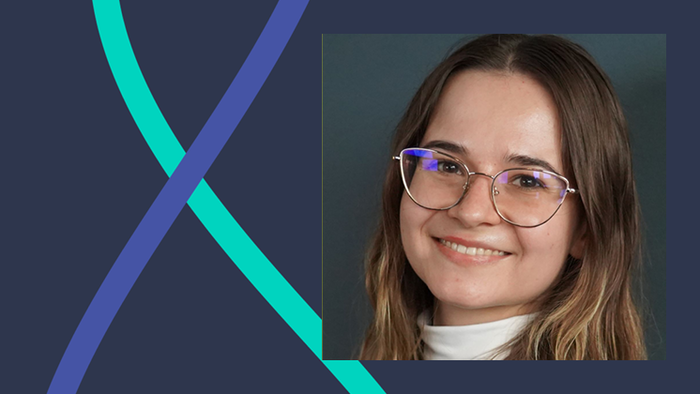
Welcome to this week's lunch seminar in the dScience lounge with Agnieszka Seremak. She will talk about how dehydration in sodium zeolite Y drives cation migration and unusual structural changes, revealed through combined experiments and simulations.
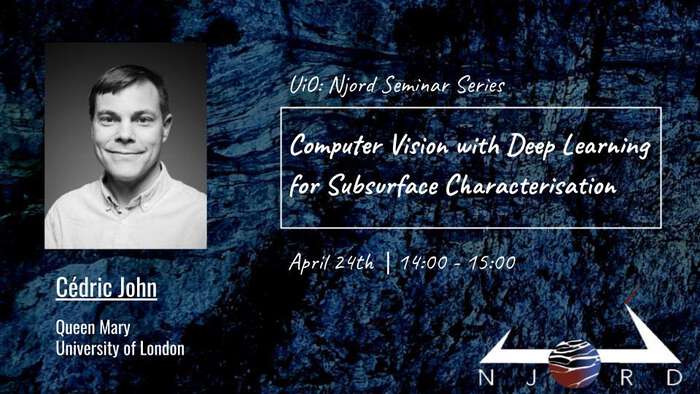
Professor Cédric John is Head of Data Science and the Environment at the Digital Environments Research Institute (DERI) at Queen Mary University of London.

Aker Scholarship er et stipend for deg som ønsker å ta en master- eller doktorgrad ved et av verdens ledende universiteter. Stipendet ønsker søkere fra alle fagområder.

TRUST aims to be highly interdisciplinary in research and innovation. But what does this mean? How can we achieve it?

Join us for a lunch seminar with Professor Kjetil Tasken in the Science Library. He will talk about how artificial intelligence can be used to harness growing healthcare data to improve research, clinical decision-making, and the efficiency of future healthcare systems.
Filippo Sala, University of Bologna
Weekly Theory Seminar.
.jpg?alt=listing)
An introduction to tools, techniques, and strategies for a more effective and efficient management of postdoctoral projects.
Day 1: Monday, 20 April : 13:00-16:00
Day 2: Tuesday, 21 April : 13:00-16:00
Day 3: Wednesday, 22 April : 13:00-16:00
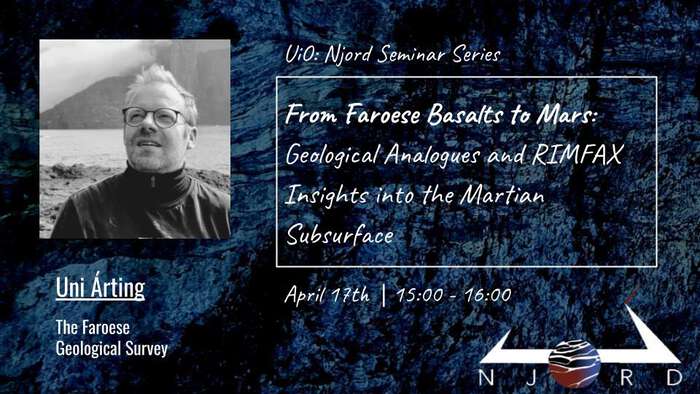
Uni E. Árting is a Faroese geologist with a passion for volcanic terrains, shaped by two decades of fieldwork in the Faroe Islands.


Om du vurderer Computational Science-programmet er dette møtet for deg. Alle de involverte instituttene er invitert til å være med.
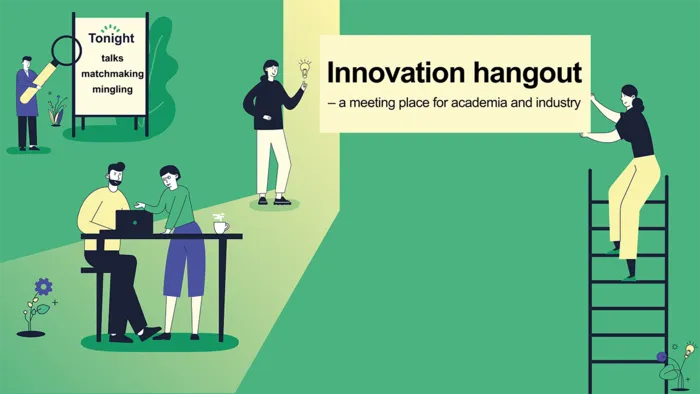
Welcome to this meeting place where we want to inspire researchers and students, give them self-confidence and knowledge about the innovation process, help them build networks, and facilitate collaboration between academia and industry. This hangout is a collaboration with Norway Health Tech and Health2B.
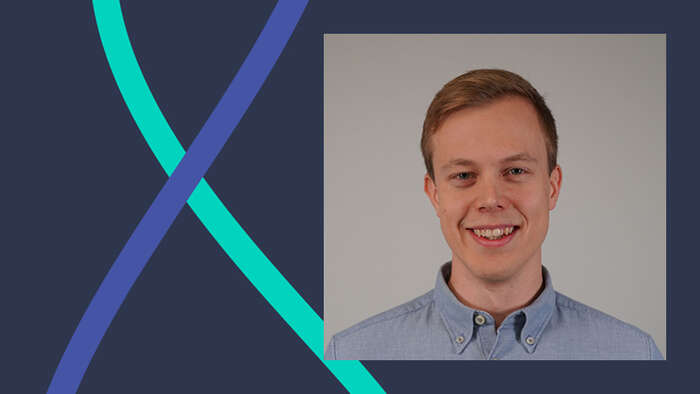
Welcome to this week's lunch seminar in the dScience lounge with Oskar Leinonen, PhD Candidate at the Department of Physics. He will talk about designing fast, high-fidelity two-qubit gates – the fundamental building blocks of quantum computing – using electrons on superfluid helium, a promising new platform that could surpass existing technologies in coherence and scalability.
Philipp Schicho, University of Geneva
Weekly Theory Seminar.
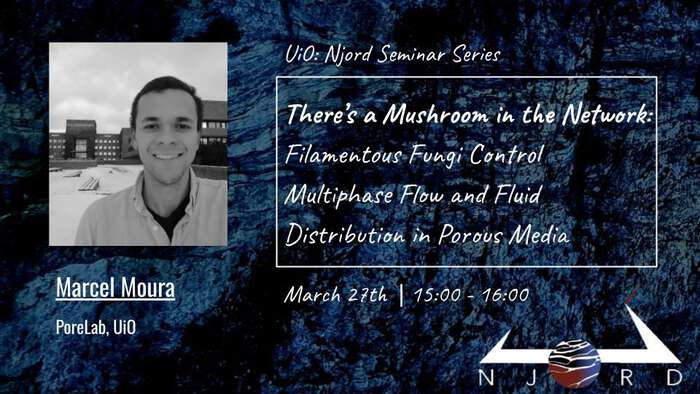

Welcome to this week's lunch seminar in the dScience lounge with Postdoctoral Fellow Camilla Lingjærde. She will present why many machine learning models fail in new environments and introduce Constrained Random Forest, a method for learning predictive patterns that remain stable when conditions change.