
Disputas og prøveforelesning er i Auditorium 1 i Geologibygningen. I noen tilfeller vil prøveforelesning og disputas være mulig å delta på digitalt, i så fall blir det lagt ut en lenke til Zoom.
Prøveforelesning
Onsdag 24 juni, 10:15-11:00, Aud 1, Geologibygningen:
Selvvalgt tema:
- Quaternary geology mapping - vital data in an ever-changing landscape
Onsdag 24 juni, 13:15-14:00, Aud 1, Geologibygningen:
Prøveforelesning over oppgitt tema:
- Development of the Ice Age Theory from the 1820s to the present
Kreeringssammendrag
Mot slutten av siste istid, trakk den store innlandsisen seg gradvis tilbake. Smeltevann samlet seg i gigantiske issjøer, som ble tappet i voldsomme naturkatastrofer. I sin avhandling har Fredrik Høgaas viet fokus på disse bresjøene og jøkullaupene, som satte markante spor etter seg i terrenget i Sør-Norge. Sporene har gjort det mulig nå i dag å undersøke den mektige innlandsisens tilbaketrekning i detalj – og å påvise Norges første megaflom.
Hovedfunn
Populærvitenskapelig artikkel om Høgaas sin avhandling:
The Ice Age floods in South Norway
Traces of ancient shorelines and other landforms in South Norway demonstrate that numerous ice-dammed lakes existed along the ice sheet at the end of the last Ice Age. The lakes in the largest inland valleys grew to become vast inland oceans larger than 50 cubic kilometres (Mjøsa = 56 km3).The ice-dammed lakes formed and drained as the ice sheet retreated, and their very existence likely contributed to quicker glacier retreat rates compared to glaciers or ice sheet sectors that exclusively terminated in a terrestrial environment.
This doctoral work by Fredrik Høgaas present the extent and size of previously known as well as undescribed ice-dammed lakes, and show that some of the lakes drained in cataclysmic glacial lake outburst floods. The extreme natural events occurred dramatically and involved the drainage of several cubic kilometres of water in a matter of few days. Ice-dammed lake Nedre Glomsjø drained in a megaflood with peak discharges as high as 2 000 000 m3/s. The outburst floods were terrain-defining events that wreaked havoc on the Early Holocene landscape, for instance sculpting large-scale canyons and depositing vast sediment volumes.

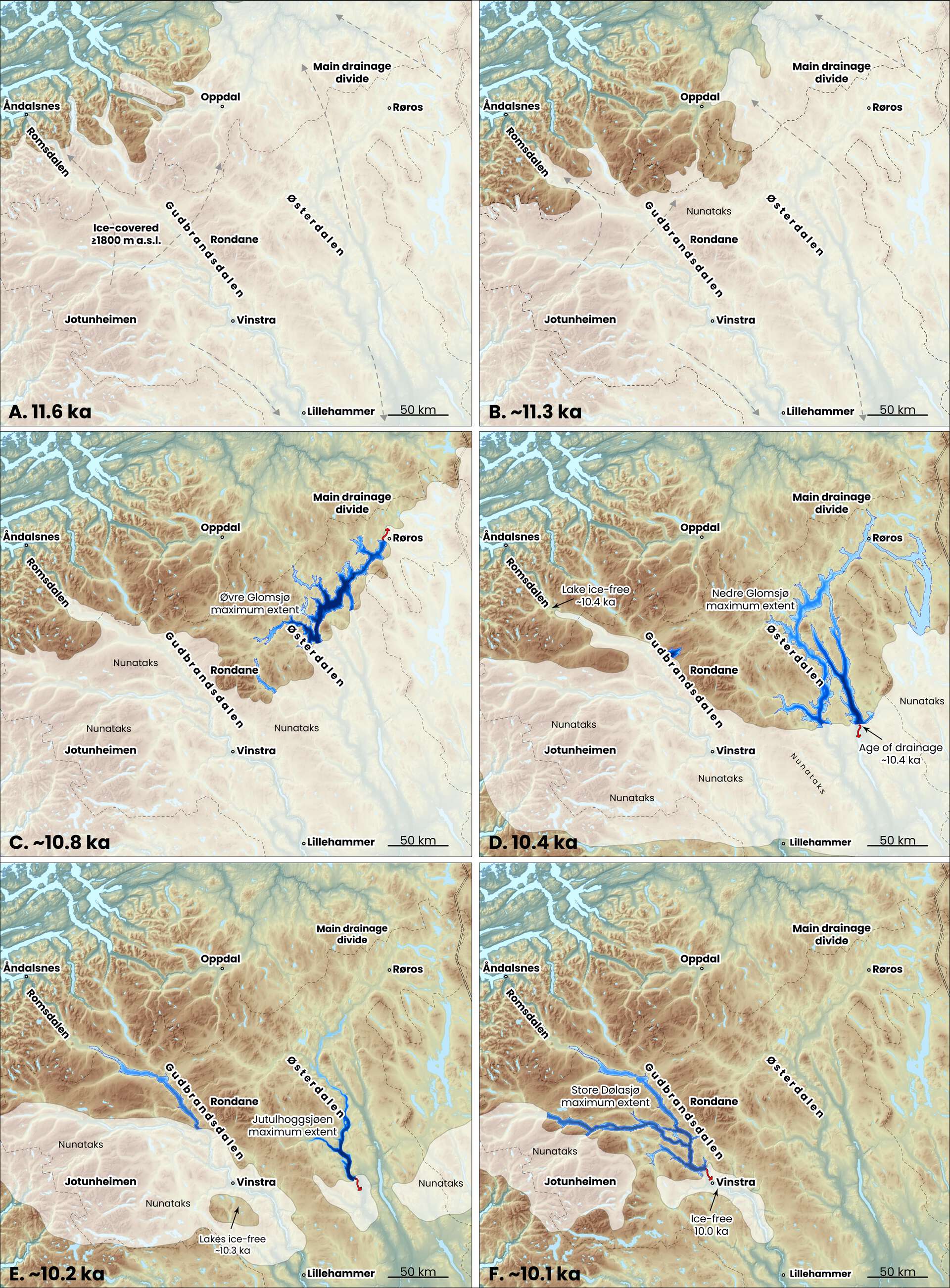
Analyses of relevant sediment archives allow for detailed reconstructions of the glacial events and glacial lake outburst floods, e.g. providing an absolute age for the regionally important Romerike Silt Bed (Romeriksmjele) stratigraphical marker.
The studies provide insights into the course and effects of glacial meltwater events during the Early Holocene ice sheet retreat and support short-lived, catastrophic events as important drivers of landscape development.
Foto og annen informasjon:
Pressefoto: Fredrik Høgaas, portrett; 1200px. Foto: Privat

Annet bildemateriale: Figur med beskrivelse og kreditering som spesifisert i artikkelen over, størrelse 5000px.

Se også blog-innleggene: