
Disputas og prøveforelesning er i Auditorium 1 i Geologibygningen. I noen tilfeller vil prøveforelesning og disputas være mulig å delta på digitalt, i så fall blir det lagt ut en lenke til Zoom.
Prøveforelesning
Onsdag 9 september, 10:15-11:00, Aud 1, Geologibygningen:
70 Years of the Monin-Obukhov Similarity Theory: Successes, Limitations, and the Road Ahead
Kreeringssammendrag
Arktiske og alpine landområder har stor variasjon i landskapsformer og dette påvirker i betydelig grad hvordan varme, fuktighet og momentum utveksles mellom overflaten og atmosfæren. Særlig under stabile forhold som er vanlige om vinteren og om natten, har dagens værvarslingsmodeller problemer med å representere koblingen mellom overflate og atmosfære på en korrekt måte. I sin avhandling kombinerer Laura Mack feltmålinger, høyoppløste simuleringer og sannsynlighetsbaserte, datadrevne metoder for å bedre beskrive de komplekse vekselvirkningene mellom land og atmosfære. Resultatene bidrar til en forbedret representasjon av småskala overflatevariasjoner i kalde områder i numeriske værvarslingsmodeller.
Hovedfunn
Populærvitenskapelig artikkel om Macks avhandling:
Boundary-Layer Processes in Heterogeneous Arctic and Alpine Environments: Integrating Observational, Numerical and Probabilistic Approaches
Arctic and alpine regions strongly influence weather patterns, the global energy and water balance, and support unique ecosystems. Their landscapes are very heterogeneous, with a mix of tundra, lakes, wetlands, and snow. This patchiness shapes how heat, moisture, and momentum are exchanged between the surface and the atmosphere. In winter, strong cooling over snow creates temperature inversions with suppressed turbulent mixing. These conditions are difficult to capture with standard boundary-layer theories and lead to systematic errors in numerical weather prediction (NWP) models, especially during cold extremes.
The thesis by Laura Mack combines field observations, large-eddy simulations, and probabilistic methods to better represent land-atmosphere coupling in heterogeneous arctic and alpine environments. Eddy-covariance flux measurements, fiber-optic temperature sensing, and land-cover maps are used to analyze turbulent transport and evaluate NWP models. A specialized software package for processing flux measurements over complex terrain is developed. A probabilistic framework for land-atmosphere coupling based on a copula Bayesian network is introduced, which improves the representation of cold temperature extremes and explicitly accounts for unresolved temperature variability. Large-eddy simulations with stochastic land-cover maps are set up to investigate the imprint of different surface patterns on the three-dimensional atmospheric flow. Together, these probabilistic approaches inform improved NWP parameterizations for heterogeneous arctic and alpine landscapes.
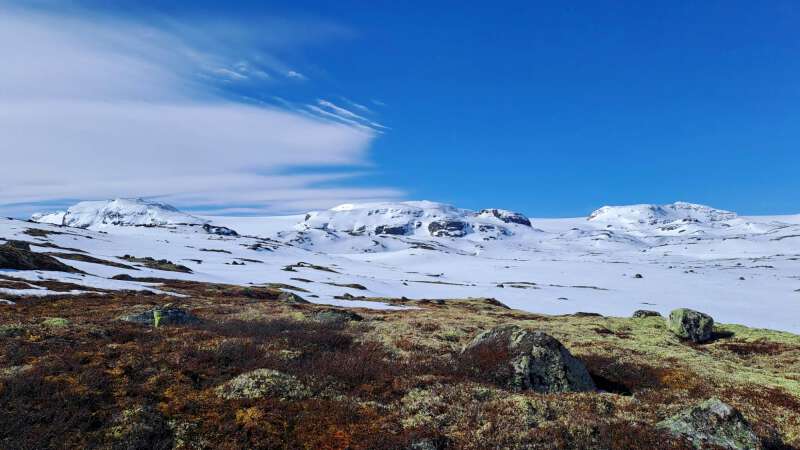
Foto og annen informasjon:
Annet bildemateriale: Foto med beskrivelse og kreditering som spesifisert i artikkelen over, størrelse 2000px.
