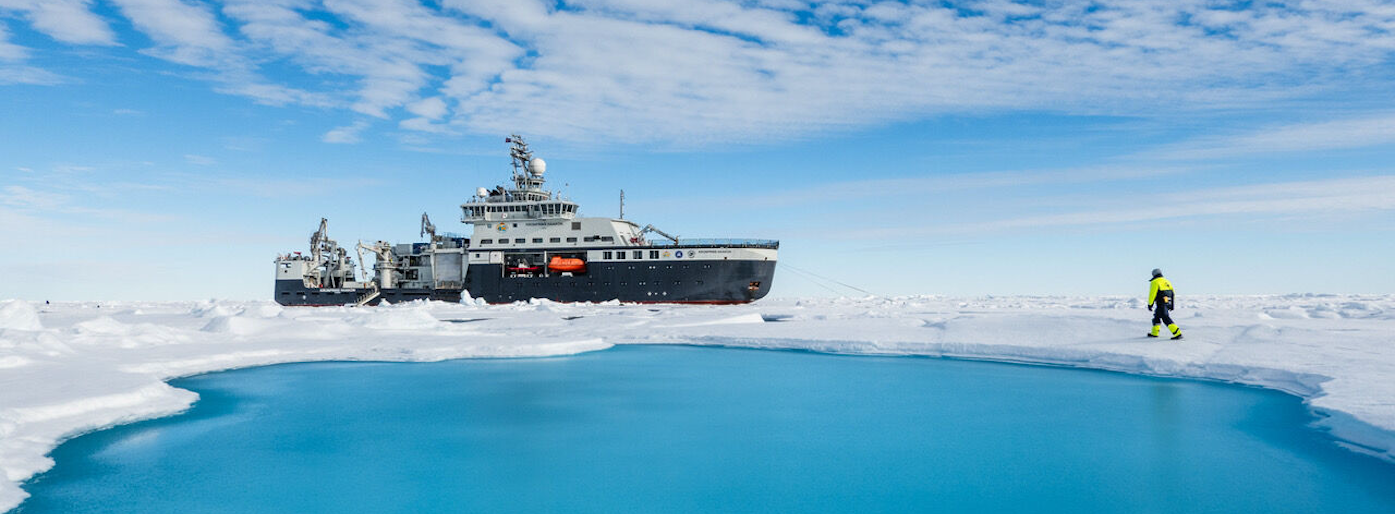
The new 10-year research program Polhavet 2050 – Arctic Ocean 2050 unites 18 Norwegian research institutions in an unparallelled effort to address how the Arctic Ocean will change in the near future. The University of Oslo is one of these research institutions. Arctic Ocean 2050 aims to develop inter- and transdisciplinary insights urgently needed to facilitate the development of updated management principles for the new Arctic Ocean.
The national consortium is managed by an ownership group that includes the leaders of the 18 research institutes in Norway, a board consisting of seven members, and a working group comprising representatives from all institutions.
Vision and ambition
A sustainably, collaboratively managed Arctic Ocean. For setting the foundation of a long-term colletive research effort towards the International Polar Year in 2032-2033, we aim for the establishment of Arctic Ocean 2050 as a 10-year national research program. The ongoing climate change in the Arctic Ocean and its impacts on the environmental, industrial, and political developments, can only be properly addressed through a large national initiative that goes beyond the timescale and funding schemes of regular research projects.
Mission
We want to understand the Arctic Ocean as one interconnected system. Spanning from the seafloor through the water column and sea ice, into the atmosphere, we aim to explore the local, regional, and global consequences – and opportunities – of climate change. Arctic Ocean 2050 will generate a baseline for a sustainable management for environmental protection, socio-economic development and international collaboration in the region.
Scientific plan
Arctic Ocean 2050 is organized along 6 research themes (RT). A common focus across all five axes are the physical environment, biogeochemistry, biology and governance.
RT1: Global Drivers & Feedbacks. Zooming out. Objective: Understand the interplay between global trends, dynamics, processes, and the ongoing natural and political changes in the Arctic.
RT2: The Changing Arctic Ocean. Zooming in. Objective: Investigate the Arctic Ocean and its current management, understand how it is changing, project short- and long-term futures, understand ramifications for future regional governance needs.
RT3: Abrupt Changes and Extreme Events. Preparing for unforeseen situations. Objective: Characterize the nature and impacts of abrupt change and extreme events in natural and political systems, with focus on their likelihood and reversibility. Provide insights into possible mitigation and adaptation strategies.
RT4: Humans and a blue Arctic Ocean. Consequences and possibilities. Objective: Assess possible future human activity, its risks and the pressures on the ecosystem. Provide guidance and science-based advice allowing for a sustainable use.
RT5: Advances in Modelling and Observing. Innovations for the future. Objective: Utilize the advances in observing and modelling to enhance our ability to understand, monitor, and predict the Arctic Ocean system, and to facilitate the implementation of digital twin solutions for user-specific applications.
RT6: Arctic Ocean Pathways. Action-based knowledge. Objective: Develop policy-relevant scenarios for the future Arctic Ocean, implement the knowledge generated within Arctic Ocean 2050.
International cooperation
The Arctic Ocean 2050 is a unique research programme, both nationally and internationally, in that it encompasses questions and ambitions within natural sciences, humanities, technology, geopolitics and law. The programme covers everything from deep-sea ocean floor to the upper atmosphere, and from geopolitical realities to fundamental climate research. The Arctic Ocean 2050 has a geographical focus on the Eurasian part of the Arctic Ocean north of Svalbard, but is designed to facilitate strong international pan-Arctic cooperation. Understanding the Arctic Ocean as one continuous ocean is only possible by including data, models and knowledge that cover the entire Arctic Ocean and the surrounding shelf seas.
The range of disciplines covered by the Arctic Ocean 2050, as well as the fact that it will be a ten-year programme with long-term core funding, opens up for broad international cooperation with institutions, nations and, not least, major international initiatives. The Arctic Ocean 2050 will contribute to the UN Decade of Ocean Science for Sustainable Development and the Synoptic Arctic Survey (SAS2030), and will furthermore constitute the core of Norway’s research efforts in the Arctic during the upcoming International Polar Year 2032–2033 (IPY).
An international scientific advisory board with representatives from the most central actors in the Arctic will ensure that the Arctic Ocean 2050 collaborates with other nations, non-governmental organisations and industry in order to maintain a holistic and inclusive perspective.