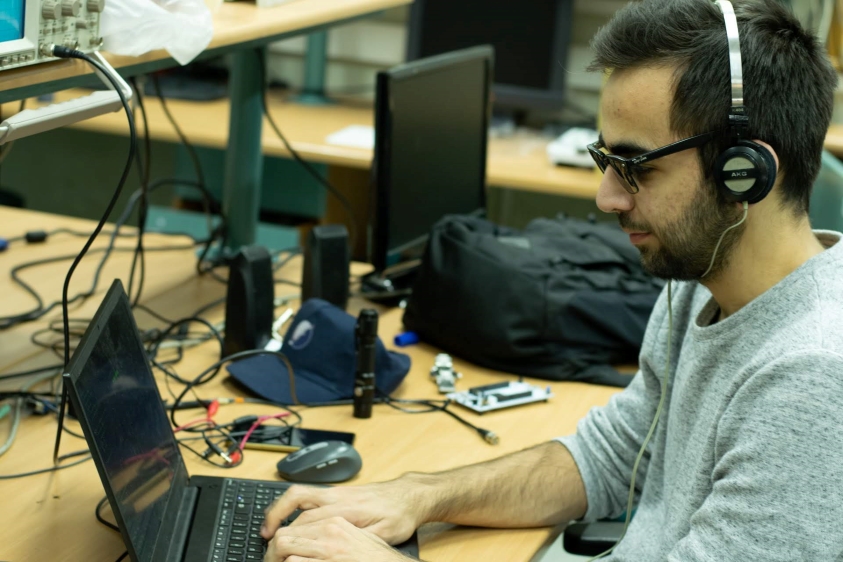
From a young age, I have been fascinated by space exploration, and witnessing the last days of the space shuttle program as a young teenager I was determined to get myself professionally involved with space systems. So far, I have helped design 2 spacecraft and operated a constellation of 35 spacecraft in orbit. Apart from my love for space, I thoroughly enjoy hiking, gardening and a good cup of coffee!
Various background
I have a degree in physics and a master’s degree in computational physics (specializing in astrodynamics) from the Aristotle University of Thessaloniki (AUTh). During my time there as a student, I was heavily involved for several years in designing and developing AcubeSAT, a 3U CubeSat mission hosting a large-scale biology-centered experiment which is supported by ESA’s educational Fly Your Satellite! program.
After graduating I briefly worked in the conception and the early stages of an optical communications mission called PeakSat, which helped solidify a core team of people working on space engineering activities at AUTh. Having witnessed a lot of spacecraft design, I thought it would be beneficial to explore the world of spacecraft operations, which is why I joined the earth observation company Satellogic as a Flight Dynamics Engineer, maneuvering satellites and troubleshooting issues in-orbit while also developing different key frameworks.
Joining CENSSS and my work here
I have been thinking a lot about returning to the academic world, and I think that joining CENSSS was the right move for me. The CENSSAT-1 mission is picking up speed and just completed its Mission Concept Review with a lot of new people joining the team.
I would like to bring my experience in space systems design and operations to make sure the CENSSAT-1 mission will be successful and pave the way for new missions at CENSSS and The Department of Technology Systems (ITS). There is a lot of potential for CENSSS and ITS here at Kjeller: several industrial partners, a multidisciplinary team and a very welcoming and caring work environment, which I have really appreciated so far during my first few weeks here.
Development of a digital twin for spacecraft a core focus
On a personal level, I will be working as a researcher for space systems for the CENSSAT-1 mission, helping with many different aspects of the mission spanning from systems engineering to mission analysis and spacecraft operations. Apart from those duties, my core focus will be the development of a digital twin for the spacecraft. A digital twin is a virtual representation of the satellite and its operating space environment, which when paired with real-life measurements and simulations can greatly improve our ability to troubleshoot issues with the spacecraft, optimize different aspects of a mission and enhance decision-making. This has been demonstrated and implemented successfully so far mainly in industries featuring production lines, and I will investigate to what extent we can use digital twins for more reliable and efficient space missions in the future, hopefully also forming the basis for a PhD degree as well.
Welcome to UiO! We wish Anastasios good luck with his research work at ITS and CENSSS.