
Disputas og prøveforelesning er i Auditorium 1 i Geologibygningen. I noen tilfeller vil prøveforelesning og disputas være mulig å delta på digitalt, i så fall blir det lagt ut en lenke til Zoom.
Prøveforelesning
Fredag 11 oktober, 10:15-11:00, Aud 1, Geologibygningen:
The past and future roles of machine learning in land surface modeling
Kreeringssammendrag
Planter er en vesentlig komponent i utallige sammenhenger i naturens kretsløp. For å forstå konsekvenser av klimaendringer, endringer i arealbruk og arealdekke, og tap av biodiversitet må vi ha robuste modellprediksjoner av vegetasjonsfordeling og -dynamikk, og tilbakekoblingene til klimasystemet. I sin avhandling har Lasse Torben Keetz brukt maskinlæring og andre datadrevne metoder for å videreutvikle to komplementære modelleringsverktøy, økosystemutbredelsesmodeller (EDM) og landoverflatemodeller (LSM) med fokus på hvordan de representerer vegetasjonsprosesser i dynamiske globale vegetasjonsmodeller (DGVM).
Hovedfunn
Populærvitenskapelig artikkel om Keetzs avhandling:
Unraveling the emerald planet: learning vegetation-environment interactions from data
Plants are vital components of many processes and interactions within the Earth system. Accordingly, improving our understanding of environmental pressures such as climate change, land use and land cover change, and biodiversity loss requires better predictions of vegetation distribution and dynamics and related Earth system feedbacks. Like many other domains, vegetation modeling has greatly benefited from the recent advent of novel machine learning and data assimilation algorithms paired with an unprecedented abundance of data, and from constantly improving hardware and software with easier accessibility. However, there is still great untapped potential for integrating available data and methods, which also hinges on improving technical infrastructure and data flow.
For his doctoral work, Lasse Torben Keetz and his co-authors thus aim to advance the understanding of vegetation-environment interactions from three data-driven directions. First, they used machine learning to predict the spatial distribution of Norwegian ecosystem types from available environmental raster data. Second, they developed new software designed to facilitate technical access to a Dynamic Global Vegetation Model (DGVM) embedded in a Land Surface Model (LSM), which are state-of-the-art approaches for simulating ecosystem-climate feedbacks on a global scale. Finally, they combined powerful data assimilation and machine learning methods to refine the DGVM/LSM’s parameters based on carbon and water exchange data, successfully improving agreements between model predictions and site-level observations.
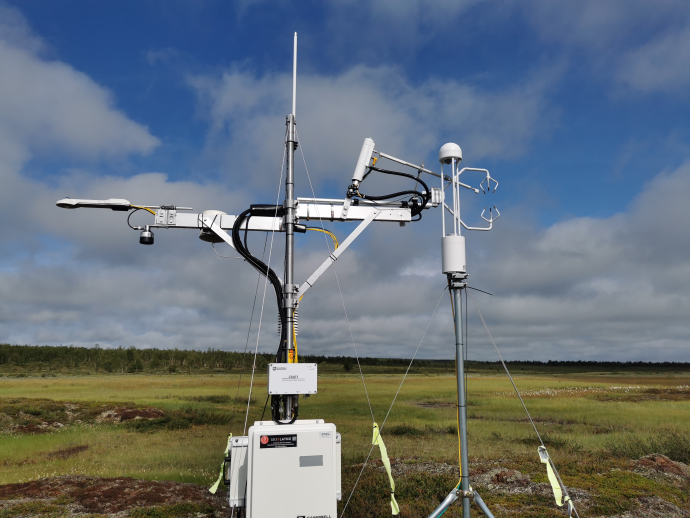
Foto og annen informasjon:
Pressefoto: Lasse Torben Keetz, portrett; 900px. Foto: Privat

Annet bildemateriale: Figur med beskrivelse og kreditering som spesifisert i artikkelen over, størrelse 1500px.
