

About the project
Universet is a research-based educational innovation developed at the University of Oslo within the Department of Informatics. It was created to address a central challenge in contemporary higher education: how to cultivate deep technological literacy, collaboration, and critical reflection in large-scale introductory courses.
Rather than adding isolated digital tools or gamified elements, Universet represents a structural redesign of course architecture. It integrates narrative progression, scaffolded learning sequences, and assessment innovation into a coherent, scalable framework that has been implemented and evaluated in cohorts of more than 500 students annually.
Explore Universet
Impact and Results
Universet has been evaluated through mixed-method research, including surveys, interviews, academic performance analysis, and platform analytics.
Key highlights:
- 88–92% completion in full-scale implementation; 100% in pilot Endgame cohort
- 76% of students reported stronger collaboration skills
- Positive correlation between participation and exam performance (GPA-controlled, β = 0.31)
- Engagement peaked when narrative and platform consistency were maintained
Data snapshot:
| 88–92% | 76% | β = 0.31 | 100% |
| Completion rate | Collaboration skills strengthened | Participation–performance association | Pilot Endgame completion |
Participation was voluntary; students could return to the traditional course path at any time. Read more about Universet’s impact and results here.
The Framework
Universet is a full structural course redesign integrating narrative, competition, collaboration, role-playing, and level progression into a unified academic system. Rather than adding isolated game elements, the framework reorganizes the semester around a coherent storyline supported by a dedicated digital platform and structured team participation.
Core elements include:
- Narrative-driven semester structure
- Structured team-based competition and collaboration
- Role-based participation within teams
- Level progression across the course
- Digital platform support with participation analytics
Read more about Universet’s framework here.
Assessment Innovation: The Endgame Model
The Endgame model is a structured alternative final assessment integrated into the semester narrative. Student teams complete a time-constrained collaborative problem-solving session followed by an oral mini-disputation, demonstrating both conceptual understanding and practical application developed throughout the course. Participation in the Endgame pathway was voluntary, and students could return to the traditional course track and standard examination format at any point if they preferred.
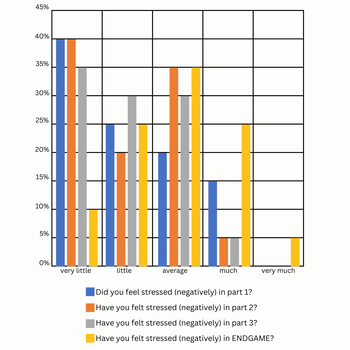
Students reported high engagement and reduced stress with the alternative Endgame assessment format, describing it as motivating and academically meaningful. The voluntary format was received positively, particularly due to its combination of collaboration and oral examination elements.
Read more about Universet’s assessment model here.
Research and Ethics
Published open access in Frontiers in Education (2025), Universet’s research combines quantitative and qualitative methods:
- Surveys & academic performance data
- Platform engagement metrics
- Semi-structured interviews
Limitations include self-selection and single-institution scope. All research was ethically approved; data anonymized and GDPR-compliant.
Transferability
Universet is designed as a transferable framework rather than a course-specific model. Its structure could be adapted across disciplines, course sizes, and institutional contexts.
Explore how Universet can be adapted:
Publications
Key publications and documentation related to the Universet project are available online. Highlights include:
- Gamification as a transferable pedagogical innovation for technology education: developing 21st-century skills through collaborative game-based learning (Frontiers in Education, 2025)
- Spillifisering for økt engasjement, fleksibilitet og alternativt læringsløp (NIKT, 2023)
To see the full list of publications on Universet, see the Universet publications page.
Ethics and Governance
Universet adheres to rigorous ethical standards and institutional oversight.
- Approved by Sikt – Norwegian Agency for Shared Services in Education & Research
- Student participation voluntary; informed consent obtained
- Data handled according to GDPR and institutional guidelines
Media and Recognition
Universet has received national and institutional recognition, and featured in media outlets:
Read more about Universet’s media and recognition here.

.jpg)