Recently, it was demonstrated for the first time that incorporation of protons into a material can be utilized to modulate its electrical conductivity, with great potential for memristor applications (Figure 1).1 These types of devices may also pave the way towards human-like artificial general intelligence!
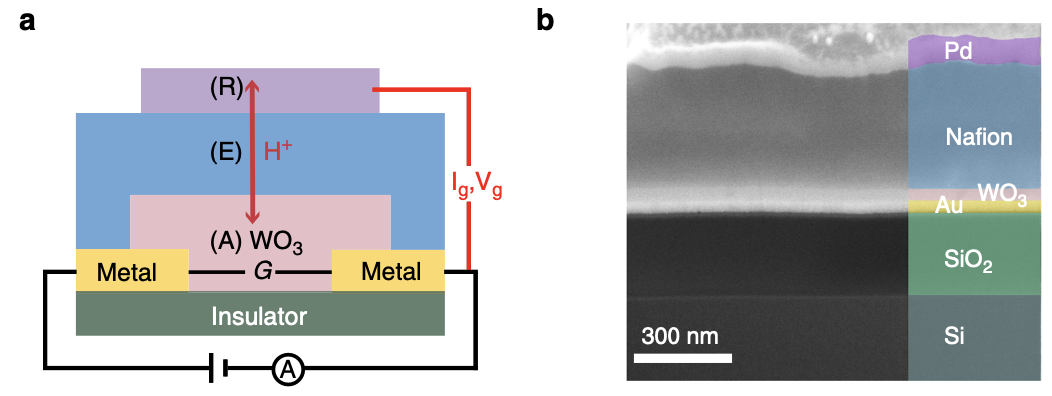
Figure 1: Schematic (a) and SEM image (b) of memristor device with WO3 memristor material.1
Activities and methods
Projects can involve combinations of the following activities and methods. Get in touch for an informal chat about specific projects that suits your interests!
- Synthesis and thin film deposition (PLD) of novel memristor materials
- Electrical characterization of materials upon proton incorporation
- Fabrication of devices using photolithography techniques (in collaboration with MinaLab)
- Characterization of materials and devices by XRD, SEM, XPS, etc.
- Atomistic simulations using density functional theory (DFT)
Collaboration
Co-supervisors from other groups will be included depending on the main methods.
References
- Yao, X. et al. Protonic solid-state electrochemical synapse for physical neural networks. Nature Communications 11, 3134-3134 (2020). https://doi.org/10.1038/s41467-020-16866-6