Main supervisor:
Professor Reidar Haugsrud
A typical MSc project often begins with synthesis of one or more oxide based materials. However, the primary focus mostly lies on the characterization and understanding of the functional properties of the materials. This includes exploring aspects such as transport properties and electrocatalysis. The structure, microstructure, and defect structure of the materials provide the foundation for developing insights and evaluating their potential applications in advanced technologies.
Structure and microstructure are characterized using X-ray diffraction and electron microscopy. Defect concentration and transport properties are assessed through thermogravimetry and electrochemical methods. Surface kinetics and electrocatalysis are analyzed using these techniques, and often employing gaseous isotopes and mass spectrometry. Additionally, advanced spectroscopic methods provide further insights into material surface properties and behaviors.
My main interests in which research projects are available comprises:
Ionic and mixed ionic-electronic conductors – materials for future energy technologies:
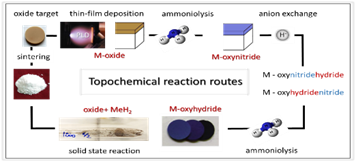
Mixed Anion Metal Oxides (MAOs) are a novel class of functional materials comprising metal oxides with additional anions beyond the standard oxide ion. These solids offer significant potential for designing properties crucial for sustainable energy and chemical technologies. Various synthesis routes can be utilized to optimize these materials for specific applications, as depicted in the illustrative figure.
Ionic and mixed ionic-electronic conductors – materials for future energy technologies:
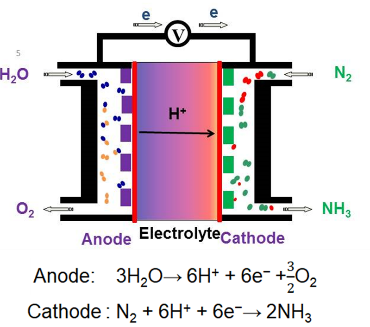
Proton-conducting oxides, oxide ion conductors, and materials that conduct both ions and electrons are crucial for developing sustainable energy conversion technologies. These materials are vital for processes such as producing hydrogen from "green" electricity through electrolysis and utilizing hydrogen in fuel cells, or as illustrated, for ammonia production. Advancing these technologies is essential for achieving a carbon-neutral society.
Surface kinetics/electrocatalysis – «everything starts at the surface:
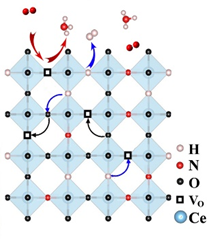
Heterogeneous reactions between gases and solids depend on the kinetics of processes at the gas-solid interface. Advancing this area of science is essential for implementing the technologies mentioned above to achieve sustainable energy conversion. The accompanying figure illustrates how a surface can interact with H2 and N2, producing NH3 through a mechanism where N2 fixation partially relies on diffusion via anion vacancies.