Project Overview
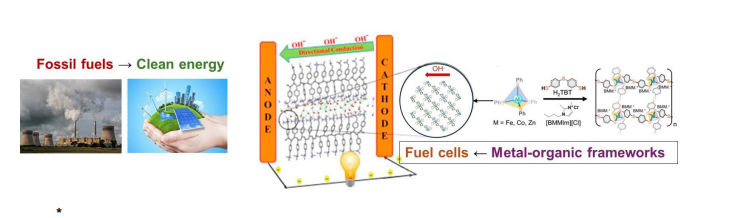
This project focuses on developing hydroxide-ion conducting metal-organic frameworks (MOFs) with the goal of integrating them into alkaline anion-exchange membrane fuel cells [2] This is a collaborative project between the Sections of Catalysis and Organic Chemistry and Electrochemistry.
The research aims at tackling key material challenges in energy storage, particularly in the context of the global energy transition. The approach follows two main steps: (1) designing and synthesising highly stable MOFs and (2) improving their ion conductivity through functionalisation.
Among the known stable and alkali-resistant MOFs, the MTBT family (M=Fe/Zn; TBT=dehydrated 4,4'-thiobisbenzenethiol) [1] has been selected for this study. These MOFs show exceptional stability in high pH conditions and have low electrical conductivity, making them suitable for alkaline fuel-cell applications.
*MOF structure reproduced from reference [1]
Master’s Student Tasks
1. Synthesis and Characterisation of New MOFs
- Develop and test MOFs analogous to the MTBT frameworks with larger pore sizes to enhance ion conductivity.
- Perform structural characterisation using techniques such as X-ray diffraction (XRD), Fourier-transform infrared spectroscopy (FTIR), and thermogravimetric analysis (TGA).
2. Exploration of MOF Properties
- Investigate the relationship between the factors such as porosity, surface area, and pore structure from the ionic conductivity of these materials.
- Evaluate the stability of different MOFs under alkaline conditions.
This project provides an opportunity for master’s students to gain experience in MOF synthesis, structural analysis, and electrochemical testing, contributing to the development of next-generation materials for energy applications.
References
[1] Q. Hou et al., Chem. Commun., 2023, 59, 7072-7075 [2] S. Hérou et al., Sci. Rep., 2024, 14, #14529
Expected Outcomes
The expected outcomes are manifold; on the one hand you will get cutting-edge training on the synthesis and characterisation of advanced functional materials, sought after and applicable both in the industry and academia. In addition, the project will result in the design of new MOF materials with high stability towards alkaline conditions, an area, which has been a great challenge in the relevant research field thus far, we expect that the so-synthesised MOFs will be processable as membranes, directly integratable into alkaline fuel cells or electrolysers (energy storage).
Project supervisors:
Qingqing Shao, PhD candidate, qingqing.shao@kjemi.uio.no
Petra Ágota Szilágyi, Professor, p.a.szilagyi@kjemi.uio.no
Bonus
You will be part of a scientifically excellent, dynamic, and inclusive research group with lots of activities.