Master’s students’ Task
Please note that there are possibilities for several MSc projects within this area
1. Synthesis
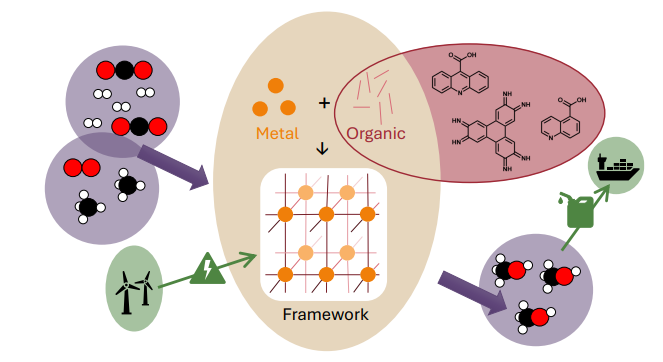
Novel metal-organic frameworks with redox activity and ideally exhibiting electrical conductivity will be synthesised. The MOF syntheses will be carried out through wet chemical methods, using metal salts and organic molecules, which may be commercially available or custom-made. The catalyst may be deposited as a thin film or an ink for further electrochemical testing.
2. Characterisation
The structural integrity, chemical nature, thermal stability, and porosity of the materials will be evaluated using standard X-ray diffraction, optical and NMR spectroscopic, thermal gravimetric, and gas adsorption techniques. The chemical identity and local structure of the catalytic sites require a mode of advanced characterisation, which shall be carried out at large-scale facilities in e.g. France, the UK, Sweden. There is a real possibility for the students to participate in such beamtimes.
3. Testing
Following an assessment of redox activity and stability by cyclic voltammetry, promising materials prepared in the project will be evaluated in electrocatalytic studies in the liquid phase using electrolytes. This may be followed up with gas-phase experiments.
References
[1] Y. Y. Birdja et al., Nature Energy 2019, 4, 732-745. [2] Xing et al., Appl. Catal. B, 2020, 278, 119295
Project supervisors:
Julie Brun, PhD candidate, CuMOF, julie.brun@smn.uio.no
Ken Luca Abel, Post-doc, CuMOF, k.l.abel@smn.uio.no
Petra Ágota Szilágyi, Professor, p.a.szilagyi@kjemi.uio.no