Nettsider med emneord «space systems»
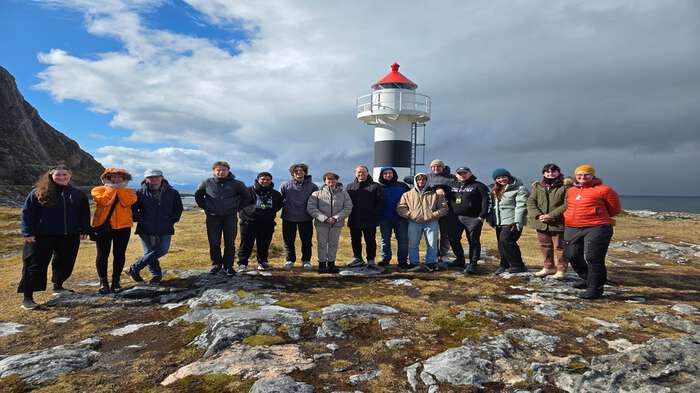
A new semester has started, and the department is happy to have welcomed a new class of Space Systems students!

US approval for Reflect Orbital’s plan to put reflecting satellites into orbit in order to reflect light from the sun into Earth has reignited a heated debate among astronomers, space scientists and ecologists. The company says it has received more than 260,000 inquiries from customers wanting redirected sunlight for energy, disaster relief, agriculture, defence and city lighting. Researchers warn that if the project grows from a few demonstrators to a constellation of tens of thousands, the consequences for ground- and space-based astronomy, orbital safety and nocturnal ecosystems could be severe.
In Assenbly, Integration, and Test, it is you building the satellite, funktional test it, and verify it's suitability for space deployment in environmental tests.
We are planning to send a Gamma-ray and Neutron Spectrometer (GRNS) to the Moon.
To prepare this mission, a data processing pipeline is needed.
We are planning to send a Gamma-ray and Neutron Spectrometer (GRNS) to the Moon.
To prepare this mission, the measurement principle for abundance mapping needs to be demonstrated on Earth.

UiT The Arctic University of Norway joins the CENSSAT-1 team in building University of Oslo's first satellite! In these two talks Doctoral Research Fellow Alessio Bocci and Associate Professor, PhD, Pål Gunnar Ellingsen will tell us about the research activities at UiT The Arctic University of Norway, and how they will contribute to the CENSSAT-1 mission. There will also be an Q & A session.
This special event will be hosted by PhD-candidates Elena López-Contreras González and Veronica Orlandi. Their presentation will cover 3 topics; Asclepios: A Student-Driven Analog Mission and Space Sector, IMMERCOG: Exploring Human Performance in Extreme Environments and Plasma processes for space applications. There will also be an Q & A session.
The Centre for Space, Sensors, and Systems (CENSSS) is currently working on a CubeSat mission, CENSSat-1 with launch targeted in 2027.
In the field of satellite operation, we are offering the following thesis topics:
The Centre for Space, Sensors, and Systems (CENSSS) is currently working on a CubeSat mission, CENSSat-1 with launch targeted in 2027.
In the field of satellite engineering, we are offering the following thesis topics:
