Project News
Here you can follow news and updates from our research project!


.jpg)
16.10.2024
Olli Hyvärinen, a Postdoctoral Researcher in our group attended and presented at the 7th International Marine Conservation Congress (IMCC7), held at the Cape Town International Convention Centre in Cape Town, South Africa, from October 13-18, 2024. The event provided an important platform for scientists, policymakers, and practitioners to collaborate, share insights, and discuss innovative approaches for marine conservation.
Olli presented the group's recent work, led by our MSc graduate Lone Kvalheim, on the power of environmental DNA (eDNA) and Citizen Science to inform marine conservation and management strategies. His presentation highlighted the potential of eDNA as a non-invasive tool for monitoring marine biodiversity and how engaging local communities in data collection can enhance the reach and impact of conservation efforts. Olli's presentation contributed to discussions about the benefits and challenges of involving citizens in scientific research, particularly in eDNA research, including the role of citizen science in democratizing data collection, ensuring high-quality data and sustaining volunteer engagement.
The conference emphasized the importance of interdisciplinary collaboration, highlighting that effective marine conservation demands an inclusive approach that integrates science, local and indigenous knowledge, experiences, and efforts from a wide range of ocean stakeholders.

27.09.2024
We are excited to announce that our instructional video series on library preparation for DNA metabarcoding is now available online under an open-access license. This series provides clear, step-by-step guidance through the two-step PCR process, making it a valuable resource for both students and researchers new to the technique. We hope this resource will benefit many students and enhance their understanding of DNA metabarcoding.
A special thank you to everyone involved in production from the Department of Biosciences and LINK, The Center for Learning, Innovation and Academic Development.
You can watch the series here: DNA Metabarcoding Video Series.


10.09.2024
We are excited to share that our Master’s student at AQUA, Jesper Nilsen Negård, recently visited our collaborator, Esben Moland, at the Institute of Marine Research (IMR) in Flødevigen. During his stay, Jesper took on the important task of designing and constructing sediment traps aimed at capturing cod feces from a large outdoor research pool where cod are kept for scientific studies.
Jesper was lucky to be able to work outdoors in the warm summery weather, carefully installing the traps in the pool. With the traps now in place and first samples collected, Jesper’s next challenge takes him to the lab, where he will be analyzing the captured material under a microscope to isolate cod feces from other particles caught in the traps. This process will provide essential insights into the carbon export potential of cod and other species in the Norwegian Skagerrak coast, shedding light onto the little known impacts of fish on the biological carbon pump.
We look forward to Jesper’s research progresses.

09.08.2024
We are happy to announce our latest publication exploring fish diversity in the Oslofjord, through combining the power of environmental DNA (eDNA) and citizen science. This work, spearheaded by our recent MSc graduate Lone Kvalheim, showcases the impactful role that community involvement can play in scientific discovery.
The study enlisted the help of 32 dedicated volunteers who collected water samples across various locations in the fjord. Utilizing eDNA metabarcoding techniques, Lone was able to identify several species previously undocumented in the region and track shifts in biodiversity. Among the interesting findings was an increase in warm-water species and a notable decline in species diversity within the inner fjord.
These insights are crucial for informing future conservation efforts and emphasize the importance of public participation in environmental monitoring.

Photo: Elina Melteig (UiO)
15.07.2024
Our master's student, Jesper Nilsen Negård, has been featured in a UiO's Titan Magazine article interviewed by Elina Melteig for his innovative research on the role of fish feces in the carbon cycle. Jesper's study explores how fish species such as cod, saithe, and herring in the Oslofjord contribute to carbon sequestration. In his research, his tries to better understand if fish feces could be a crucial natural mechanism for climate change mitigation. This research, part of the Coastal Ecosystem Dynamics Under Anthropogenic Pressures project, underscores the importance of including carbon perspectives into fisheries management.

Photo: Alexander Eiler
21.06.2024
AQUA's BSc student Mikkel Martinussen Mørch showcased his project on environmental DNA (eDNA) persistence in aquatic environments. Presenting his final poster as part of the research internship course, Mikkel described his study plans on improving species detection through the separation of eDNA into various states based on its environmental persistence.
Mikkel's research involved extensive fieldwork aboard the UiO research vessel Trygve Braarud, where he gained hands-on experience in eDNA water filtration techniques. His project also included molecular lab work, including DNA extraction.
Great work Mikkel!

Photo: Olli Hyvärinen
10.06.2024
Our environmental DNA (eDNA) citizen science project has started! Lone Kvalheim, our previous MSc thesis student, came back to take part in a instructional film depicting the eDNA sampling protocol that current and future volunteers can use to quickly learn the filtration procedure. Together with Audun Bjerknes and Hans Magnus Nedreberg from LINK - Centre for Learning, Innovation & Academic Development, we spent the whole morning filming at a beautiful location at Hovedøya.

Photo: Olli Hyvärinen
06.06.2024
AQUA's new PhD student Even Werner and Postdoc researcher Olli Hyvärinen joined forces with the LINK video production team of UiO to film a instructional video series depicting the two-step PCR procedure we use at AQUA for environmental DNA-based aquatic biodiversity analyses. The aim of this series is to standardize and streamline the teaching and training of the PCR methodology for AQUA's MSc students who use these methods for their theses. The series will become available for students in the Autumn semester of 2024.

Photo: Michele Legernes

Photo: Michele Legernes
08.02.2024
We are so incredibly pleased that over 150 people came to our "Folkeforskning i Oslofjorden" event tonight!
It was great seeing so many people interested in our research and concerned about the status of the Oslofjord. Science communication is an essential part of our project, and we hope to continue actively bringing our research into the public conversation. Additionally, we are very pleased that so many people want to contribute in the scientific process themselves through our citizen science projects.

12.12.23
The last main sampling cruise of 2023 was now completed and we are very grateful that so many people were able to join. Along with all of our Msc students, we were very pleased to have welcomed Jessica Hough, Michele Legernes and Ingrid Hauge from the environmental organization Miljøstiftelsen Bellona onboard. They joined the cruise to learn about our research happening on the Oslofjord and they had many important questions on how our research fits into the larger understanding of what is happening with the Oslofjord.
We look forward to continue the field sampling next year, but we wish everyone in our project a Merry Christmas and Happy New Year!

27.10.23
We are now in October and only have two more cruises left in the time series of the Oslofjord that we have had running since August of 2022. On the September cruise we were lucky to be joined by Elina Melteig, a reporter from the University's science magazine Titan. She is working on an article on our project, where we try to communicate the work and research we do on the fjord.
On the October cruise we were joined by visiting PhD student Denise Ong from Nanyang Technological University in Singapore, who will be working here at our Department until the end of the year. Thanks for joining the cruise Denise!


20.09.2023
Welcome Sandra Irén Bongo and Hanna Strindberg as master's students to our project!
Sandra's and Hanna's theses are focused on a group of marine protists called Labyrinthulomycetes. These microorganisms play critical roles in nutrient cycling, carbon sequestration, and microbial food webs, yet remain underrepresented in ecological research.
Sandra will investigate the genetic diversity of this group as well as their biogeography using DNA sequencing data. Sandra has a bachelor’s degree in biology from the Norwegian University of Science and Technology (NTNU).
“I gained a general understanding of biological sciences with a main focus on marine ecosystems, and I am looking forward to expanding my knowledge further."
Hanna will explore the dynamics between Labyrinthulomycetes and the important phytoplankton group called diatoms. From a young age, Hanna has been irresistibly drawn to the ocean and its mysteries. Her decision to explore Labyrinthulomycetes comes from a combination of curiosity and desire to contribute to our understanding of the hidden, often overlooked, microbial life in aquatic ecosystems. She has a bachelor degree in Biosciences from University of Oslo.
“I had the chance to join a sampling cruise with AQUA where I was introduced to Adriana and the project on Labyrinthulomycetes. This enigmatic group of protists, often referred to as “slime molds of the sea”, captured my fascination due to their enigmatic life histories and ecological roles. I am very excited to expand my knowledge in this interesting field of marine biology, and doing so surrounded by an amazing team of people!”
Sandra and Hanna will be supervised by Adriana Lopes and co-supervised Bente Edvardsen and Daniel Valout, Wenche Eikrem and Micah Dunthorn respectively.

14.09.23
Welcome to Jesper Negård as a master's student to our project!
Jesper will be joining our project with a thesis focused on the carbon export of fish. Jesper is looking forward to combining his interests in fish and fieldwork while exploring how fish can contribute to natural solutions for global climate change. He is excited to learn more about NCS (Natural Climate Solutions) because he believes that the ocean holds many answers to the climate questions we'll face in the future.
Jesper will be supervised by Olli Hyvarinen and co-supervised by Alexander Eiler.
Welcome to the project Jesper!

31.08.23
The August cruise was a packed one with 10 participants! It was a beautiful day on the fjord and the sampling went really well. Joining this cruise were the new master's students who just began in the project, as well as our new associate professor Adriana Lopes dos Santos.
Thank you to all the cruise participants for their help in completing this month's cruise!

22.08.23
Bente Edvardsen and Simon Kline have been at the 8th European Phycological Congress in Brest, France and presented our project to a wide array of international colleagues.
Simon presented a part of his project through the poster session, focusing on the time series of the protist community in the Oslofjord and Skagerrak investigated through metabarcoding. It was an excellent opportunity to establish networks with scientists from other institutes who are working on similar topics. Overall it was an excellent conference!
.jpg)
18.08.23
Our PhD student Simon Kline was on NRKs Abels Tårn again today, the first episode of the semester!
Today he answered the following popular science questions from listeners:
-"Can whales sneeze?"
-"Is it possible to compensate for sea-level rising through digging trenches in the ocean floor?"
-"Does an octopus get a fever when sick?"
Simon was one of the panelists along with physicist Vidar Skogvoll and paleontologist Lene Liebe Delsett.
If you want to listen to the episode, visit the NRK radio webpage.

01.08.2023
As a part of the bachelor course BIOS3050 Andreas Pettersen got the chance to work in our project for the last year. He enjoyed working with us so much that when the time came to choose where he wanted to do his master's project, he felt it was only natural to continue working with us!
In Andreas' project, he will be studying the degradation rate of eDNA in the marine environment. Andreas is looking forwards to expanding his understanding about marine ecosystems and factors which threatens their functioning. He also hopes that the results of his master's project somehow can be used in future marine conservation efforts.
Welcome (back) to the project Andreas!
Andreas will be supervised Olli Hyvarinen and co-supervised by Alexander Eiler.


01.08.2023
We would also like to introduce Sigurd Skaar Eliassen and Olav Myrann to our project as a new master's students.
Sigurd and Olav will collaborate, but conduct two separate projects. For their projects they will investigate the spring bloom diatom dynamics in the Oslofjord. Through common garden experiments, they will test how important diatoms species in the Oslofjord respond to various environmental conditions. Using the Planktoscope imaging microscope the community composition will be quantified throughout the experiment.
Sigurd says he is excited to join our research group and to be a part of a large research environment and learn about the marine ecosystem from experts within this field.
Olav is looking forward to contribute to our understanding of how complex coastal ecosystems are impacted by anthropogenic changes.
Sigurd and Olav will be supervised by Bente Edvardsen and co-supervised by Simon Kline and Tom Andersen.
Welcome to the project Sigurd and Olav!

01.08.2023
We would like to quickly introduce Elise Nygård to our project as a new master's student.
For her project she will be investigating the autumn phytoplankton bloom in the Oslofjord through metabarcoding with intensive sampling during the blooms of 2023 and 2024. Elise decided to join our project as a student because she wanted to better understand the dynamics in the coastal zone, while also getting to be part of a group with high expertise in the field.
Elise will be supervised by Bente Edvardsen and co-supervised by Simon Kline.
Welcome to the project Elise!

03.07.2023
The June/July cruise for the monthly sampling was successfully completed on Monday the 3rd of July. We had multiple new cruise participants step in on the cruise, and we are grateful to everybody for their hard work!
On our cruises we incorporate our master's students involved in the project, and we are currently looking for new students that want to write a thesis within the research project!
The next cruise will be in August and we hope all project participants and colleagues have a wonderful summer this year. It is well deserved!

20.06.2023
Our research technician Lone is hard at work processing and sending out sampling kits to all the participants in our citizen science project aimed at exploring the biodiversity of the Oslofjord!
The samples will be sent back to us and we will then begin to analyze the DNA present in the water samples, which will then hopefully give us new information about the Oslofjord. This is an important step to better manage the important Oslofjord ecosystem!
If you're interested in joining the citizen science project as a participant and are willing to do some sampling on the fjord, it's not too late to sign up!

13.06.2023
Andreas Pettersen, an active BSc student in our project, presented his poster at a symposium for the Research Internship Course at Blindern in Oslo. The poster was titled: "Crime scene: Oslofjorden - eDNA metabarcoding for monitoring ecosystem dynamics in the Oslo fjord".
In his presentation, Andreas talked about the research that he has participated in as part of the Coastal Ecosystem Dynamics under Anthropogenic Pressures project stemming from the SKO-initiative. Among other things, Andreas has for instance taken active part of all our monthly field cruises in the Oslo fjord, collecting and filtering water samples, and performed laboratory work including the optimization of DNA extraction for eDNA.
Nice work Andreas! It was a pleasure to listen to such a clear and well-articulated poster presentation.

05-09.06.2023
Olli Hyvärinen, a Postdoctoral Fellow in our project, spent a week at the beautiful surroundings of Flødevigen sampling juvenile cod, from an extensive and unique 20-year collection, created and maintained by Institute of Marine Research (IMR).
Our project has a tight collaboration with the Flødevigen station, which has decades of experience and expertise in fish ecology in the southern coast of Norway.
At Flødevigen, Olli sampled cod gut and muscle tissue to perform dietary DNA metabarcoding and C and N stable isotope analyses to gain more detailed insight into how the diet of cod has changed over the years. This research will help us better understand how environmental change, including climate change and the darkening of our coasts, influence cod's food base, which will contribute to sustainable management of our marine resources!
This effort is part of a wider project to developing cost-effective methods to monitor multi-trophic dynamics in marine ecosystems.
Many thanks for the helpful staff at IMR Flødevigen who made this sampling possible!

03.06.2023 & 04.06.2023
We are at this year's Passion for Ocean festival as well as Verdens Miljødag for barn! These are some of the largest festivals in Norway focused on the marine conservation and aimed at increasing awareness of life in the ocean, how they are threatened, and how we can manage our common ocean even better.
Lone Kvalheim and Eivind Stensrud are representing the project, telling guests about our research project and trying to recruit people to a citizen science project we are conducting. With the help of people living all around the Oslofjord, we hope to explore the biodiversity present in the fjord and reach parts of the fjord system that traditional scientific sampling doesn't include.
Are you interested in helping us and becoming a citizen scientist? Click here!

26.05.2023
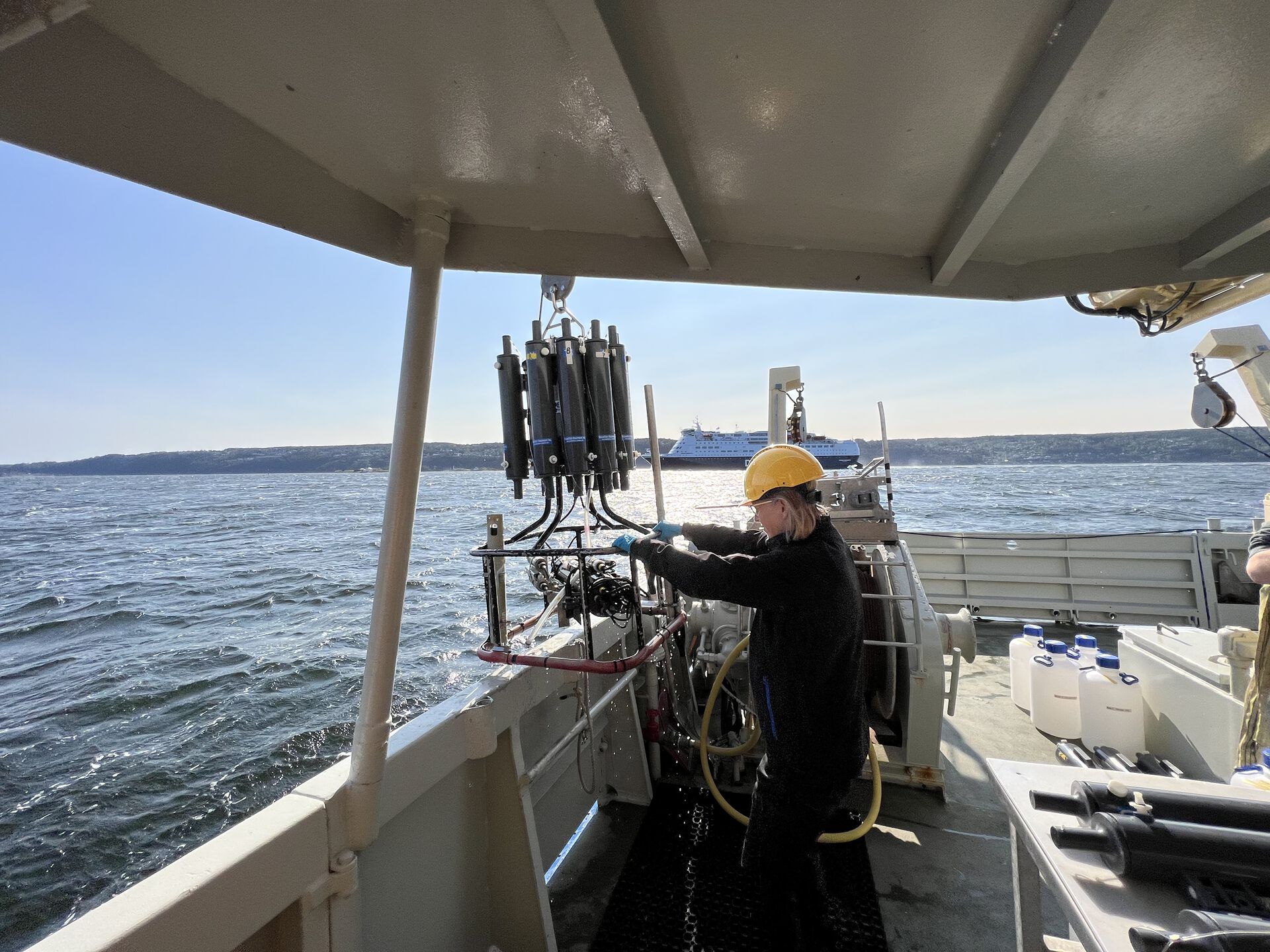
Yesterday was the June cruise for the project onboard UiO's research vessel RV Trygve Braarud! For the duration of 2023 we have monthly cruises on the Oslofjord, visiting two sampling stations in different parts of the fjord. During these cruises, we measure various environmental parameters such as nutrient and chlorophyll concentrations, light conditions in the water and temperature/salinity profiles. Additionally, we collect plankton samples through net hauls and water samples to analyze for the presence of eDNA and protist diversity.
We were very lucky with the weather for the June cruise, and it was a successful cruise thanks to the help of all involved cruise participants!
A representative from the Norwegian environmental organization Natur og Ungdom, Ingrid Braastad, joined this month's cruise to learn more about how scientific sampling on the Oslofjord is done and how this influences the management of the fjord by various government agencies.

05.05.2023
Our PhD student Simon Kline, was on the popular science radio program Abels Tårn on NRK! On Abels Tårn listeners can send in their questions and a panel of researchers answer questions. On this episode, Simon talked about marine fungi and whether the Oslofjord is getting darker. If you want to listen to the episode, click here.
Joining Simon on the panel was chemist Carl Henrik Gørbitz and cell biologist Sissel Rønning.


27.04.2023
The citizen science driven Planktoscope is now onboard the Rognfjell school ship!
As a part of the Seasonal dynamics of the protist community in the Oslofjord and Skagerrak in a changing ocean project, we have installed a digital imaging microscope onboard an educational ship used in the Frisk Oslofjord project. The Planktoscope can eventually quantify and identify species of plankton through an attached computer with a connected software. The ease of use of the Planktoscope makes it ideal to incorporate citizen science into plankton research.
The Planktoscope will be used by secondary school students on excursions in the Oslofjord and provide a vast amount of quantitative plankton data across the most productive months in the fjord, including side-fjords and regions not usually studied in scientific monitoring and sampling of the Oslofjord.